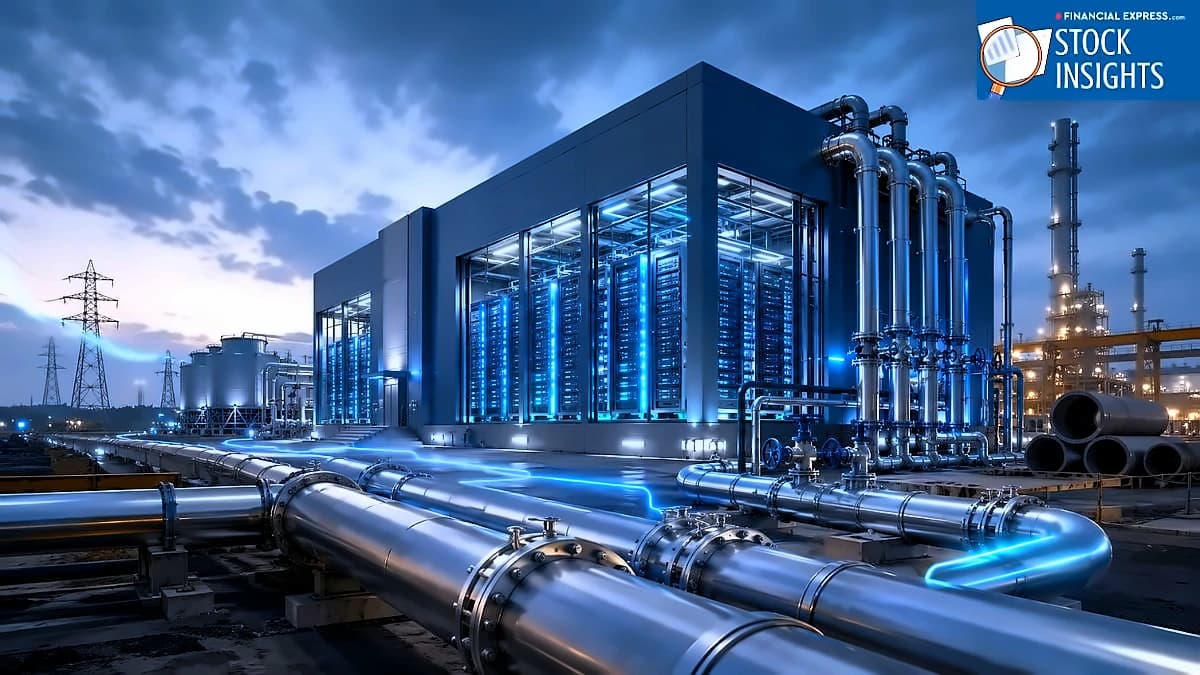
The AI computing revolution is creating unprecedented infrastructure demand across the data center value chain. According to industry estimates reported by The Financial Express, global data center capacity could double to nearly 200,000 megawatt (MW) by 2030. This massive expansion is driving demand for pipeline manufacturing and cooling solutions critical to AI computing power and energy supply reliability. In the US market specifically, developers are pairing data centers with gas-fired power plants for reliable electricity supply, triggering fresh investments across the entire energy value chain from gas turbines and heat recovery systems to natural gas pipeline networks. Data centers, the backbone of AI computing, are emerging as one of the largest infrastructure opportunities globally, with tech companies investing billions of dollars to support AI applications growth.
Welspun Corp has established itself as a dominant player in the US pipeline manufacturing sector, holding 33%-35% of the US line pipe market and ranking among the top three global line pipe manufacturers. As reported by The Financial Express, the company's US spiral mill is fully booked through FY28, with all production dedicated to either gas transportation for AI data centers or LNG exports. Management expects more than 5,000 data centers to be constructed across America, representing a long-term structural shift requiring pipeline infrastructure for the next 5 to 7 years. The company delivered strong FY26 performance with revenue increasing 20% year-on-year to ₹16,770 crore and EBITDA surging 28% to a record ₹2,371 crore, comfortably surpassing management's full-year guidance of ₹2,200 crore. Adjusted net profit jumped 42% to ₹1,613 crore with the company guiding to reach ₹20,000 crore in revenue and ₹2,850 crore in EBITDA for FY27, representing 20% growth over FY26 actuals.
DEE Development Engineers (DDEL) is India's largest player in process piping solutions with 93,500 metric tonnes per annum (MTPA) in piping and 32,400 MTPA in heavy fabrication capacity. According to The Financial Express, the company is targeting the cooling infrastructure segment within data centers, with management estimating that every 25 MW of data center capacity requires approximately ₹25 crore in specialized piping. DDEL has strategically reserved 60% of its Thailand facility's capacity (approximately 8,700 tons) exclusively for Nooter Eriksen, generating annual revenue of roughly ₹150 crore from pure job work with EBITDA margins expected above 20%. The company's Thailand facility boasts a fabrication capacity of 14,500 MTPA and is directly supplying specialized HRSG piping to global OEMs like GE, Siemens, and Mitsubishi. DDEL's FY26 revenue rose 38% to ₹1,142 crore with core business EBITDA margins expanding 360 bps to 18%, while the company projects ₹1,500 crore revenue for FY27 with over ₹2,000 crore in new order inflows anticipated.
Both companies have demonstrated strong financial performance in FY26, with Welspun's consolidated order book at an all-time high of ₹25,350 crore providing revenue visibility for the next year. As reported by The Financial Express, Welspun's share price is up 72% in 2026 YTD while DDEL's share price has gained 215% in 2026 YTD. DDEL's FY26 revenue rose 38% to ₹1,142 crore with core business EBITDA margins expanding 360 bps to 18%, while the company's order book stood at ₹2,434 crore as of May 31, 2026, providing revenue visibility of around 2 years. DDEL's net profit grew 76.9% to ₹77.2 crore with EBITDA surging 52.9% to ₹189.3 crore. Both companies are now trading at a premium to industry and historical median valuations after sharp re-ratings in 2026, with Welspun trading at 23.1x P/E multiple and DDEL at 60.3x P/E.
The AI data center boom is creating opportunities beyond semiconductor companies, with both companies benefiting from the multi-year infrastructure cycle. However, as noted by The Financial Express, both stocks have witnessed sharp re-ratings in 2026, with future returns likely dependent on execution, capacity utilization, and the ability to convert future demand into profitable growth. Key risks include volatility in raw material prices, supply chain disruptions, and high leverage exposure, with DDEL maintaining a net debt-to-EBITDA ratio of 3.8X. While major capital expenditure is now complete, DDEL aims to gradually reduce debt using free cash flow. The next phase of returns will likely depend less on the AI narrative and more on operational execution, with both companies well-positioned to capitalize on the structural shift toward AI infrastructure demand.