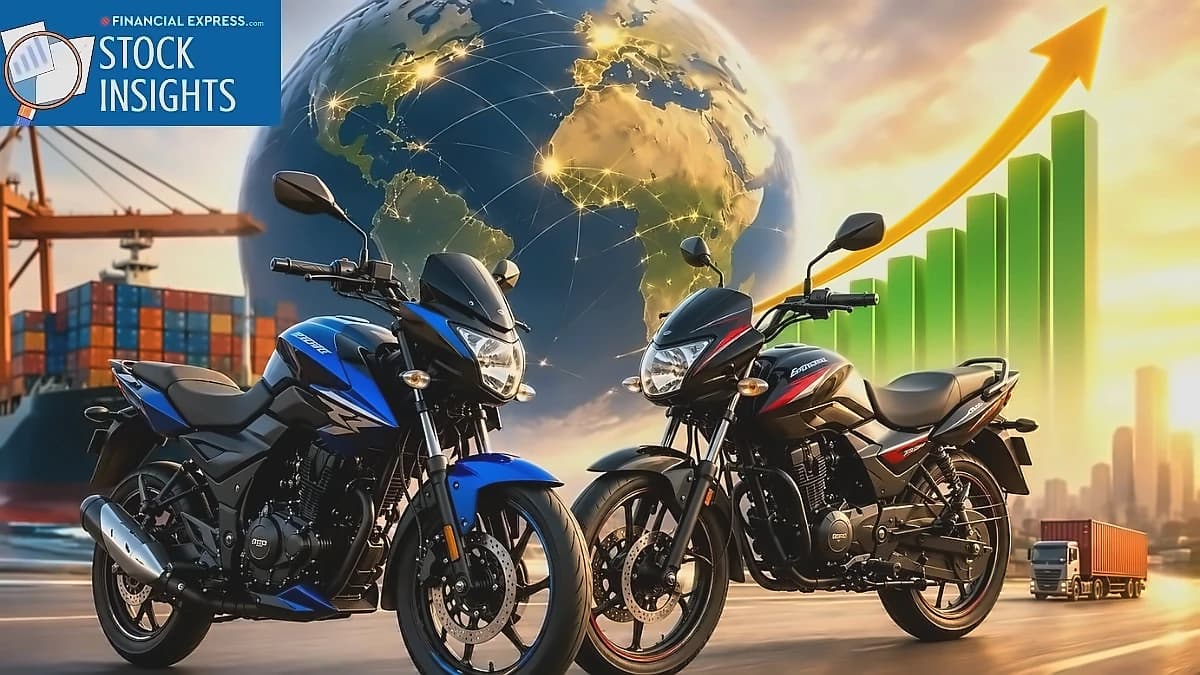
TVS Motor Company achieved its highest ever sales volume, revenue, and profits in FY 2026, with the company reporting revenue of ₹47,270 crore, marking a 30% year-on-year increase. According to the latest earnings call highlights, the company sold 5.9 million units during the full year, up 24% Y-o-Y, demonstrating strong operational performance across all segments. The company's profit after tax surged by 41.8% in FY26, significantly outperforming previous expectations. Despite the record financial results, TVS Motor shares fell 4% on the BSE following the results announcement. The company's Ebitda grew by 37% to ₹6,079 crore with margins improving by 60 basis points to 12.9%, while international sales grew by 33%, driven by strong demand in Africa, Asia, and LATAM regions.
TVS Motor has announced capital expenditure plans of around ₹1,900 crore for FY27, as reported by Forbes India. CEO Radhakrishnan expressed optimism about FY27, calling it the turnaround year for exports. The company's Ebitda grew by 37% to ₹6,079 crore with margins improving by 60 basis points to 12.9%, while international sales grew by 33%, driven by strong demand in Africa, Asia, and LATAM regions. The management highlighted that around 35% of the 3-5% commodity cost impact has been offset via price hikes in domestic and international markets. TVS Motor has planned capacity expansion of 1.5 million units annually in FY27, which would take total capacity to 8.3 million units per annum.

Despite the market decline, analysts maintain a bullish outlook on TVS Motor's growth prospects. As reported by Business Standard, Motilal Oswal Financial Services (MOFSL) values the stock at 35x FY28 EPS with a target price of ₹4,267 and 'Buy' rating. The brokerage expects the company to clock revenue, Ebitda, and profit after tax CAGR of 16%, 19%, and 21% respectively over FY26-28. PL Capital estimates volume and revenue compound annual growth rates of 10.3% and 15.4% respectively over FY26-28, while adjusted earnings per share CAGR is projected at 20.4%. The management expects the domestic 2W industry to grow at high single-digit in FY27, while the company aims to outpace this growth through its diversified product portfolio.
According to Business Standard reports, TVS Motor's growth is supported by strengthening presence in scooters, premium motorcycles, electric vehicles (EVs), and exports. The company is targeting market share gains in electric two-wheelers and electric three-wheelers, with TVS Motor targeting market share gains aided by a strong multi-variant E-2W portfolio and recent product launches in E-3Ws. The management highlighted that around 35% of the 3-5% commodity cost impact has been offset via price hikes in domestic and international markets. TVS Motor has planned capacity expansion of 1.5 million units annually in FY27, which would take total capacity to 8.3 million units per annum. The company maintains relatively limited exposure to the economy motorcycle segment, which accounts for only around 5% of its two-wheeler volumes.
As reported by Business Standard, Nomura highlighted that export demand remained robust across Latin America, Asia, and Africa despite logistical and transit disruptions. The brokerage expects TVS Motor's growth to remain strong at 10%/9% over FY27-28, led by domestic growth of 9%/8% and export growth of 12% each. Upcoming launches, particularly Norton motorcycles slated for Q2FY27, are expected to strengthen the company's premium positioning. Analysts noted that despite commodity-led cost pressures, TVS Motor maintained its profitability through calibrated price hikes, premium motorcycle sales, scooters, and operational efficiencies.
According to the latest earnings call highlights, TVS Motor faces several operational challenges including rising commodity prices, including steel, aluminum, and crude oil derivatives. The company is experiencing supply chain disruptions, particularly in labor availability and raw material supply, which have impacted production. There are geopolitical uncertainties, such as the ongoing West Asia conflict, affecting the business environment. The economy category of two-wheelers faces challenges due to higher inflation and fuel prices, while logistical issues, including container availability and increased lead times, are affecting international operations. Despite these challenges, the company's consistent market share gains across key domestic and export segments, along with gradual improvement in margins, have driven healthy returns over the years.