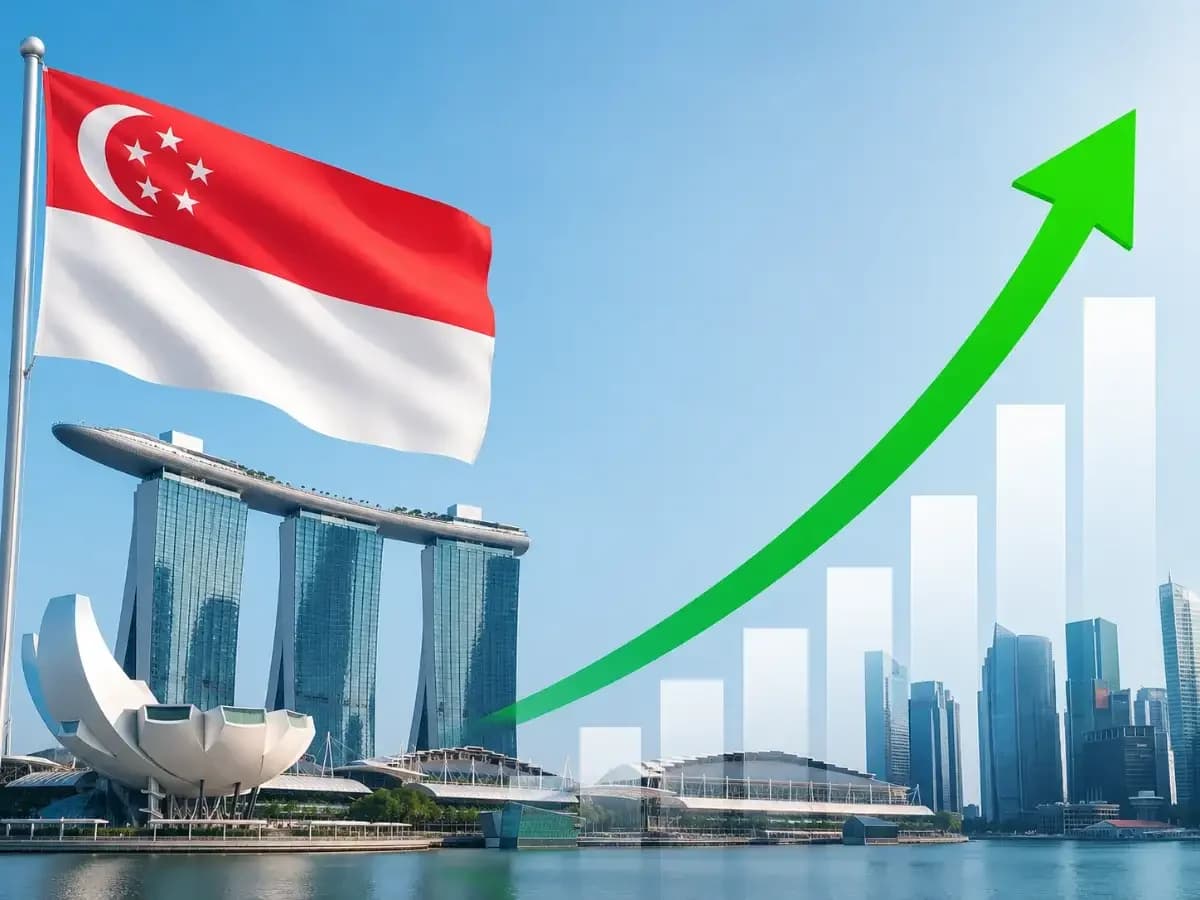
Singapore's state investor Temasek Holdings has announced a comprehensive strategic shift, prioritizing artificial intelligence investments over cryptocurrencies due to regulatory uncertainty and the lingering impact of a $275 million write-off from the collapse of FTX in 2022. As reported by CNBC, Nagi Hamiyeh, president of Temasek Global Investments, stated that 'We don't have directly any investment in crypto. I can't forecast what happens in the future, and the role that crypto is going to play in the main economy, depending on the different regulations that might happen.' The company is continuing to explore blockchain technology while focusing on artificial intelligence adoption and developing a commercial AI ecosystem. 'Not every situation needs frontier models,' Hamiyeh explained, adding that 'it's all about the applications, and it's all about the companies that embrace AI and build a moat.'
Singapore's state investor Temasek Holdings has unveiled an ambitious plan to expand its AI holdings from the current 6% of its portfolio to 15% by 2031, as reported by CNBC. Nagi Hamiyeh, president of Temasek Global Investments, told CNBC that 'The AI investment cycle has just begun and will continue for decades', while cautioning that valuations in some parts of the industry have run ahead of fundamentals. The company has already made significant AI investments, investing in Anthropic and OpenAI, and said it intends to more than double its AI-related exposure over the next five years as part of a broader strategy to build resilient, future-ready portfolios. Temasek's official report put its net portfolio value at S$518 billion ($400 billion) as of March, with AI making up about 6% of holdings at that point. Temasek remains constructive on India's AI potential, with CEO Dilhan Pillay Sandrasegara noting that 'India has done very well for us, although the last year has been challenging because of exchange rate volatility'.
Singapore's state investor Temasek Holdings announced that its net portfolio value increased 10.5% from a year ago to S$518 billion (US$401 billion) as of March 31, according to the latest financial results. The growth was driven largely by strong performance of Singapore-based listed companies in Temasek's portfolio, as well as gains from divestments, despite ongoing volatility. However, 2026 growth was slower than the 11.9% increase from 2024 to 2025, with the company's net portfolio value last year was S$469 billion on a mark-to-market basis. CEO Dilhan Pillay Sandrasegara noted that the present environment is the most complex that Temasek has seen in five decades, stating that 'We're not simply in a VUCA (volatility, uncertainty, complexity and ambiguity) world, we are in a polycrisis world'. The company's one-year total shareholder return was 10.5% in Singapore dollar terms and 14.8% in US dollar terms, with the strength of the Singapore dollar reducing returns by around 2 percentage points. Temasek reported a one-year total shareholder return (TSR) of 10.5%, while its 20-year and 10-year TSR stood at 6.8% and 7.1%, respectively. Since starting strategic portfolio shifts, Temasek has added about S$100 billion in portfolio value, representing a positive trajectory forward.
The strategic pivot reflects Singapore's hardening regulatory posture toward digital currencies following the FTX custody failures after Sam Bankman-Fried's exchange collapse. As reported by CNBC, regulators tightened licensing rules soon after, and compliance costs climbed as approvals slowed. Several exchanges and fund managers reportedly rethought their Singapore operations because of the regulatory changes. Temasek confirmed it holds no direct crypto positions today, with the company still remembering the FTX collapse and its aftermath. Singapore's regulatory stance toward digital currencies keeps hardening as this shift unfolds, following years of scrutiny tied to the FTX collapse aftermath, including ongoing pardon debates around Bankman-Fried. In contrast to its earlier crypto bet, Temasek's AI push carries fewer known regulatory landmines for now, that advantage likely depends on how quickly valuations across the wider sector cool.
Temasek's geographic allocation shows significant shifts in its global investment strategy. The US remains the largest destination of capital for the company's global direct investments, with Temasek's share of investments in the Americas growing to 26% this year, up from 24% last year. The company sees attractive opportunities given its leadership in innovation, particularly across the AI value chain, supported by deep public and private capital markets. However, India investments decreased from 8% to 7%, while China's exposure dipped from 18% in 2025 to 17% in 2026. CEO Rohit Sipahimalani acknowledged the weakening US dollar but emphasized that 'if company earnings are growing and the economy is growing, reasonable returns can be expected', noting 'very strong momentum' in earnings growth. The company has also completed key divestments including the sale of Dutch company Axia Vegetable Seeds and Schneider Electric India, while investing S$51 billion and divesting S$31 billion, making a net investment of S$20 billion. Temasek's India portfolio already includes investments in Haldiram's, Manipal Health Enterprises, upGrad, Clean Max Enviro Energy Solutions, Air India, Axis Bank, PB Fintech, Medanta, Lenskart and Eternal, among others.
Looking ahead, Temasek remains confident in Singapore's resilience despite global uncertainty and energy-related disruptions. The company sees 'compelling opportunities' in areas where innovation is accelerating, such as biotech, robotics, AI-related technologies and advanced manufacturing. CEO Dilhan Pillay Sandrasegara noted that the company is seeking to invest in areas 'not dependent on consumer spending or the real estate market', adding that 'those are somewhat structural, and therefore we can't invest (by) assuming that it will reverse itself'. The company intends to increase its investments in artificial intelligence, core-plus infrastructure and private credit. While it remains constructive on India, it expects near-term equity-market volatility due to the country's relatively limited exposure to the artificial intelligence value chain, while remaining 'mindful of the longer-term workforce impact from AI'. The strategic pivot from crypto to AI reflects Temasek's focus on building a commercial AI ecosystem and embracing companies that build competitive moats in the rapidly evolving artificial intelligence landscape.