Swiggy's Instamart is targeting an impressive ₹60,000 crore in annualised net order value to achieve profitability, according to management communications to shareholders. The platform must double its current orders and enhance contribution margins significantly to reach this goal. As reported by The Economic Times, Instamart should aim to garner an additional ₹30 per order through various optimizations, with higher margins and favorable product mix contributing ₹10 per order, advertising adding another ₹10, and densification generating ₹5. Moving towards an inventory-led operating model could unlock an additional ₹4-₹5 per order. The company has reiterated its medium-term ambition of exceeding ₹1 lakh crore in NOV at a 4%-5% adjusted Ebitda margin, representing a significant scaling challenge from current levels.
Instamart's contribution margin improved to negative 0.3% of NOV in the June quarter from negative 2.5% three months earlier, but adjusted Ebitda margin remained deeply negative at about 13.4%. According to The Economic Times, more than 45% of Instamart's store network was contribution margin positive during the quarter, up from 30% previously, with a quarter of the network operating at contribution margins of 3%-5%. However, adjusted Ebitda losses remained elevated at about ₹778 crore during the quarter, compared with ₹859 crore in the preceding three months. Over the last five quarters, Instamart has added ₹28 per order and needs to add another ₹30 per order to break-even at the required volume run-rate.
Blinkit generated ₹17,100 crore in NOV during the June quarter against Instamart's ₹5,850 crore, with sequential growth of 19% compared to 3% for Instamart, according to Goldman Sachs data. Blinkit operates at nearly three times Instamart's scale and is adjusted Ebitda-positive, while Instamart requires ₹60,000 crore in NOV to reach breakeven. The competitive advantage is further highlighted by Blinkit's contribution margin of 5.3% versus Instamart's negative 0.3%, with adjusted Ebitda margins differing by 14 percentage points. Blinkit added 200 stores during the period and 4.6 million monthly transacting users, while Instamart added 28 stores and 0.2 million users. Goldman Sachs estimates that Swiggy carries largely similar absolute indirect costs to Blinkit despite operating at one-third the scale, with Blinkit's scale allowing expenses to be spread across a significantly larger order base.
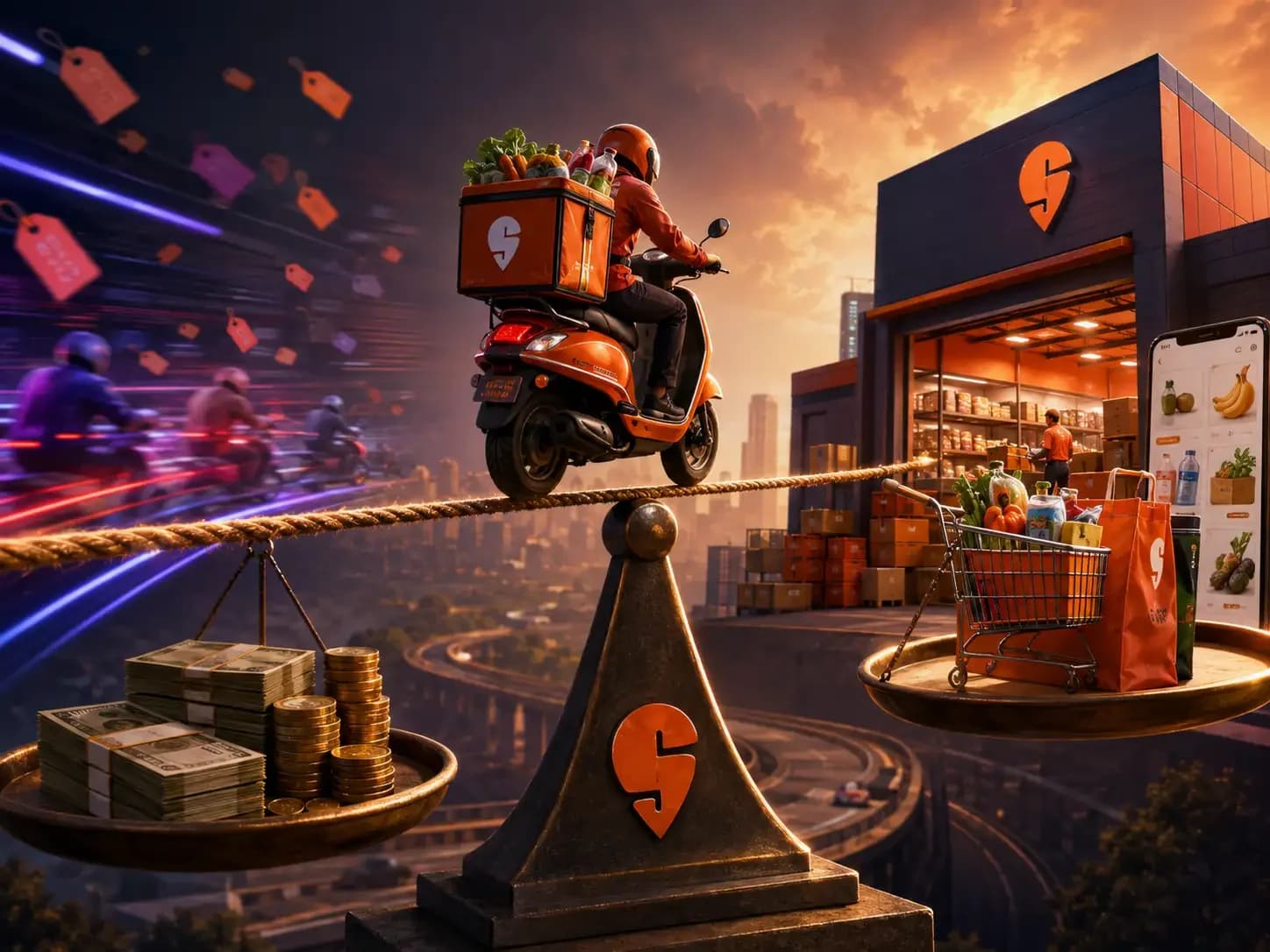
Instamart's four-week trending NOV growth accelerated to 10% by late July from 1% in the preceding four weeks, as reported by The Economic Times. Kotak expects sequential NOV growth of 13%-15% in the September quarter as Swiggy accelerates store openings and customer acquisition. Management expects contribution margin to remain between zero and negative 1% for the next few quarters as it invests in growth, giving Swiggy limited room to use discounts aggressively without reversing recent improvements. Citi described Swiggy as shifting towards "maximal growth at CM breakeven" from a "CM breakeven above all" approach, with the company trying to increase purchase frequency through wallet top-ups, saver passes, private labels and strategic brand partnerships instead of relying exclusively on deep discounts. However, Bernstein estimates Instamart is still consuming about $100 million every quarter across Ebitda losses, capital expenditure and working capital.
The quick-commerce industry excluding Blinkit operates at a negative double-digit Ebitda margin, according to Goldman Sachs estimates. Bernstein expects Instamart to remain loss-making in FY27 and FY28 before reaching breakeven during FY29, while JPMorgan forecasts the ₹60,000 crore threshold may be reached sometime in FY30. Jefferies estimated that Swiggy's market value, after accounting for food delivery, cash and other businesses, implied a negative value of about ₹2,400 crore for Instamart, with Blinkit valued at about ₹1.25 lakh crore. Citi said reaching the target during FY29 would require about 40% annual NOV growth between FY26 and FY29. The valuation disconnect creates upside potential for Swiggy but depends on Instamart's ability to convert scale into operating leverage. A tougher funding environment for competitors could support Instamart's growth while reducing price competition, with Bernstein similarly expecting a potentially more benign competitive environment to provide Swiggy with breathing room to improve economics.