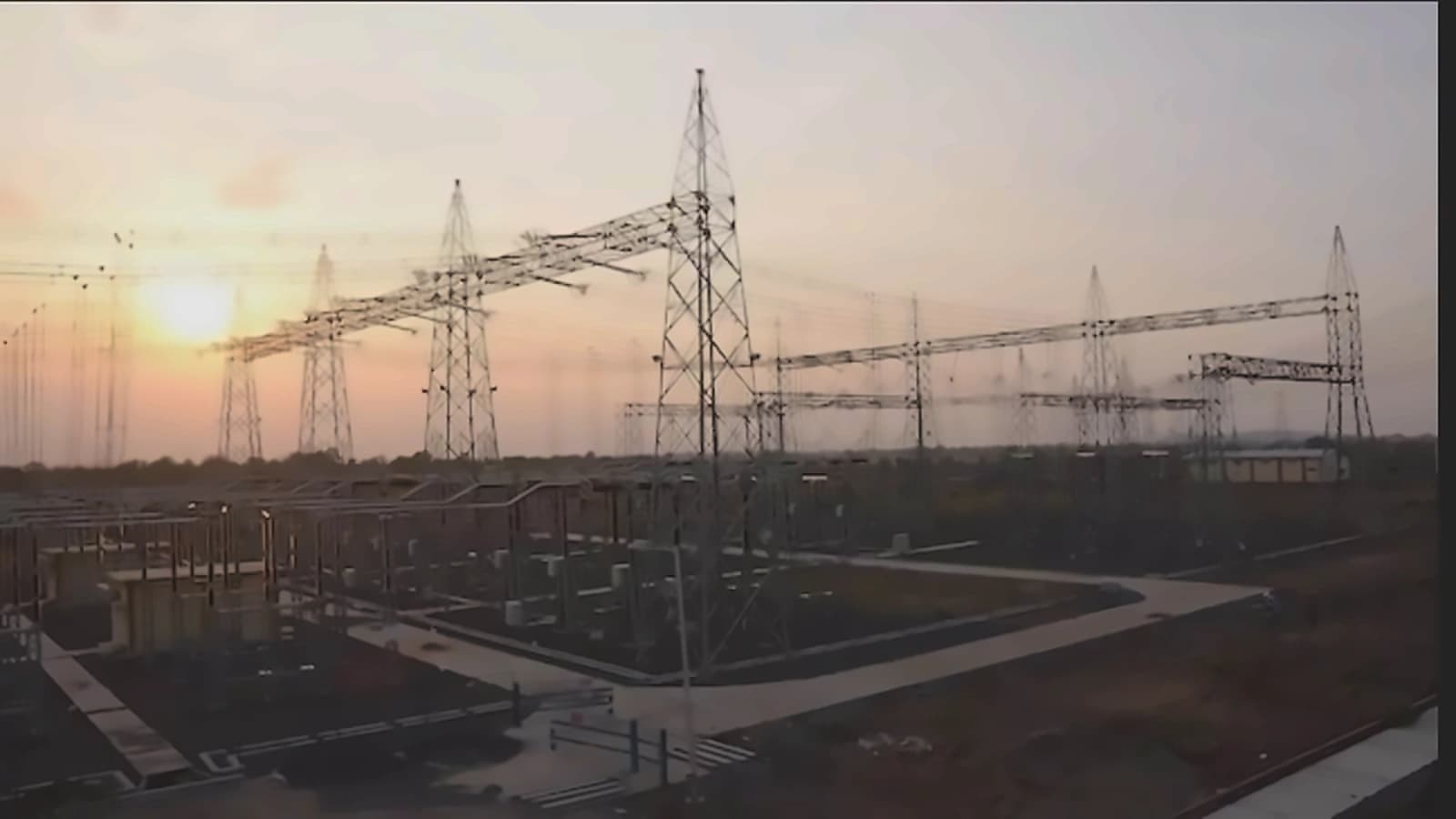
Power Grid Corporation of India's shares fell 2.15% to ₹275.70 in early trade on Thursday, positioning the stock among the top losers on the Nifty 50 index. According to reports from Moneycontrol, the stock's decline came despite the company reporting increased annual net profit and upcoming dividend payouts. The mixed market reaction reflects investor sentiment toward the company's quarterly performance amid broader market conditions.
For the quarter-ending June 2026, Power Grid Corporation of India's standalone net profit declined 6.56% year-on-year to ₹3,410.95 crore from ₹3,650.58 crore in the same quarter of 2025, primarily due to delays in tariff orders from regulators leading to continued lags in standalone provisional income recognition. However, consolidated net profit showed resilience, decreasing only 0.89% to ₹3,598.42 crore from ₹3,630.58 crore, while consolidated operational revenue grew 2.68% to ₹11,696.72 crore from ₹11,196.22 crore in the corresponding quarter of 2025. The company also incurred significant capital expenditure of ₹7,765 crore during Q1FY27, while capitalizing assets worth ₹5,277 crore on a consolidated basis. On a standalone basis, net profit fell 6.6% year-on-year to ₹3,410.95 crore, primarily driven by reduced provisional income recognition on transmission assets awaiting tariff orders.

Power Grid Corporation's investment committee approved an additional capital expenditure of ₹856.94 crore for a brownfield reconductoring upgrade of the Tirunelveli–Udumalpet and Pugalur–Madurai 400kV double-circuit transmission lines in Tamil Nadu. The project utilizes High-Temperature Low-Sag (HTLS) technology to increase thermal capacity without requiring extensive new land acquisition, with commissioning scheduled by February 11, 2028. This strategic investment highlights the company's efficient brownfield capital deployment strategy and positions Power Grid to address thermal bottlenecks while meeting surging renewable energy evacuation needs in the southern grid. The upgradation will increase power transfer capacity on existing tower infrastructure, bypassing right-of-way challenges and accelerating execution timelines.
On an annual consolidated basis, Power Grid Corporation of India's revenue for the year-ending March 2026 reached ₹46,732.87 crore, representing a 2.05% increase from ₹45,792.32 crore in the year-ending March 2025. According to Moneycontrol reports, net profit for the year-ending March 2026 rose to ₹16,060.29 crore, a 2.74% increase from ₹15,631.70 crore in the prior year. The Debt to Equity ratio increased by 4.26% to 1.47 in March 2026 from 1.41 in March 2025, suggesting a slight increase in the company's reliance on debt financing. However, the debt service coverage ratio improved significantly to 1.46 from 1.06 in the corresponding quarter last year, signaling better cash flow generation relative to debt obligations. During Q1FY27, Power Grid Corporation emerged as the successful bidder in five transmission projects under tariff-based competitive bidding, comprising three Inter-State Transmission System (ISTS) projects and two Intra-State Transmission System (InSTS) projects.
Power Grid Corporation has demonstrated active capital expansion with recent acquisitions including Krishnagiri REZ Transmission Limited from PFCCL for ₹19.82 crore on August 3, 2026, and the commissioning of the Rajasthan 20 GW REZ evacuation project (Phase-III Part-H) on July 4, 2026. The company also approved a ₹772.65 crore upgrade of the Udumalpet–Madurai transmission corridor in Tamil Nadu, scheduled for completion by August 2028. Power Grid Corporation maintains a consistent record of shareholder returns through dividends and bonus issues, including a final dividend of ₹1.25 per share (12.5%) with an effective date of August 13, 2026. The company's gross fixed assets on consolidated basis stood at ₹3,25,671 crore (including Gross Lease Receivables) as of June 30, 2026. Despite the marginal contraction in standalone profit, the capital expenditure approval of ₹856.94 crore will reinforce long-term growth visibility and public sector utility investors are likely to focus on the company's disciplined capex deployment and high-yield transmission projects.