Polycab India Ltd. delivered its highest-ever revenue and profitability for both Q2 and H1 FY27, significantly exceeding market expectations across all key parameters. The wires and cables company reported consolidated net profit of ₹9,900 million for the quarter, representing a 43% growth from the same quarter last year and surpassing the Zee Business poll expectation of ₹804 crore. Revenue from operations grew by nearly 53% year-on-year to ₹98,989 million from ₹6,467 crore in the corresponding quarter last year, also beating the poll expectation of ₹8,791 crore. For the half-year period, revenues surpassed ₹180 billion for the first time, marking a 46% year-on-year growth with EBITDA rising 36% to ₹25,587 million and PAT increasing 38% to ₹17,867 million. However, EBITDA margins contracted 140 basis points year-on-year to 14.2% due to a sharp 60% increase in raw material costs driven by surging copper prices, though margins improved sequentially by about 60 basis points.
Despite robust operational performance, Polycab faces intensifying competition following UltraTech Cement's launch of its wires & cables brand Ultravolt in early September. According to management, the new entrant is primarily targeting the wires segment, which accounts for around 30% of total W&C market of ₹1.1 trillion, with Polycab not planning any pricing action currently to defend its market share. Jefferies India estimates that Ultravolt's sales can form about 5-6% of FY30 C&W market, while JM Financial Institutional Securities noted that "margin risk sustains given the likelihood of disrupted pricing discipline." ICICI Securities similarly cautioned that pricing behaviour, new capacity additions, and the pace of market share gains should be monitored closely as competition intensifies. The company's shares have declined nearly 20% from their 52-week high of ₹10,126 amid these competitive concerns.
The Wires & Cables business recorded 47% growth in Q2 FY27, with domestic W&C revenue increasing 50% year-on-year, supported by healthy demand across government and private sectors, strong execution and favourable commodity-linked realizations. Wires continued to outperform cables with early double-digit volume growth compared to mid-single-digit growth in cables, demonstrating the company's strategic focus on higher-margin wire products. Exports grew 84.6% quarter-over-quarter despite geopolitical challenges, with exports' contribution to revenue increasing from 3.3% in Q1 FY26 to 5.0% in Q2 FY27. International business also recovered strongly, growing 17% after declining 13% in the previous quarter, with the segment contributing around 84% of Polycab's total revenue. EBIT margin improved sequentially by ~90 basis points to 14.2%, driven by operational efficiencies and a favourable product mix, though EHV plant commissioning has been delayed from December 2027 to FY28.
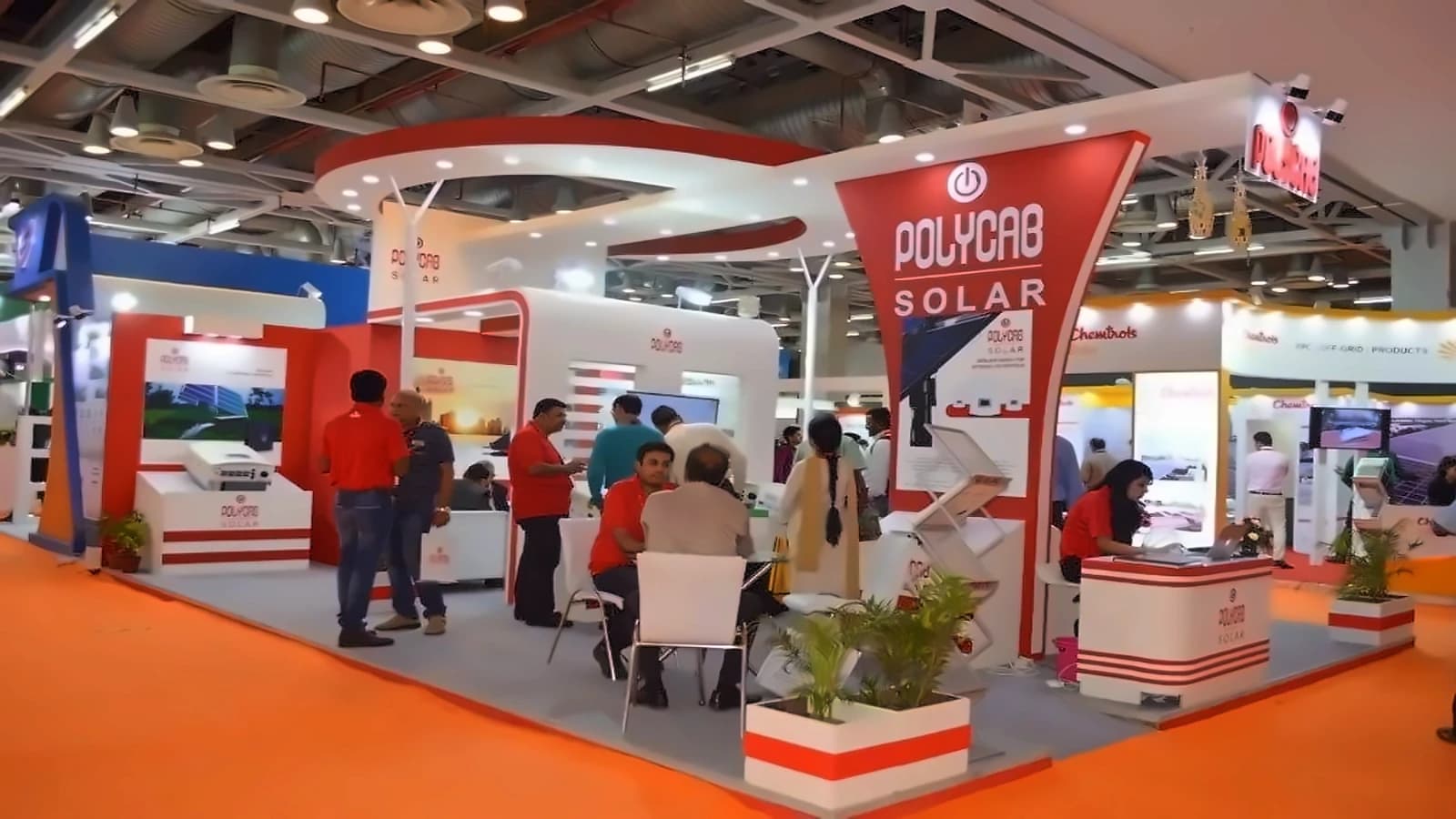
The FMEG segment delivered exceptional performance with revenue growing over 120% year-on-year, led by solar products and expansion of the product portfolio. The segment's contribution to consolidated revenue doubled to 10% in Q2, demonstrating the company's successful diversification strategy beyond traditional wires and cables. This marks the first time FMEG achieved double-digit EBIT margins of 10.1%, supported by operating leverage, premiumisation and a favourable product mix. The engineering, procurement and construction (EPC) segment, which accounts for around 6% of revenue, also recorded robust growth of 53%, reinforcing the growth story and showing sharp acceleration in profitability across key business segments.
Despite strong operational performance, Polycab's shares have declined nearly 20% from their 52-week high of ₹10,126 amid concerns over intensifying competition. The stock is trading at a one-year forward price-to-earnings ratio of about 34 times, below its five-year average multiple of 37.5x according to JM Financial. The company maintains a healthy cash position of ₹4,500 crore (+53.6% YoY) even after capex of ₹290 crore in Q2 FY27, providing financial flexibility for growth investments. Average net working capital days stood at ~11 days due to higher payable days and are expected to normalize to 45-50 days in coming quarters. Project Spring continues to progress as planned, with investments in capacity, distribution, and innovation supporting long-term growth ambitions, though all eyes are now on the impact of new market entrants on the company's market share and profitability.