Oil India shares declined 2.00% to ₹470.20 on Friday, August 10, 2026, at 12:17 pm, as reported by Moneycontrol. The stock is a constituent of the Nifty Midcap 150 index and has shown mixed performance following its strong quarterly results. Despite the recent decline, the stock had previously surged over 5% to ₹478.80 on Tuesday after multiple brokerages turned bullish on the stock following strong Q1FY27 results. According to The Economic Times, Emkay Global upgraded the Indian PSU company's rating to 'Buy' from 'Add', retaining the target price of ₹575. Elara Capital maintained its 'Buy' rating with an unchanged 12-month target price of ₹672, implying a potential upside of 48%. Nomura and Motilal Oswal retained their neutral ratings with target prices of ₹500 and ₹485 respectively. The rally was supported by strong buying interest and robust trading volumes, with around 57 lakh equity shares changing hands on August 11, significantly higher than its one-month average trading volume of 37 lakh shares.
Oil India achieved its highest-ever quarterly revenue and PAT, with standalone profit after tax (PAT) soaring 253% year-on-year to ₹2,900 crore, beating Elara Capital's estimate of ₹2,300 crore. As reported by The Economic Times, consolidated PAT almost doubled YoY to ₹4,000 crore, aided by exceptionally strong refining margins at NRL (Numaligarh Refinery Ltd), where Oil India holds a majority stake. Revenue from operations grew 34.5% to ₹12,503 crore from ₹9,293 crore quarter-on-quarter. The company reported record quarterly EBITDA, PBT, and PAT, with EPS of ₹17.65. The earnings beat was supported by stronger-than-expected production and sales volumes, lower other operating expenses and higher other income, partly offset by higher statutory levies. Prabhudas Lilladher noted that PAT came in-line with estimates at ₹28.7bn (PLe: ₹27.6bn; BBGe: ₹22.5bn), up 60.4% QoQ and 2.5x YoY. ICICI Securities reports that EBITDA/PAT accelerated 2.1x/2.9x YoY to ₹43.3/₹28.7 billion, driven by a 2% uptick in oil and gas output, USD 32.5/bbl higher oil realisations and an INR 3.7/scm rise in gas realisations.
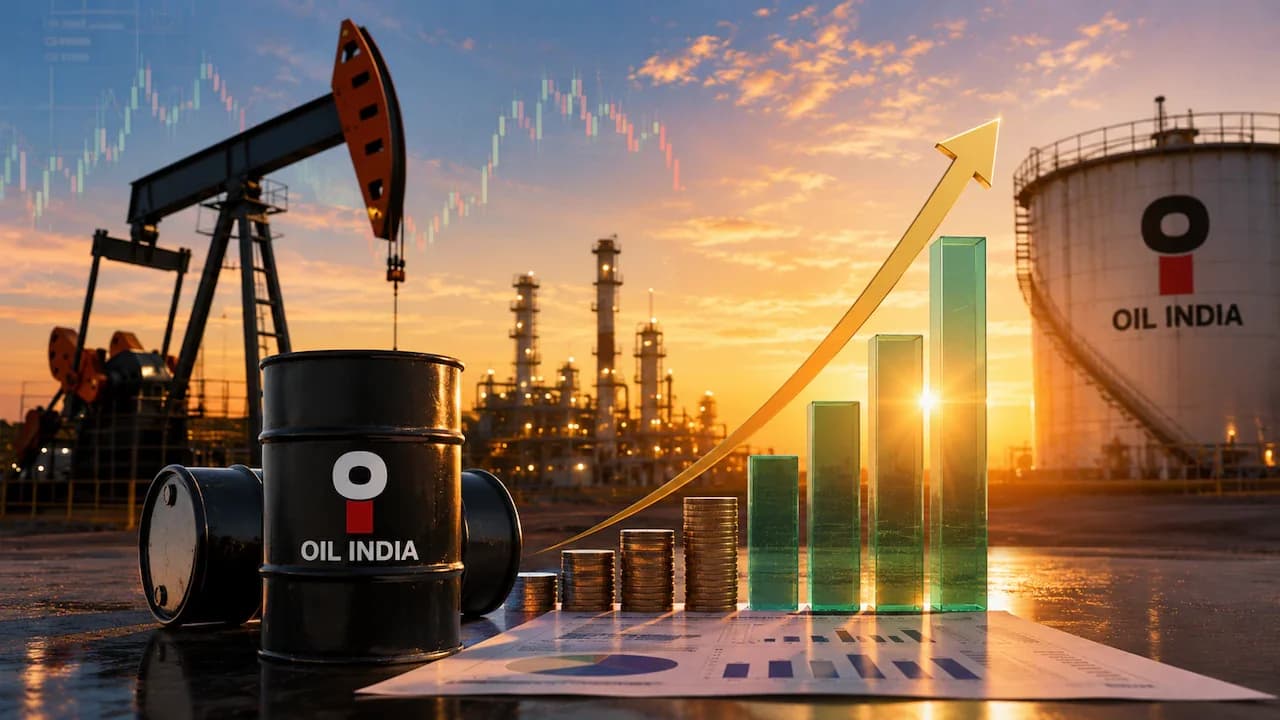
Oil India's operational performance showed mixed results across segments. According to the company's Q1 results, oil production increased 11% year-on-year to 0.95 million metric tonnes, with crude output rising 11% YoY to 0.95 MMT, 2% ahead of estimates, as noted by Elara Capital. Crude realisation rose 49% YoY to $99 per barrel, significantly higher than the previous quarter's $98.7 per barrel. The company achieved a record daily crude production of 11,017 barrels per day in early August, after hitting 10,921 barrels per day in late June. Management indicated that crude output could reach at least ~3.9-4.0 MMT in FY27, providing potential upside if the current production run-rate sustains. Gas production declined 8% year-on-year to 0.76 billion cubic meters, while gas sales were 11% below estimates at 0.92 MMT/0.62 bcm. The company drilled 17 wells during the quarter, including 7 exploratory and 10 development wells. Prabhudas Lilladher expects Oil India to achieve 3.9mmt in FY27 and >4.0mmt in FY28, with gas production guidance of 3.8bcm in FY28, with a significant jump expected from Q1FY29 once pipeline infrastructure is fully in place.
Oil India's material subsidiary Numaligarh Refinery Limited (NRL) delivered exceptional performance with 167% growth in PAT, rising to ₹1,305 crore in Q1FY27 from ₹488 crore in Q1FY26, supported by a GRM of $35.95/bbl and Distillate Yield of 87.58%. As reported by The Economic Times, NRL reported robust GRMs despite windfall taxes and lower excise duty, with the expansion on track for completion by March 2027. The refinery segment is expected to achieve 75% capacity utilization by FY28-end, providing additional growth catalysts. Oil India targets 100 wells in FY27, with drilling to rise 10% annually, with increasing focus on deepwater exploration. The brokerage factors in $85/80 crude in FY27/28E as material decline in crude prices remains a key risk. ICICI Securities notes that aggressive drilling, geographical diversification, gas monetisation over FY27–29E and government's Samudra Manthan Scheme for deep-water exploration, along with NRL's expansion by FY27E-end could support a strong 29% CAGR in consolidated earnings over FY27–28E.
Oil India's annual financial performance reveals mixed trends with strong quarterly growth but declining annual net profit. According to Moneycontrol, annual revenue increased to ₹33,946.13 crore in FY26 from ₹32,512.48 crore in FY25, representing a 4.41% increase. However, net profit for FY26 decreased to ₹6,429.11 crore from ₹7,098.28 crore in FY25, representing a 9.49% decline. The company's EPS increased marginally to ₹40.70 from ₹40.27 over the same period. As of March 2026, the company's P/E ratio stands at 11.68 and P/B ratio is 1.33. The debt to equity ratio is 0.62 while return on networth/equity is 11.41%. Moneycontrol analysis indicates a 'Very Bullish' sentiment for Oil India as of August 10, 2026. The company announced interim dividends of ₹7.00 per share (70%) on February 10, 2026, and ₹3.50 per share (35%) on November 14, 2025. Oil India is scheduled to participate in a conference call organized by DAM Capital Advisors Ltd. on August 10, 2026, to discuss the Financial Results for Quarter 1 - FY 2026-27.