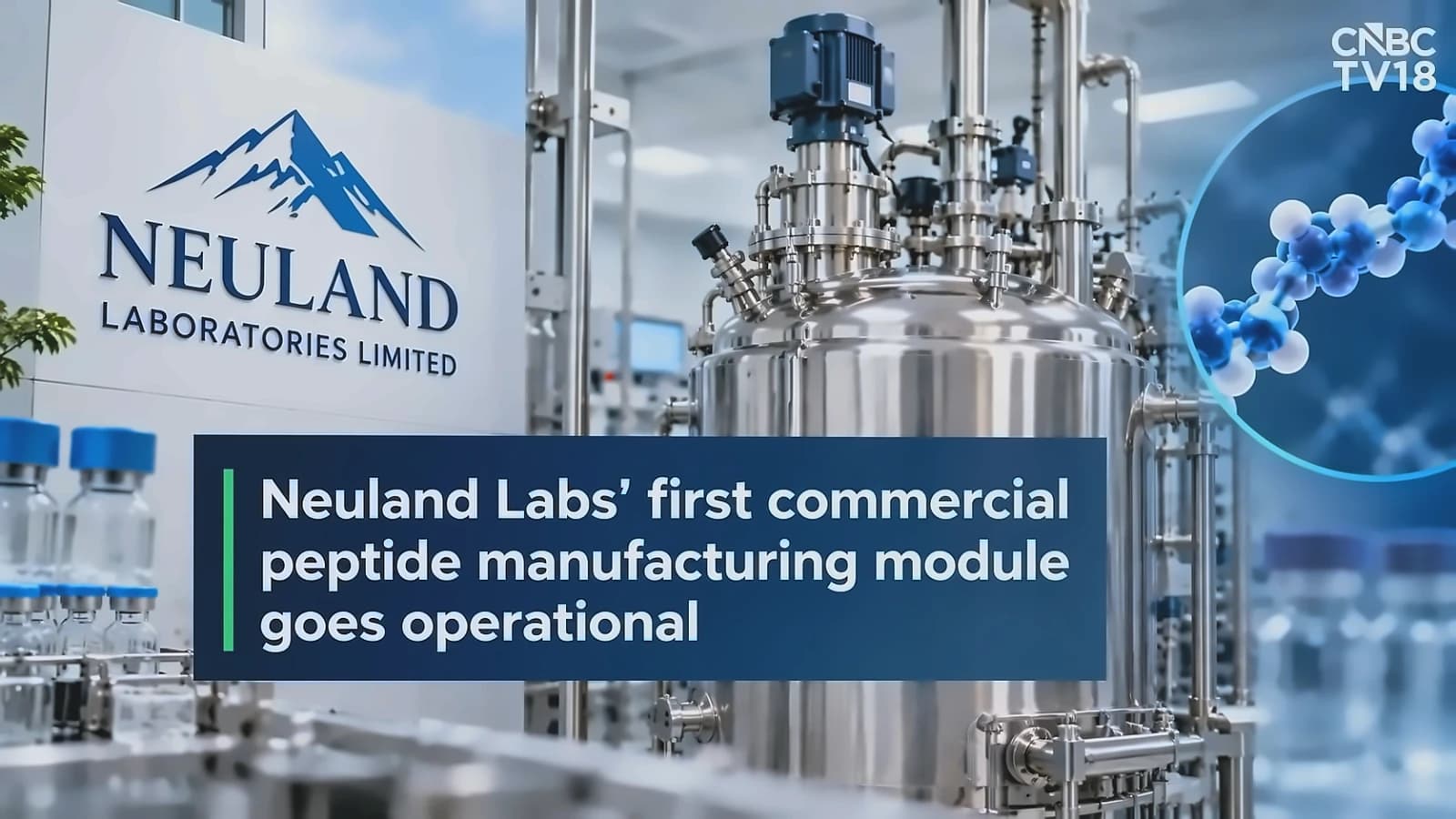
Neuland Laboratories announced on Tuesday, September 15, that its first commercial peptide manufacturing module has commenced operations, marking a significant milestone in the company's expansion plans. The facility provides 7,000 litres total reactor capacity, comprising 750 litres of solid-phase peptide synthesis (SPPS) and 6,250 litres of liquid-phase peptide synthesis (LPPS). With foundational infrastructure for the second module already in place, Neuland expects to begin work ahead of the original timeline once customer requirements are finalised. The module features 750 L SPPS and 6,250 L LPPS capacity following a $30 million investment, enabling flexible customer programmes ranging from small-scale to multikilogram quantities for complete peptide APIs.
The newly operational module features 7,000 litres total reactor capacity split between 750 litres of solid-phase peptide synthesis (SPPS) and 6,250 litres of liquid-phase peptide synthesis (LPPS). The facility can support customer programmes ranging from small-scale to multikilogram quantities for complete peptide APIs, including complex and long-chain peptides, as well as commercial-scale production of crude peptides. The SPPS and LPPS reactors are housed in separate suites, allowing parallel operations, while the module is supported by three DAC columns (one 45 cm and two 60 cm) and two lyophilisers with capacities of 100 litres and 200 litres respectively. A team of nearly 212 peptide experts supports module one, demonstrating the company's commitment to building specialized capabilities in this growing market segment.
Neuland invested $30 million in the first module and indicated that further investments in subsequent modules will be aligned with new customer requirements. The second module is planned to have a total reactor capacity of up to 18,000 litres, featuring three 5,000-litre LPPS reactors, either a 1,000-litre or 2,000-litre SPPS reactor, and smaller reactors of up to 1,000 litres. This configuration will allow support for a broad range of peptide programmes and production scales, with the company expecting to begin work on module two ahead of the original timeline once customer needs are finalised. The configuration, instrumentation and capacity are currently being defined in close collaboration with the customer whose projects will anchor the expanded capability.
Despite the operational milestone, shares of Neuland Laboratories fell 2.4% on Tuesday at ₹22,965, experiencing profit booking at higher levels after rising 53% so far this year. The company's CDMO business has shown strong growth with revenues rising 116% in its most recent quarterly results, driven primarily by increased commercial contracts and a growing number of clinical projects. Neuland CEO and Managing Director Saharsh Davuluri emphasized the company's long-term planning approach, stating the goal is to ensure capacity to meet customer demand not just over the next 24 months, but over the next decade as strategic partnerships deepen.
According to Business Standard, Neuland noted that as peptide pipelines expand, a growing number of biotech companies are struggling to access capable outsourced development and commercial manufacturing capacity. The company highlighted that the range of partner indications is expanding beyond obesity and metabolic disease, with oncology emerging as a particularly active area of early-stage development. Module one is supported by a team of nearly 212 peptide experts, demonstrating the company's commitment to building specialized capabilities in this growing market segment. As reported by Sea Isle News, Neuland's expertise covers complex small molecules and peptides along with generic APIs, allowing it to support companies from early development through commercial-scale supply across its three certified facilities with approvals from FDA, EMA, and PMDA.