According to reports from NDTV Profit, Molbio Diagnostics delivered robust financial results in FY26, with revenue increasing 41.7% year-on-year to ₹1,446 crore while net profit rose 14.9% to ₹164 crore. The company's test-kit volumes demonstrated exceptional growth at a compound annual growth rate (CAGR) of 41% between FY24 and FY26, rising from 8.8 million units to 17.6 million units. In the first quarter of FY27, revenue surged to ₹408.4 crore from ₹99.7 crore in the previous year, with EBITDA reaching ₹103.7 crore compared to a loss of ₹14.5 crore in Q1FY26. The company's EBITDA margin improved to 22.6% in FY26 with revenue reaching ₹328 crore, demonstrating strong operational efficiency.
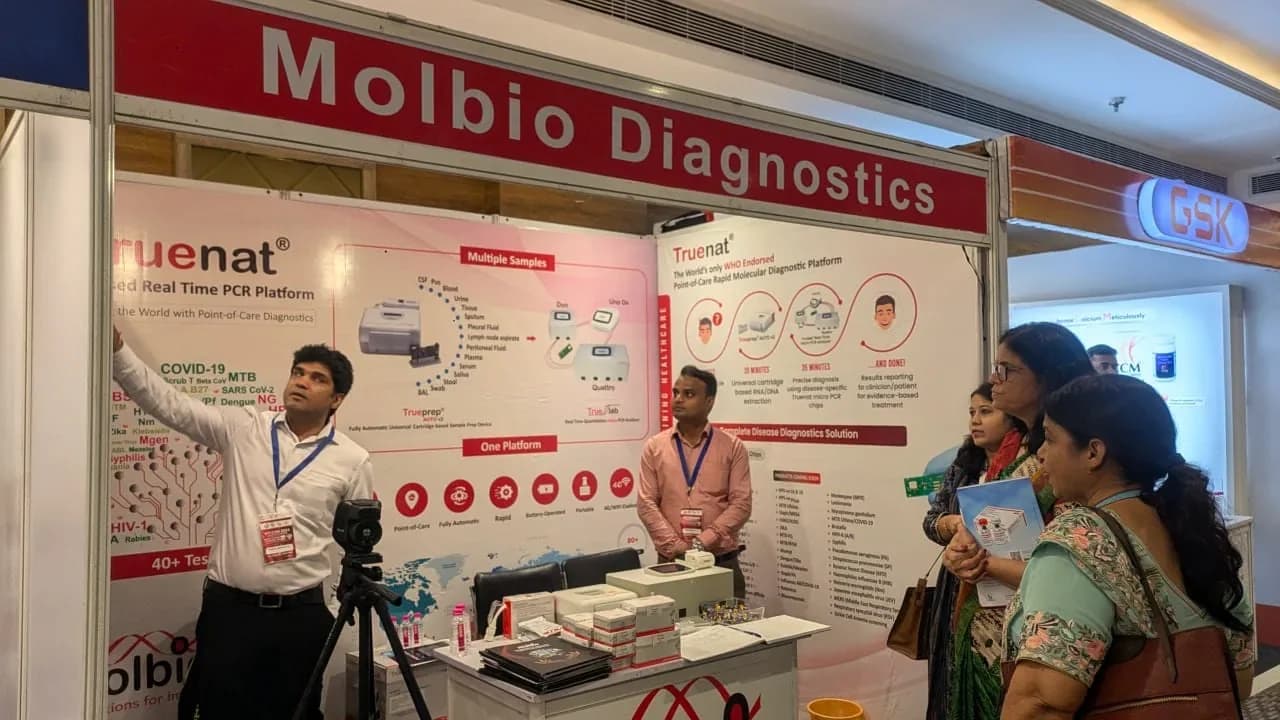
As reported by NDTV Profit, the company's proprietary Truenat platform has been installed across more than 12,500 devices in over 90 countries, creating a substantial base for recurring consumables sales. The portable, battery-operated device can deliver results in approximately 60 minutes compared to conventional laboratory testing that takes two to seven days, making it particularly relevant for remote healthcare facilities. Consumables accounted for 74% of product revenue in FY26 and 75% in Q1FY27, with test kits alone contributing 74% of product revenue in FY26. The platform has conducted more than 40 million tests worldwide and received endorsements from both the World Health Organization and Indian Council of Medical Research for tuberculosis diagnosis and the detection of rifampicin resistance. As of March 2026, Molbio offered 43 commercial assays covering 30 diseases, including TB, hepatitis B and C, HIV, human papillomavirus, dengue, influenza, chlamydia and gonorrhoea, with another 34 assays across 22 diseases in development.
According to NDTV Profit, Molbio is expanding beyond its core molecular diagnostics business through strategic acquisitions and technology investments. The company acquired Prognosys Medical Systems, adding ultra-portable X-ray systems under the PRORAD brand with expected revenue growth at a CAGR of 36% between FY26 and FY29, reaching ₹390 crore. Additionally, Molbio owns a 60% stake in OptraScan, which provides whole-slide scanners and artificial intelligence-driven pathology analysis, with revenue expected to reach ₹290 crore by FY29. The company maintains more than 90% of India's public-sector molecular diagnostic installed base across approximately 8,000 to 9,000 public health centres. Private healthcare presents another growth avenue, with only about 1,400 out of an estimated 17,000 private healthcare facilities in India currently having molecular diagnostic capabilities, offering significant expansion potential.
As reported by NDTV Profit, Molbio currently operates with annual manufacturing capacity for 39 million test kits and 5,400 Truenat devices, with capacity utilization at 58.25% for test kits and 42.30% for devices in FY26. Management indicates that revenue could potentially double from current levels with limited near-term additional capital spending, depending on demand and utilization of the installed device base. The company targets revenue growth of about 25% and an EBITDA margin of 24% to 25% for FY27, with annual Truenat device sales expected to remain within the historical range of 2,200 to 2,600 units. For FY27, test-kit sales volumes reached 6.2 million units in Q1FY27 compared to 0.8 million units in the year-earlier period, demonstrating strong momentum in the recurring consumables business.
According to CNBC TV18, Molbio Diagnostics shares were trading at ₹1,322.00 as of October 21, 2026, representing a 7.86% decline from the previous close of ₹1,434.80. The stock has a market capitalization of ₹15,234.73 crore with a traded volume of 16,05,497 shares. The stock price-to-earnings ratio stands at 89.51, reflecting the company's strong growth trajectory. The company trades at a price-to-earnings multiple of 76 times at ₹1,442 per share, with the company having only recently listed making meaningful historical valuation trends not yet available. Key risks include dependence on government healthcare tenders and institutional procurement, which can lead to uneven quarterly results due to tender awards, approvals and shipment schedules.