Minda Corporation is targeting more than threefold revenue growth to ₹17,500 crore by FY30 from ₹5,056 crore in FY25, with the plan increasingly dependent on higher-value products, electric vehicles and automotive electronics. According to reports from NDTV Profit, the company is seeking to grow not just by selling more components, but by increasing the value of what it supplies to each vehicle. The shift matters because Minda is focusing on growing its kit value through mechanical products combined with electronic access, body electronics, cockpit systems and EV powertrain components. The strategy is already visible in the company's financial performance, with revenue rising 33.2% year over year to ₹1,846 crore in Q1 FY27, while EBITDA increased 35.4% to ₹212 crore and net profit, excluding extraordinary items, rose 53.8% to ₹100 crore.
The company's strategy is already showing results in its financial performance. As reported by NDTV Profit, revenue rose 33.2% year over year to ₹1,846 crore in Q1 FY27, while EBITDA increased 35.4% to ₹212 crore. Net profit, excluding extraordinary items, rose 53.8% to ₹100 crore. The bigger test will be whether newer, higher-value businesses can scale quickly enough to support the FY30 revenue target and push the EBITDA margin above 12.5%, from 11.7% in FY26. The company is targeting an EBITDA margin of more than 12.5% by FY30, compared with 11.7% in FY26, and aims to raise return on capital employed, excluding Flash Electronics, to more than 25%, from 23.1% in FY26.
Two-wheelers and three-wheelers accounted for 46% of Minda's revenue in Q1 FY27, making the company's strategy to increase content per vehicle particularly important. According to NDTV Profit, a basic mechanical lockset costs about ₹3,000 per two-wheeler, but adding smart electronic access and body electronics can take the potential kit value to ₹12,000-₹15,000. The company holds a 49% stake in Flash Electronics, which makes automotive electrical, electronic and powertrain components for brands including Audi, Mahindra, Bajaj, Harley-Davidson, KTM, Kawasaki and Piaggio. Through Flash, Minda is targeting integrated EV powertrain systems with a kit value of ₹35,000-₹40,000 per vehicle. Flash's revenue rose 42% year over year to ₹533 crore in Q1 FY27, while its EV revenue increased 90%, with EV products accounting for 30% of total sales. Management is targeting 20%-24% growth for Flash while focusing on profitable growth as demand for EV components increases.
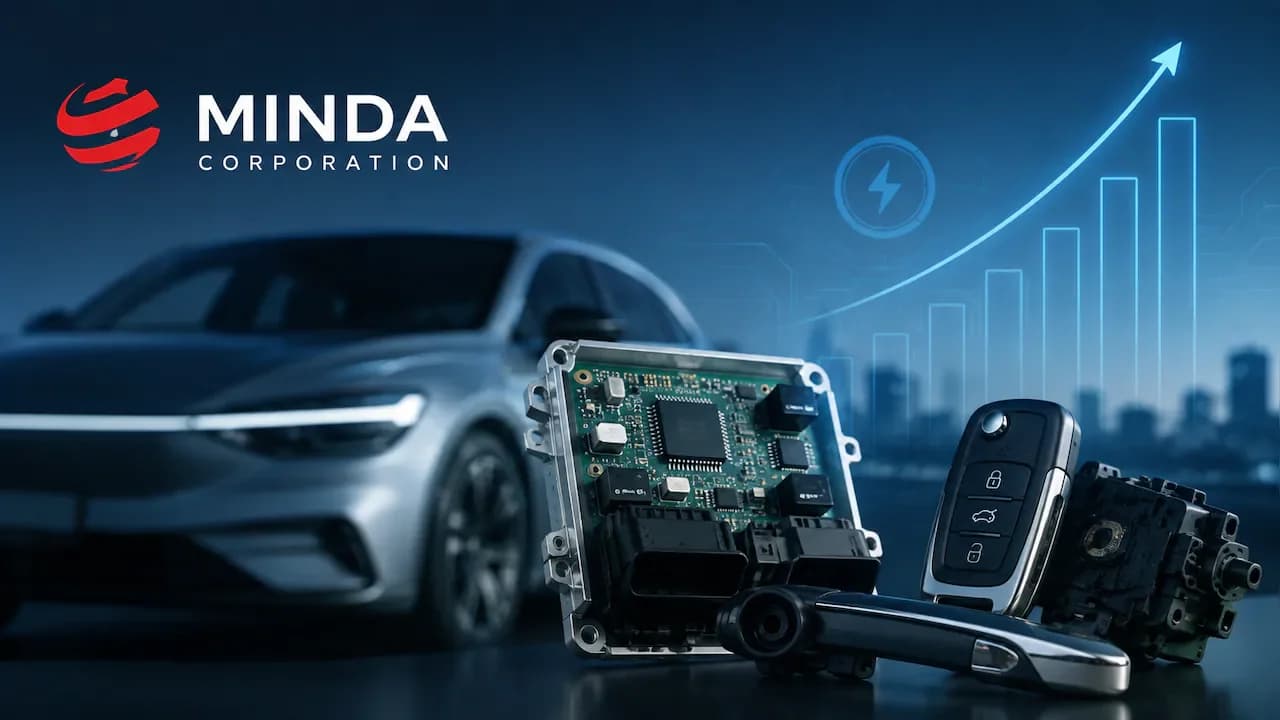
The same approach is being applied to passenger vehicles, which contributed 19% of Minda's revenue in Q1 FY27. After the consolidation of Minda VAST, vehicle access systems have a kit value of about ₹8,000-₹13,000 per vehicle, with plans to double that value by FY28 to ₹16,000-₹26,000. The company is adding passive entry passive start systems, smart key fobs, integrated digital displays and electronic steering column locks. EV-related revenue grew 40% year over year in Q1 FY27 and accounted for 10% of revenue, with EV components accounting for more than 15% of new lifetime orders worth ₹2,500 crore secured during the quarter. Including Flash Electronics, EVs represented about 14% of revenue, with the company securing new lifetime orders worth ₹2,500 crore in Q1 FY27, where EV components accounted for more than 15% of the total.
Minda is expanding its technology portfolio through strategic partnerships and new product development. The company has partnered with UK-based Turntide Technologies to add high-power EV motors and controllers for commercial electric trucks and buses, with production scheduled to begin in October-November 2026. The Toyodenso joint venture is focused on advanced automotive switches, with production scheduled to begin in Q2 FY28 and expected to generate about ₹150 crore in its first year. The company is also moving towards mass production of sunroof and closure systems with HCMF, with production and deliveries scheduled to begin in Q2 FY27. Minda has developed prototype sunroof designs for domestic SUV manufacturers and secured a lifetime order book of ₹350 crore from a major Indian automaker. The company is targeting a larger international business as part of Vision 2030, aiming to increase export revenue to ₹1,500 crore by FY30 from ₹533 crore in FY25. About 20% of the ₹10,000 crore of new lifetime orders secured during FY26 came from international export orders.
The company is targeting an EBITDA margin of more than 12.5% by FY30, compared with 11.7% in FY26, and aims to raise return on capital employed, excluding Flash Electronics, to more than 25%, from 23.1% in FY26. At ₹704 per share, Minda trades at 42 times trailing 12-month earnings, the same as its five-year median. The valuation leaves less room for growth to come from a higher earnings multiple, putting greater emphasis on sustained revenue growth and margin improvement needed to support the Vision 2030 targets. The growth case rests on several moving parts: higher kit value, a shift towards electronics, EV expansion, new product launches, partnerships, exports and growth in existing businesses. The key question is therefore not simply whether Minda can reach ₹17,500 crore in revenue, but how much of that growth can come with the margin improvement needed to support its Vision 2030 targets.