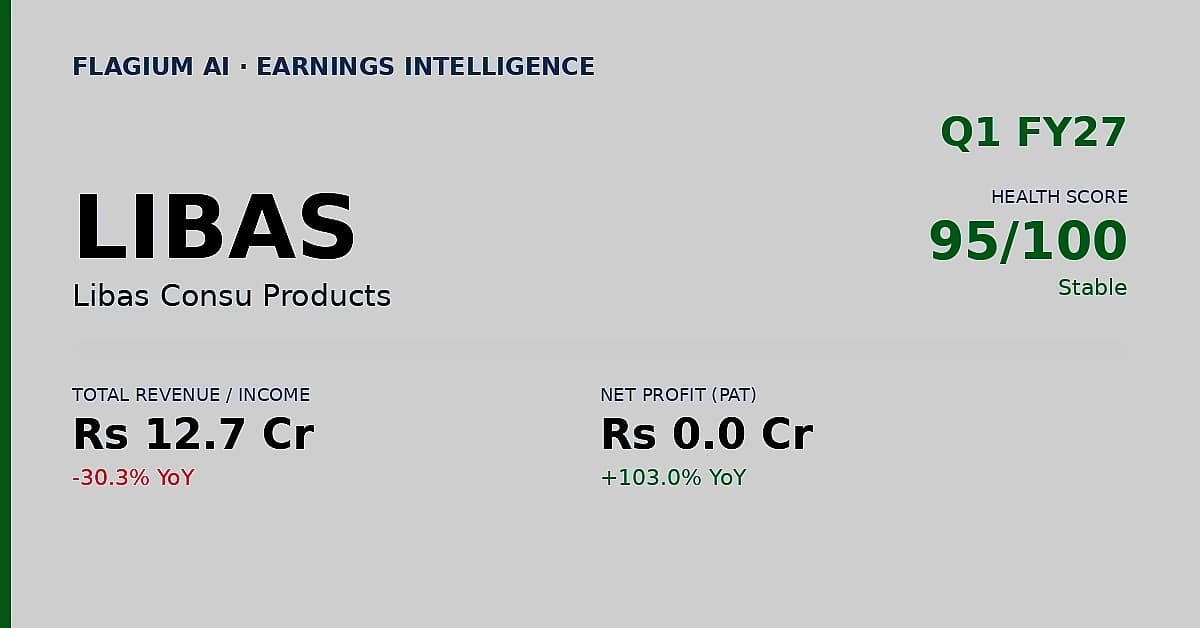
Libas Consumer Products achieved a significant turnaround in the June 2026 quarter, reporting a consolidated net profit of ₹0.05 crore compared to a net loss of ₹1.65 crore in the corresponding quarter of the previous year. According to reports from Business Standard, this represents a complete reversal of the company's financial performance from the same period last year. The latest quarterly results show net profit of ₹0.0 crore compared to ₹-1.6 crore in Q1 FY26, marking a 103% year-on-year improvement.
Despite the profit turnaround, the company faced revenue challenges with sales declining 30.22% to ₹12.70 crore in the quarter ended June 2026, as reported by Business Standard. This compares to sales of ₹18.20 crore recorded in the same quarter of the previous financial year, indicating a substantial contraction in the company's top-line performance. The latest data from Flagium AI confirms this trend with revenue declining 30.3% year-on-year and 32.4% quarter-on-quarter to ₹12.7 crore, reflecting challenging industry-wide demand trends.
The company's operating profit margin (OPM) improved to 2.81% in the current quarter from 5.88% in the corresponding quarter of the previous year, as reported by Business Standard. However, PBDT (Profit Before Depreciation and Tax) declined 52% to ₹0.38 crore from ₹0.79 crore in the same period last year, while PBT (Profit Before Tax) also fell 52% to ₹0.36 crore from ₹0.75 crore in the previous year's quarter. The latest Flagium AI analysis shows operating margin moved -132 bps YoY and +612 bps QoQ to 2.81%, indicating sequential improvement despite year-on-year decline.
According to Flagium AI's structural risk assessment, Libas Consumer Products currently sits within the 'Stable' risk classification with 2 active flags, indicating that operating headwinds are beginning to translate into structural pressure. The company faces early signs of leverage and funding pressure, revenue growth headwinds, with revenue growth consistently lagging behind sector median (8.4%). Key risk factors include 'Low Interest Coverage' (2.15x in Q1 FY27 vs 2.5x threshold) and 'Relative Growth Weakness', though current deterioration appears cyclical rather than existential.