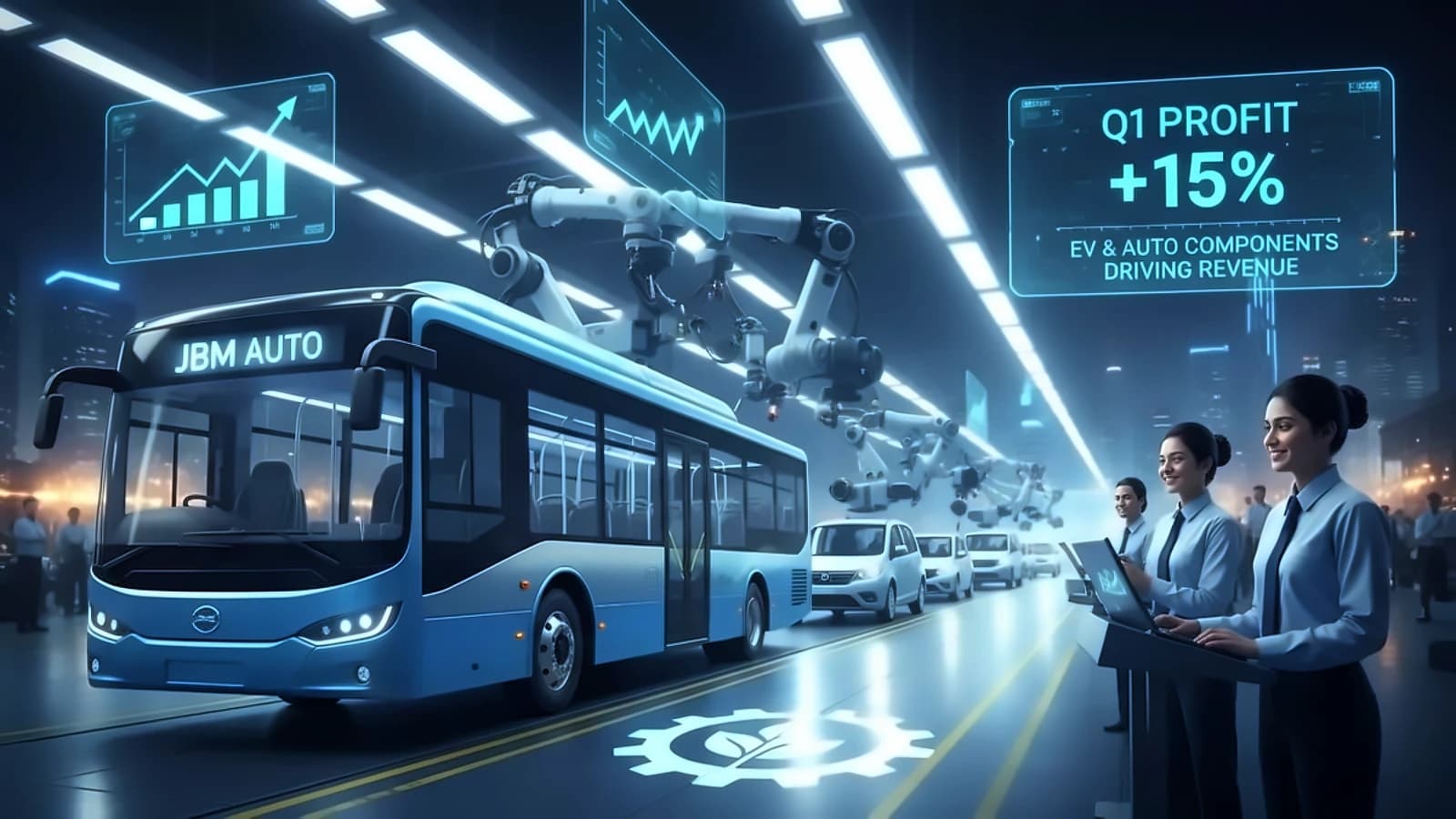
JBM Auto delivered robust financial results for Q1 FY27, with consolidated net profit rising 15.96% year-on-year to ₹42.43 crore compared to ₹36.59 crore in the corresponding quarter last year. According to reports from ETAuto, revenue from operations increased 15.04% year-on-year to ₹1,442.45 crore from ₹1,253.88 crore, demonstrating the company's ability to expand while maintaining profitability. The company also delivered EBITDA of ₹194.88 crore, up 8.48% year-on-year from ₹179.65 crore, indicating strong operational performance across all business segments. Profit before tax (PBT) increased 18.73% to ₹60.02 crore, while earnings per share (EPS) improved to ₹1.78 from ₹1.56 in Q1 FY26.
The company's board has approved a strategic fundraising proposal of up to ₹1,500 crore through the issuance of securities, subject to shareholder approval at the upcoming AGM. This massive capital authorization will enable JBM Auto to aggressively fund its rapidly rising electric bus and EV leasing divisions, supporting the company's ambitious expansion plans. The fundraising comes alongside the ₹750 crore strategic investment secured by JBM Ecolife Mobility from Motilal Oswal Alternates on June 18, 2026, providing substantial backing for scaling e-bus deployments across India. The company also reduced its long-term debt by around ₹500 crore during the quarter, significantly strengthening its financial position.
The company's operational performance strengthened significantly during the quarter, with EBITDA rising 17.1% year-on-year to ₹163.4 crore from ₹139.5 crore. As reported by CNBC TV18, EBITDA margin improved to 11.33% from 11.13% a year ago, indicating the company generated slightly higher operating profit from every rupee of revenue despite continued investments in growth. This modest margin expansion demonstrates JBM Auto's operational efficiency and cost management capabilities.
JBM Auto's diversified business model continued to drive growth across key segments. According to ETAuto, the electric vehicle business reported revenue of ₹460.04 crore, up 16.67% from ₹394.31 crore in the corresponding quarter last year. The auto components business, which remains the company's largest revenue contributor, posted revenue of ₹894.12 crore, an increase of 15.53% year-on-year from ₹773.91 crore. During the previous quarter, JBM Auto's EV business retained its market leadership with around 25% market share in Q1FY27, while the company maintained its position as a key player in India's rapidly expanding electric mobility sector. The company expanded its electric bus footprint through multiple deployments during the quarter, including buses flagged off in Ahmedabad, Gandhinagar, Vadodara, Delhi, Panipat, Ambala and Jamnagar.
JBM Auto's subsidiary JBM Ecolife Mobility successfully secured the ₹750 crore strategic investment from Motilal Oswal Alternates to support expansion, while JBM Electric Vehicles introduced its next-generation GALAXY luxury electric coach on July 10, 2026, which it described as India's first indigenous sleeper and seater electric luxury coach. The company also signed an agreement with DRIVN to supply 500 electric luxury buses, with JBM Auto continuing to act as market leader in India's e-bus segment with a dominant market share of nearly 49% as of mid-2026. As of July 30, 2026, JBM Auto share price closed at ₹678.45 on the NSE, up 0.36% from the previous close of ₹676.00, with the stock touching an intraday high of ₹689.00 and low of ₹665.10 during trading.