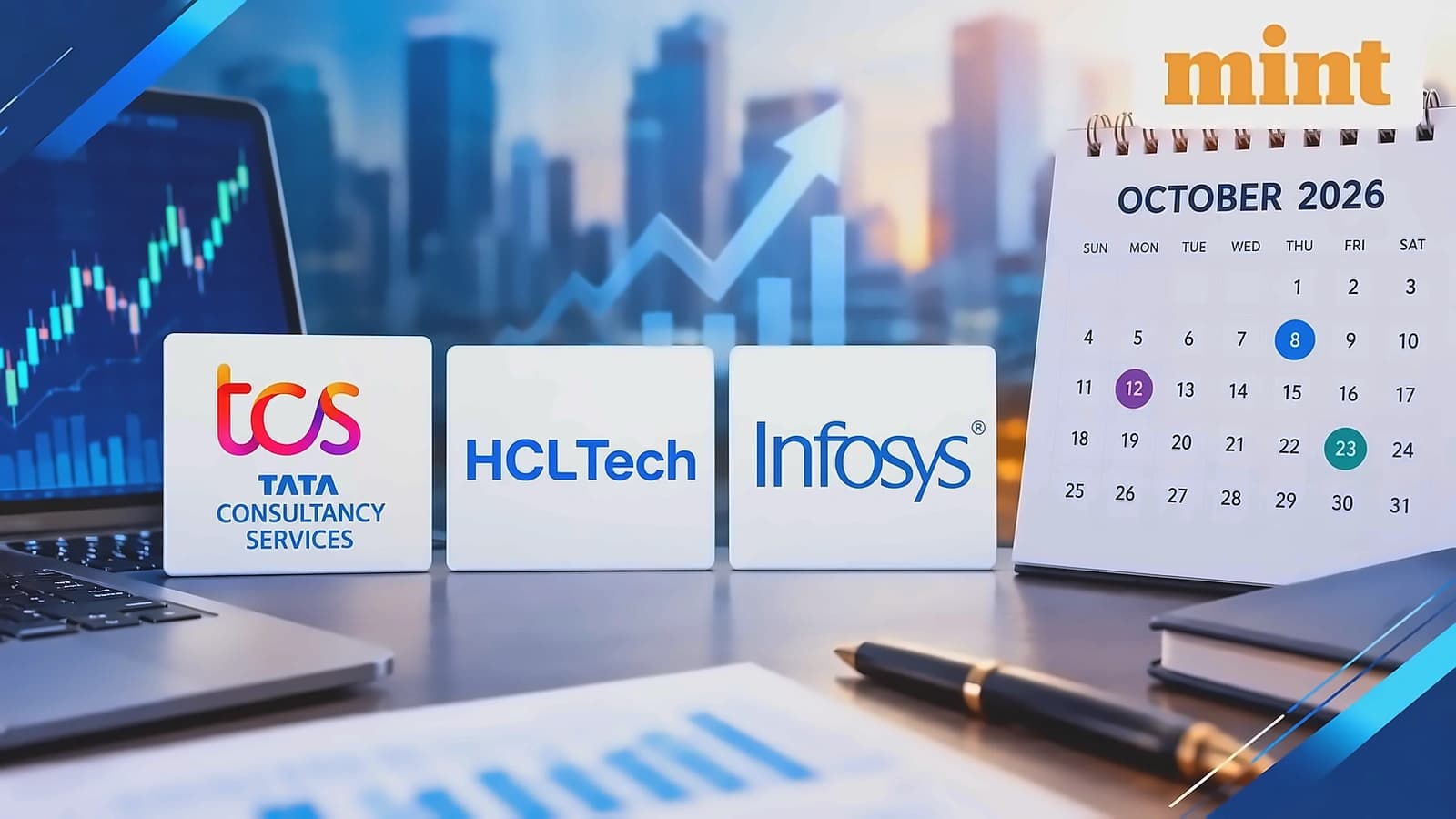
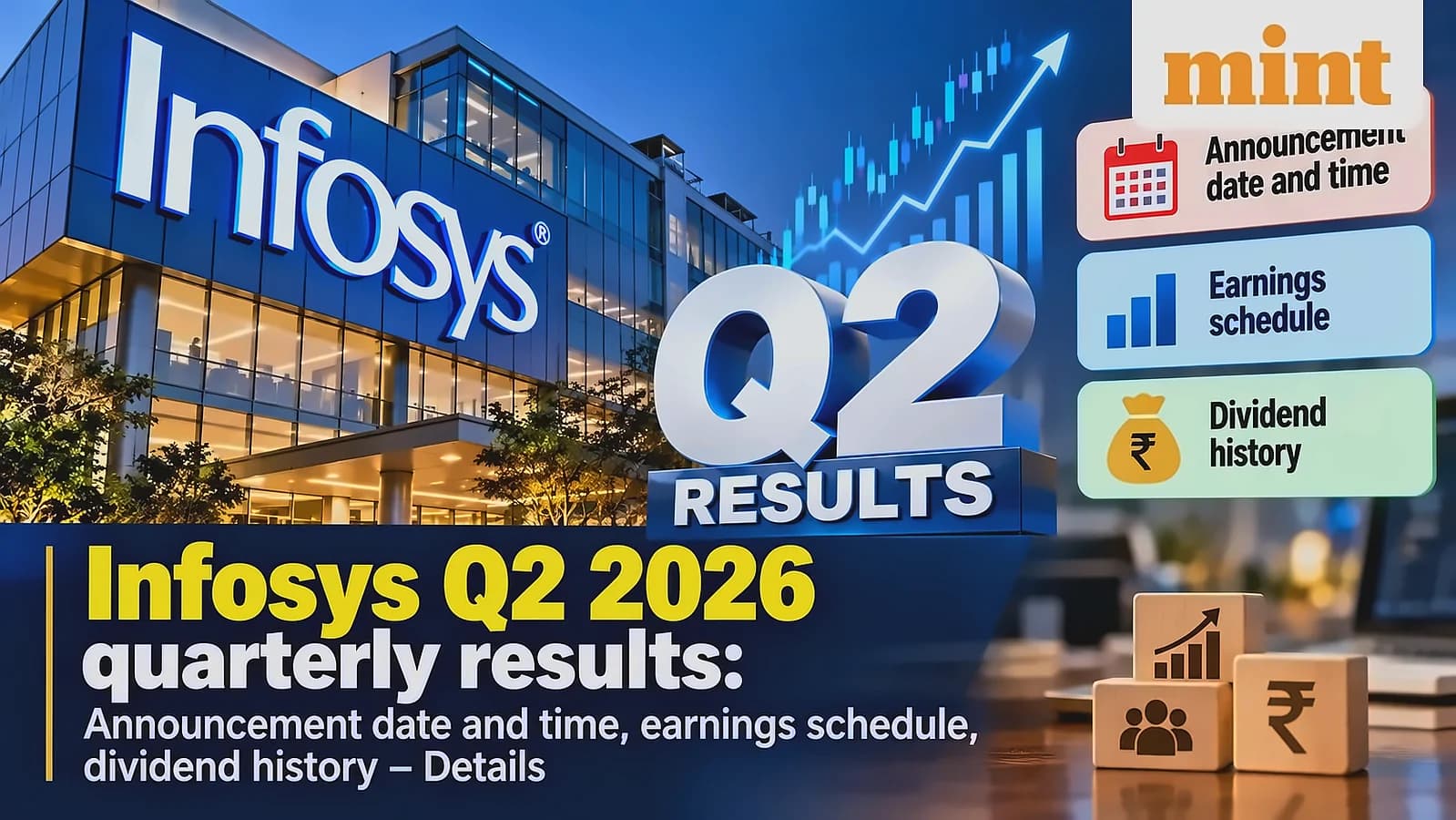
India's Q2 FY27 IT earnings season begins October 8, 2026 with TCS leading the announcements, followed by HCL Technologies on October 12, 2026, and Tata Technologies on October 14, 2026. The comprehensive schedule includes Wipro and Tech Mahindra on October 15, 2026, with Infosys reporting on October 23, 2026. Coforge and LTTS are scheduled for October 23, 2026, while Mphasis will announce results on November 5, 2026. According to the latest results calendar, TCS is scheduled to announce results on Thursday, October 8, 2026, with the company's board meeting to approve standalone and consolidated results and consider declaring a second interim dividend. HCL Technologies will announce results on Monday, October 12, 2026, while Infosys is scheduled for Friday, October 23, 2026, with an earnings call on the same day for senior management discussion. Some IT companies, including TCS, HCLTech, and Infosys, are also scheduled to consider interim dividends alongside their Q2 results, with Tech Mahindra under consideration for interim dividend and bonus share issue.
According to Kotak Institutional Equities, AI adoption could have a net deflationary impact of around 3.5% annually on IT services revenue growth between FY27 and FY29, with the brokerage estimating a gross deflation of around 7% due to AI adoption. The September quarter will provide an update on how technology spending is holding up across key client segments, with deal wins, discretionary spending and management commentary on the second half of FY27 being closely watched. Most enterprises are currently focusing on cost optimisation and productivity savings from AI rather than generating significant new revenue through AI-based use cases. The Economic Times reports that AI-led deflation has more legs to go and demand environment is not improving, with additional pressure from higher oil prices and interest rates. While open LLMs could create an incremental opportunity for IT services providers, they could also increase deflationary pressure as adoption rises. The rise of AI-based technology has battered the $315-billion information technology sector, especially vulnerable because of its reliance on billable hours, forcing companies to rejig business models and offer steep discounts. A key concern for the sector is that AI is beginning to change the economics of traditional IT services, with clients increasingly seeking productivity savings from AI and pushing for those savings to be reflected in contract pricing. Motilal Oswal notes that IT companies are all chasing the same set of large deals, which are essentially vendor consolidation and cost optimisation ones, with such deals having shrunk in size and intense competition is also putting pressure on margins. UnearthInsight reports that AI-led revenue remained under 5% of the industry's total, with a growing share of client budgets in the US and Europe going to native AI platforms and start-ups, while software vendors such as SAP and Oracle are selling more AI-embedded products that reduce the need for traditional services.
The Indian IT sector is likely to register another muted results for the July-September period, despite it being typically a seasonally strong quarter. According to HDFC Securities, Q2 FY27 tier-1 growth is projected at -0.4% to +2.0% QoQ in constant currency terms, with mid-tier companies ranging from +0.6% to +6.3%, partly aided by acquisitions. Pricing pressure persists as AI-led productivity pass-through gets embedded into renewals and new deals, according to the brokerage. With H1 tracking below expectations, the FY27 recovery rests on H2, which includes the seasonally soft furlough-impacted Q3, tempering full-year expectations. Kotak Institutional Equities expects HCL Technologies to lead Tier-1 IT companies with around 2% organic sequential revenue growth in Q2 FY27, marking the strongest performance among large-cap IT companies. Infosys is projected to report around 1.1% organic sequential growth, with approximately 50 basis points of this growth attributed to the reversal of a headwind seen in the previous quarter. TCS is expected to see modest growth of around 0.5% organic sequential growth in the September quarter. Tech Mahindra is anticipated to report around 1.6% sequential growth, supported by the ramp-up of large deals. The latest analysis from Jefferies indicates that large IT firms are seen delivering their weakest Q2 growth in three years, with aggregate revenues expected to grow only 0.7% to 3.5% sequentially in constant currency terms. The Economic Times reports that analysts predict a gradual sequential revenue rise ranging from 0.7% to 3.5% for the major players, while even giants like Infosys may lower their projections. Infosys is expected to trim the upper end of its 1.5% to 3% revenue growth forecast to 2.5%, according to Kotak analysts, with Jefferies expecting a sharper cut to 0.5% to 2%. UnearthInsight expects the top-five IT companies to grow 0.5-1% quarter-on-quarter in Q2 FY27, with little improvement over the April-June period, noting that bookings would remain strong but take longer to convert into revenue, with decision cycles expected to stay long for the next 12-18 months. Gartner sees the quarter as "somewhat stronger" than the previous one, largely on the back of previously awarded contracts moving into revenue-generating phases, though market conditions remain broadly unchanged with cautious discretionary spending.
The IT sector has shown renewed optimism ahead of Q2 FY27 earnings, with NIFTY IT index soaring 1.6% on Monday amid renewed buoyancy for the sector. The shares jumped as much as 3% on Monday after pulling the benchmark NIFTY IT index up 1.6%, hitting intraday high of 28,775. This buoyancy was largely driven ahead of the quarterly earnings and optimism after the global software and consulting firm Accenture Plc announced its Q4 earnings on Thursday, October 1, 2026. Accenture announced quarterly revenue at the higher end of the projections, with revenue surging 6% YoY to $18.7 billion for the fourth quarter and $74.2 billion for the entire year, also up 6% YoY in USD terms and 5% in the local currency terms. The strong revenue growth was largely driven by robust new bookings of $22.2 billion for the quarter and $84.5 billion, translating into a book-to-bill ratio of 1.2x. At the operating level, the GAAP operating margin stood at 15.3%, up 370 bps over the same period last year. Despite the meaningful correction in valuations, Motilal Oswal believes a sustained rerating will require evidence that demand is improving, revenue growth is accelerating, and companies can demonstrate that AI-led opportunities are beginning to offset productivity-related headwinds. The brokerage continues to prefer bottom-up ideas with better earnings visibility and execution, with HCLTech and Tech Mahindra in large-caps and Coforge in mid-caps as preferred picks. At the aggregate level, NIFTY IT index trades at 18x price to earnings, much lower than its five-year or three-year median of 27x. At the stock specific level, the Top four IT firms including TCS, Infosys, Wipro and HCL Technologies trade in the range of 12x-14x price-to-earnings, while mid-tier IT firms like Oracle Financial Services & Software, Persistent, LTM, Coforge, and Mphasis, trade above 28x price-to-earnings on TTM basis.
The AI revolution is fundamentally changing how IT companies approach deal conversion and future growth prospects. Gartner reports that generative and agentic AI are beginning to "materially reduce" demand for labour-based services, especially in managed services and service desk functions, with the research firm estimiting that by 2030, up to 50% of traditional managed-services opportunities will be difficult for incumbent providers to obtain. This represents a significant shift from the traditional IT services model to one where AI-powered automation and platforms become the primary revenue drivers. UnearthInsight maintains its full-year growth estimate of 3-4% for the top firms, noting that much of that would come from inorganic growth rather than a pickup in demand, with the tech services industry having spent USD 3.6 billion across 14 M&A deals so far in FY27. The sector has started disclosing AI revenue, with Infosys reporting AI-related revenue made up 8.2% of its total revenue in the June quarter, and TCS reporting annualised AI revenue of USD 2.6 billion. UnearthInsight expects a slight recovery in FY28, with growth of around 6%, though this improvement will still be modest given the ongoing AI deflationary pressures. Gartner sees the strongest demand from BFSI, healthcare, manufacturing and telecommunications, with retail, oil and gas comparatively softer, while the US remains the strongest market supported by investment in AI, cloud and digital transformation. Vasu noted that banking remained under stress, while retail and manufacturing were under pressure because inflation had not eased, describing the US as the weakest market. Mid-tier firms would continue to outperform larger peers, though their growth would also slow, with UnearthInsight expecting select tier-one players such as TCS, Infosys and HCLTech to see margin improvements, while mid-tier firms are expected to sustain current margins as they absorb M&A integration costs. Deal activity was healthy in Q2FY27, indicating that AI is moving beyond pilots towards scaled adoption, with key deals including HCL with a Fortune Global 50 firm, TCS with Porsche and Odisha government, Coforge with a European client, and Infosys with Crocs. However, Jefferies notes that large transformation, AI-led, cost optimisation, and vendor consolidation deals would continue to drive the deal pipeline, though slower revenue conversion may prompt Infosys and HCL Technologies to trim FY27 revenue growth guidance.