Infosys shares declined 2.6% to their day's low of ₹1,027 on the BSE following global brokerage downgrades after the company's Q1 FY27 results. JPMorgan downgraded the stock while Jefferies cut its target price to ₹1,020 from ₹1,235, citing weaker demand visibility despite strong deal wins and rising AI-led revenue. The lower revenue guidance indicates limited demand visibility despite strong deal wins and growing AI-led revenue. The IT sector continues to face slower discretionary spending, delayed client decision-making and pressure from AI-driven productivity gains.
India's two largest IT services companies presented contrasting narratives in Q1 FY27 earnings. Infosys reported 1% quarter-on-quarter growth in constant currency, with acquisitions contributing around 1.1 percentage points, implying flat organic growth. The company reduced its FY27 constant currency revenue growth guidance to 1.5% to 3% from 1.5% to 3.5% earlier, while retaining its operating margin guidance of 20% to 22%. In contrast, TCS delivered stable revenue of $7,624 million with an operating margin of 24%, supported by continued large deal momentum and AI-led transformation programmes. The company announced an order book worth $9.5 billion during the quarter and declared an interim dividend of ₹12 per share. Infosys reported a 12% year-on-year rise in consolidated net profit to ₹7,769 crore for Q1 FY27, compared with ₹6,921 crore in the year-ago quarter, while revenue from operations increased 14% YoY to ₹48,211 crore.
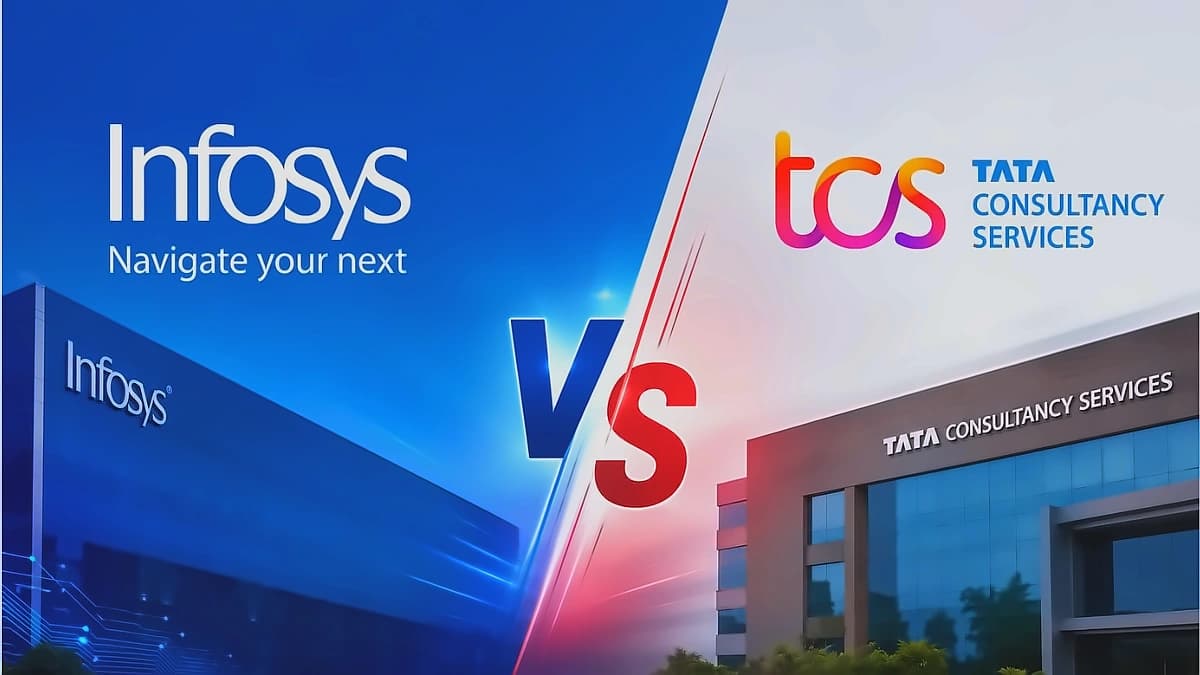
Artificial intelligence remained a key growth driver across both companies, though their approaches differed significantly. TCS's AI business reached an annualised revenue run rate of $2.6 billion during Q1 FY27, with the company highlighting several large transformation engagements including an $800 million contract with SKF. The company expanded partnerships with Anthropic, Mistral, Google Cloud and Oracle, and launched its Global Value & Innovation Centres business unit. Infosys's AI revenue accounted for 8.2% of total revenue in Q1 FY27, continuing to grow at a double-digit sequential pace, though management acknowledged that higher AI productivity expectations formed part of the reason for reducing FY27 revenue guidance. While deal signings remain strong, AI-led deflation is keeping revenue conversion subdued, according to brokerage analysis. Large deal wins in the quarter were $3.6 billion, with 61% net new, demonstrating continued client engagement despite market challenges.
The IT services sector is experiencing fundamental changes as 40-45% of change-related technology spending is going into AI and data-led transformation, according to Bain and Company's India Enterprise Technology Report 2026. Indian enterprise IT spending is expected to grow 6-8% in 2026, ahead of the 4-6% global forecast, but traditional outsourcing growth is losing its historical advantage. CRISIL Ratings forecasts Indian IT services revenue growth to stay muted at 1-3% this fiscal and next, citing AI disruption and weak discretionary spending. IBM reported Q2 2026 infrastructure revenue fell 7% with IBM Z revenue down 42%, cutting its full-year constant-currency revenue growth outlook to 4-5% as customers shifted budgets toward AI infrastructure. Wipro's Srini Pallia noted that technology investments had not slowed but become more focused, with clients requiring tighter linkage between investments and outcomes, creating pressure on traditional outsourcing models.