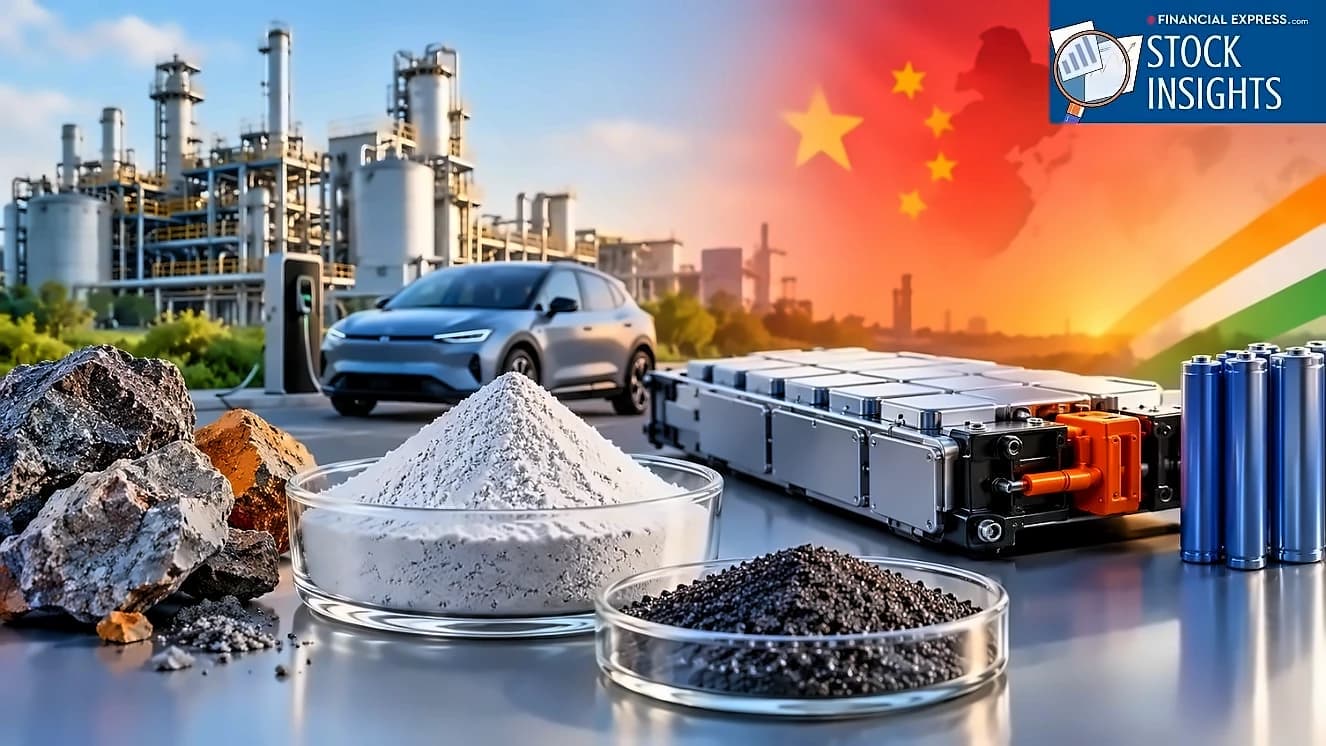
China's dominance in EV battery materials is creating significant opportunities for Indian specialty chemical companies. According to reports from The Financial Express, Lithium Iron Phosphate (LFP) batteries made up over 55% of global EV battery demand in 2025, as reported by the International Energy Agency. However, China represents nearly 98% of global LFP CAM (cathode active material) production, creating a major supply chain concentration risk. This dominance stems partly from China's cost advantage through using ferrous sulphate, a byproduct of titanium dioxide manufacturing, which relies heavily on ammonia-based processes generating significant wastewater and byproducts. The technological barrier for new manufacturers is technical know-how to reach cell compaction densities of around 2.6 g/cm³, with Chinese manufacturers working towards 2.7 g/cm³ for high-performance EV applications, while historically LFPs have had lower densities of 2.2 to 2.4 g/cm³.
Sudeep Pharma has established Sudeep Advanced Materials (SAM) as a specialized subsidiary for manufacturing battery-grade iron phosphate, a key precursor for LFP cathode active material. As reported by The Financial Express, the company has developed proprietary technology that is less polluting, does not use ammonia, and avoids generating conventional byproducts. SAM has upgraded its existing pharmaceutical facility to manufacture 5,000 MT of battery-grade iron phosphate and secured purchase orders of around 700 MT. The company is building a dedicated battery materials facility at Dahej, Gujarat, with an estimated project cost of ₹300 crore, expected to be commissioned by early 2027. Sudeep is positioning the business to meet Foreign Entity of Concern (FEOC) requirements under the US Inflation Reduction Act (IRA) and does not source phosphoric acid from China, relying instead on domestic suppliers and imports from other countries.
Acutaas Chemicals is commercialising high-purity electrolyte additives for lithium-ion batteries, marking its entry into the EV supply chain. The company manufactures four primary battery additive products: Vinylene Carbonate (VC) & Fluoroethylene Carbonate (FC), which are the first two commercial additives with manufacturing and customer shipments underway. A third battery additive began commercial shipments during Q2FY27, while a fourth product delivered pilot-scale test batches to customers for evaluation. The company has a large backlog of customer orders, with market demand significantly exceeding current supply. Previously, Acutaas produced low-margin commodity chemicals such as parabens and MS, but is scaling back these products while replacing them with higher-margin additives. Q2FY27 revenue grew 42.7% year-on-year to ₹436.9 crore, with EBITDA surging 84.6% to ₹176 crore and margins expanding to 40.3%. Management expects FY27 revenue to grow 30% with 38-40% margins.
Gujarat Fluorochemicals (GFCL) is leveraging its fluorine chemistry expertise through subsidiary GFCL EV to build a comprehensive battery materials portfolio. According to The Financial Express, GFCL EV has planned capex of around ₹6,000 crore, with GFL committing the amount till FY28, targeting asset turns of 2x and EBITDA margins of over 25%. The company's battery materials portfolio includes cathode active materials, anodes, separators and electrolytes, allowing participation across multiple stages of the battery supply chain. Major global electrolyte manufacturers have approved its lithium hexafluorophosphate (LiPF6) and LFP cathode samples have received initial customer approvals. GFL has earmarked a total Capex of ₹3,150 crore for FY27, out of which ₹2,300 crore is for battery materials, supporting expansion across its portfolio and the launch of natural graphite anode active materials.
Sudeep Pharma's Q1FY27 revenue grew 27% to ₹158.3 crore with EBITDA margin remaining healthy at 34.7%, demonstrating continued momentum from its battery-grade iron phosphate venture. As reported by The Financial Express, the company trades at 60.8x trailing earnings against the industry average of 33x. Gujarat Fluorochemicals' FY26 revenue increased 5.5% to ₹4,996 crore with EBITDA growing 11.6% to ₹1,291 crore, achieving a margin of 25.8%. The company trades at 74.6x P/E, above its five-year median of 55.9x and industry P/E of 25.2x. Acutaas Chemicals reported strong Q2FY27 performance with revenue growing 42.7% to ₹436.9 crore and EBITDA surging 84.6% to ₹176 crore, achieving 40.3% margins. Himadri Speciality Chemical's Q2FY27 revenue surged 57.9% to ₹1,691.4 crore, though EBITDA margins contracted to 17.9% from 22.2% in Q2FY26. Acutaas trades at 69.8x earnings, above its five-year median of 60.8x, while Himadri trades at 31.6x, below its five-year median of 39.2x.
Both companies are positioning to benefit from India's projected lithium-ion battery demand increase by 5X from 40 GWh in 2025 to 210 GWh by 2030, as reported by The Financial Express. Acutaas is introducing four primary battery additive products with commercial manufacturing underway, while Himadri is building a 2,000 MTPA demonstration facility for LFP cathode materials with trial production beginning in Q3FY27. Sudeep is considering increasing capacity to 200,000 MT by 2030-2031, with potential revenue of ₹1,600-1,800 crore at 100,000 MT production level. Himadri has established a 200 MTPA anode facility in West Bengal with operations beginning in April 2026, and is building India's first commercial carbon nanotube manufacturing facility of 200 MTPA. The success of these companies will depend on their ability to convert technological capabilities, customer approvals, and planned investments into commercial volumes and profitable growth. Investors need to assess whether companies can convert technological capabilities, customer approvals, and planned investments into commercial volumes and profitable growth.