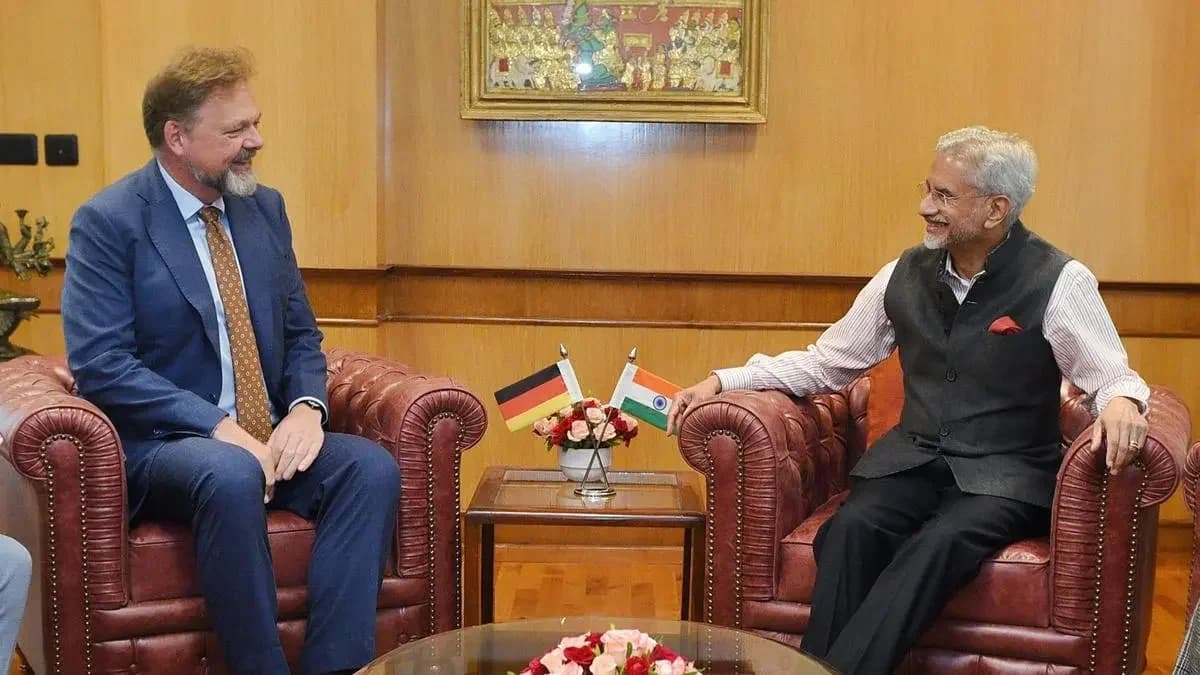
India and Germany are set to finalize their submarine cooperation agreement 'very soon', with German Ambassador Philipp Ackermann confirming the deal will be signed next month. Speaking at the Indo-German Industries Dialogue organized by the Indo-German Chamber of Commerce (IGCC), Ackermann expressed 'very hopeful and confident' that the agreement will be signed within the next month. The diplomatic confirmation comes as both nations work to formalize their strategic defense partnership, with the ambassador's statement indicating the deal is in its final stages of negotiation and approval processes. Germany's defence minister, Boris Pistorius, has since indicated a contract signature within months, following his April meeting in Kiel with his Indian counterpart, Rajnath Singh.
The submarine agreement represents a massive ₹90,000 crore investment (estimated €8 billion) for India's defense modernization under the Project-75I program. The deal encompasses six next-generation conventional submarines to be built in India for the country's navy, marking a significant milestone in India-Germany defense cooperation. According to the latest reports, the program is now valued in the ₹70,000-90,000 crore range, with cost negotiations concluded earlier this year. The partnership will involve Germany's ThyssenKrupp Marine Systems (TKMS) and India's state-owned Mazagon Dock Shipbuilders, with the agreement expected to be signed by both companies. This move is set to boost India's navy and marks a big step in defense teamwork between the two countries.
The submarine agreement represents a significant milestone in India-Germany defense cooperation, with both nations working to formalize their strategic partnership. The deal encompasses submarine technology and defense cooperation between the two countries, with the partnership expected to strengthen bilateral defense ties and enhance India's submarine capabilities through German expertise and technology. The next-generation submarines will be built specifically for India's navy, representing a substantial upgrade to the country's underwater defense capabilities. The partnership highlights stronger Indo-Germany ties and supports India's 'Make in India' push, meaning more high-tech defense gear built locally and less reliance on imports. Under the 'strategic partnership' model, indigenous content starts at 45% on the first boat and is contracted to climb to 60% by the sixth submarine, with TKMS obliged to transfer genuine design and manufacturing know-how rather than merely supervise assembly.
German Ambassador Philipp Ackermann revealed that India's expanding renewable energy capacity could soon help turn the country into an energy exporter, with Germany potentially emerging as a buyer of Indian green hydrogen in the coming years. Speaking at the Indo-German Industries Dialogue, Ackermann highlighted that renewable energy had emerged as one of the strongest pillars of India-Germany ties. He described visiting Adani Group's renewable energy project in Kutch, Gujarat, where he witnessed the scale of India's renewable energy generation capabilities and very ambitious plans for green hydrogen. The ambassador noted that discussions are moving towards concrete projects in hydrogen technologies, with Germany's ministry working together with India on hydrogen initiatives. He also highlighted the memorandum of understanding between ThyssenKrupp and Bharat Heavy Electricals Limited (BHEL) to advance localization of alkaline water electrolyzer technology, emphasizing the importance of combining electrolysis technology with strong local engineering and manufacturing to support green hydrogen projects.
The submarine deal announcement has generated significant market interest, with the development being reported as a key development in India's defense sector. The cooperation agreement is expected to involve Mazagon Dock Shipbuilders, India's state-owned defense shipbuilder, which has been identified as the primary beneficiary of the submarine construction and technology transfer arrangements. The ₹90,000 crore investment represents one of the largest defense deals between India and Germany, with both companies positioned to benefit from the strategic partnership and India's defense modernization initiatives. The ripple effects extend well beyond MDL's gates, with Steel Authority of India developing specialized corrosion-resistant steel for the project, Exide Industries supplying submarine batteries, and Bharat Electronics gaining from sonar suites and electronic-warfare equipment. The program will also benefit over 200 small and medium enterprises supplying forgings, cabling, and precision components, supporting India's broader defense manufacturing ecosystem.
Mazagon Dock Shipbuilders (MAZDOCK) shares have taken center stage on Dalal Street amid market buzz around the mega submarine order. The stock rose as much as 1.4% to ₹2,341 apiece on BSE after the news, though it later settled with a gain of 0.2% at ₹2,313 apiece. At current levels, the Navratna CPSE stock has declined 6.7% so far this year, in line with a 7.1% drop in the Nifty 50 index. The Cabinet Committee on Security (CCS) is set to give clearance for the deal soon, with the CCS being the apex decision-making authority for national defense and strategic affairs, whose approval is required for major defense procurements in the country.