India has emerged as the world's largest producer of carbon black, a critical industrial material used in EV batteries and tyres. According to reports from The Financial Express, India's carbon black export is growing at a 20% CAGR, 5X faster than China's 4%. The country overtook China as the EU's largest carbon black supplier in just 3 years, demonstrating its rapid market penetration. This transformation from a net importer to net exporter in FY22 positions India as a major beneficiary of the global EV supply chain shift. The global carbon black market had undergone a hard reset even before the EV demand story fully emerged, with Russia previously being one of the largest exporters to Europe until EU sanctions effectively pushed Russian carbon black out of the European supply chain, creating opportunities for alternative suppliers.
The traditional perception of carbon black as a cyclical commodity chemical is evolving into a higher-value advanced materials business. As reported by The Financial Express, when produced with precision and tighter control over structure, carbon black becomes specialty carbon black used in lithium-ion batteries, conductive plastics, electronics manufacturing, and semiconductors. This transformation is driving better economics and pricing power, with Himadri Speciality Chemical's EBITDA margin expanding from around 6% in FY22 to nearly 22% in FY26. Producing specialty carbon black is technologically complex, requiring very high consistency in quality and process, with customers often testing suppliers for several quarters before approval. Once approved, companies rarely switch suppliers because even small quality differences can affect product performance, resulting in structurally better economics and pricing power with demand less dependent on market cycles.
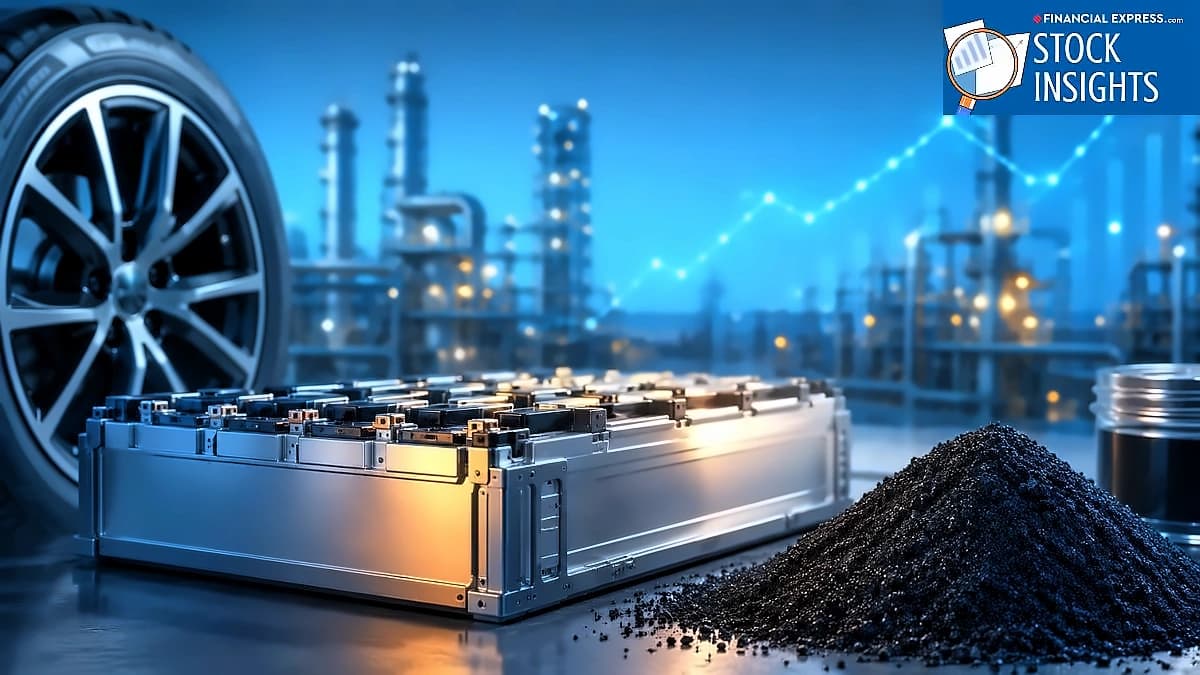
Specialty carbon black serves as a critical conductive additive in lithium-ion batteries, improving conductivity between particles of active material and enabling efficient electricity flow through the battery. According to The Financial Express, EV tyres consume more carbon black than ICE vehicle tyres due to their heavier weight (20-30% more than ICE vehicles) and instant torque production during acceleration. This increased demand is driving the transition from commodity-grade to specialty products with much higher margins. EVs are significantly heavier because of their battery packs, often by 20-30% compared to ICE vehicles, and they also produce instant torque, putting significant stress on tyres during acceleration. To solve these issues, tyre makers had to build stronger, longer-lasting tyres specifically for EVs, where carbon black becomes critical.
PCBL Chemical, the 6th largest global carbon black producer, has shown mixed results with 5-year compounded sales growth of 25% but profit decline of 7% CAGR. As reported by The Financial Express, the company's European market share increased from 4% to over 21% in the past two years, though it faces challenges from the ₹3,800 crore Aquapharm acquisition integration. Himadri Speciality Chemical demonstrates stronger fundamentals with 5-year compounded profit growth of 74% and operating margin expansion from 8% to 21%. The company's free cash flow at the end of FY26 was ₹121 crores, giving it flexibility to invest in future growth opportunities. Himadri operates one of the world's largest single-site specialty carbon black facilities at Mahistikry in West Bengal, with an annual capacity of around 130,000 tonnes, and is working on commissioning an LFP cathode active material plant with annual capacity of around 40,000 tonnes starting Q3FY27.
The valuation gap between the two companies reflects different investor perceptions of their business models. According to The Financial Express, PCBL trades at a PE of 53, significantly above its historical median of 19, while Himadri commands higher valuations due to its transition toward specialty materials. At the moment, the market is viewing PCBL more as a contra opportunity facing temporary operational and balance-sheet stress, while Himadri is being treated as a growth stock with investors willing to pay a premium for its exposure to specialty materials, battery chemicals, and the broader EV supply chain. Both companies are positioned to benefit from India's emergence as a critical supplier in the global carbon black market, with PCBL representing the scale and export story and Himadri representing the industry's move toward higher-value advanced materials.