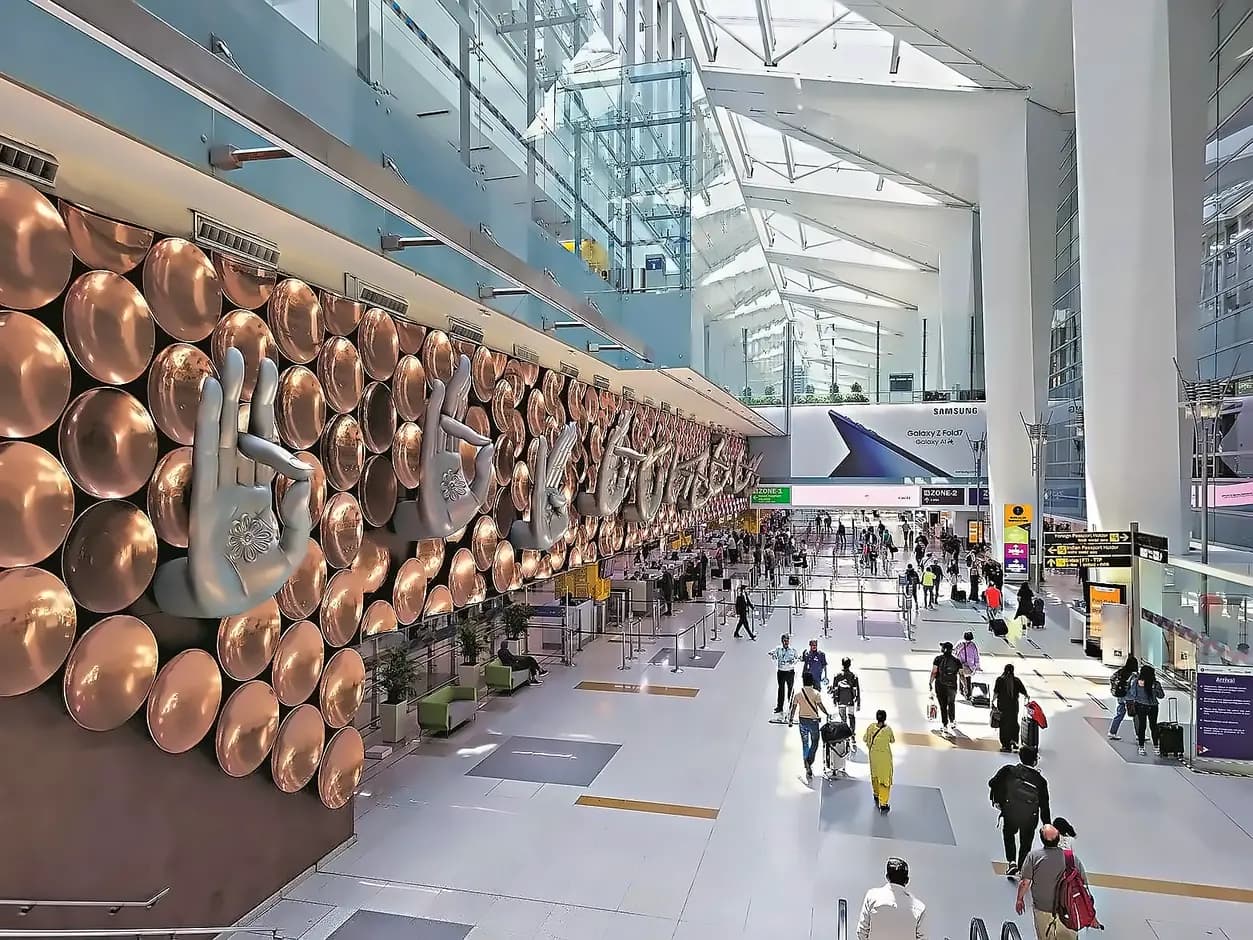
GMR Airports achieved a record 30.22 million passengers in Q1 FY27, marking the highest-ever first-quarter traffic across its portfolio. According to latest reports, Delhi Airport handled a record-breaking 2.04 crore passengers in Q1 FY27, representing a 6.9% year-on-year increase and contributing approximately 68% of total traffic. Delhi Airport's cargo volumes rose 12.3% year-on-year to approximately 3.1 lakh metric tonnes during the quarter. The airport also handled record aircraft movements, with domestic air traffic movements (ATMs) reaching approximately 95,000, an 8.4% increase. The company's diversified business model spans airport operations, power generation, coal mining, highway development, and special economic zones.
GMR Airports shares declined 1.56% to ₹110.10 following the release of June 2026 passenger traffic data. The company handled approximately 9.76 million passengers in June 2026, representing a marginal 0.3% year-on-year decline. The traffic decline was primarily driven by domestic passenger traffic, which fell 0.4% YoY to 7.4 million, while international passenger traffic remained relatively stable at 2.4 million, up 0.1% YoY. As per Business Standard, the company attributed the international traffic decline to ongoing geopolitical instability in West Asia since February 28, 2026. The stock closed at ₹112.00 on the NSE on July 15, down 1.22% or ₹1.38 from the previous close.
As reported by Business Standard, Delhi Airport demonstrated strong performance with 6.58 million passengers in June 2026, marking a significant 6.8% YoY increase and supported by an 8.6% rise in domestic traffic. In contrast, Hyderabad Airport experienced a decline with 2.29 million passengers, down 12.9% YoY, while Mopa (Goa) reported a 17.6% drop to 0.34 million passengers. International airports in Medan (Indonesia) and Cebu (Philippines) also experienced declines of 6.2% and 7.2% respectively. Hyderabad Airport reported its highest international passenger and ATM figures since February 2026, with international traffic reaching 0.43 million in June 2026. Aircraft movements across all airports decreased 2.4% YoY to 59,758 in June 2026. The company noted that monthly passenger traffic has remained around the 10 million mark since October 2025. In its May business update, the company had informed that it handled around 11 million passengers in May 2026 across its portfolio airports, up 6.1% year-on-year.
In a significant development, GMR Airports commenced commercial operations at Nagpur Airport following privatization on June 25, 2026, with the handover of approximately 1,000 hectares of land. The company has laid out a ₹300 crore phase-one expansion plan to boost capacity to 30 million passengers per annum over the concession period. Meanwhile, Bhogapuram Airport construction reached 99.73% completion as of June 30, 2026, setting the stage for a Q2 FY27 launch. The Airports Economic Regulatory Authority of India (AERA) released a consultation paper on June 19, 2026, regarding the determination of aeronautical tariffs for Hyderabad Airport for the fourth control period from April 1, 2026, to March 31, 2031. At Nagpur Airport, GMR plans to invest ₹500-600 crore in maintenance, upgrades and expansion as it prepares a long-term master plan to increase capacity over time. The operational integration of Nagpur Airport and the near-completion of Bhogapuram Airport build a strong growth runway for H2 FY27, positioning the company well for medium-term growth despite short-term West Asian headwinds.

As reported by Business Standard, GMR Airports reported a consolidated net profit of ₹302.35 crore in Q4 FY26, compared with a net loss of ₹237.59 crore in Q4 FY25. Revenue from operations increased 37.54% year-on-year to ₹3,938.16 crore for the quarter ended March 31, 2026. The company's record Q1 performance validates the long-term structural tailwinds of Indian aviation, with the Indian aviation market experiencing a structural shift, positioning itself as one of the fastest-growing globally. Despite airline capacity challenges and route rationalization, consolidated operators like GMR, who handle nearly 30% of India's air passenger traffic, are leveraging tariff revisions and expanding non-aeronautical retail businesses across West Asia and Europe to offset slower domestic passenger growth.