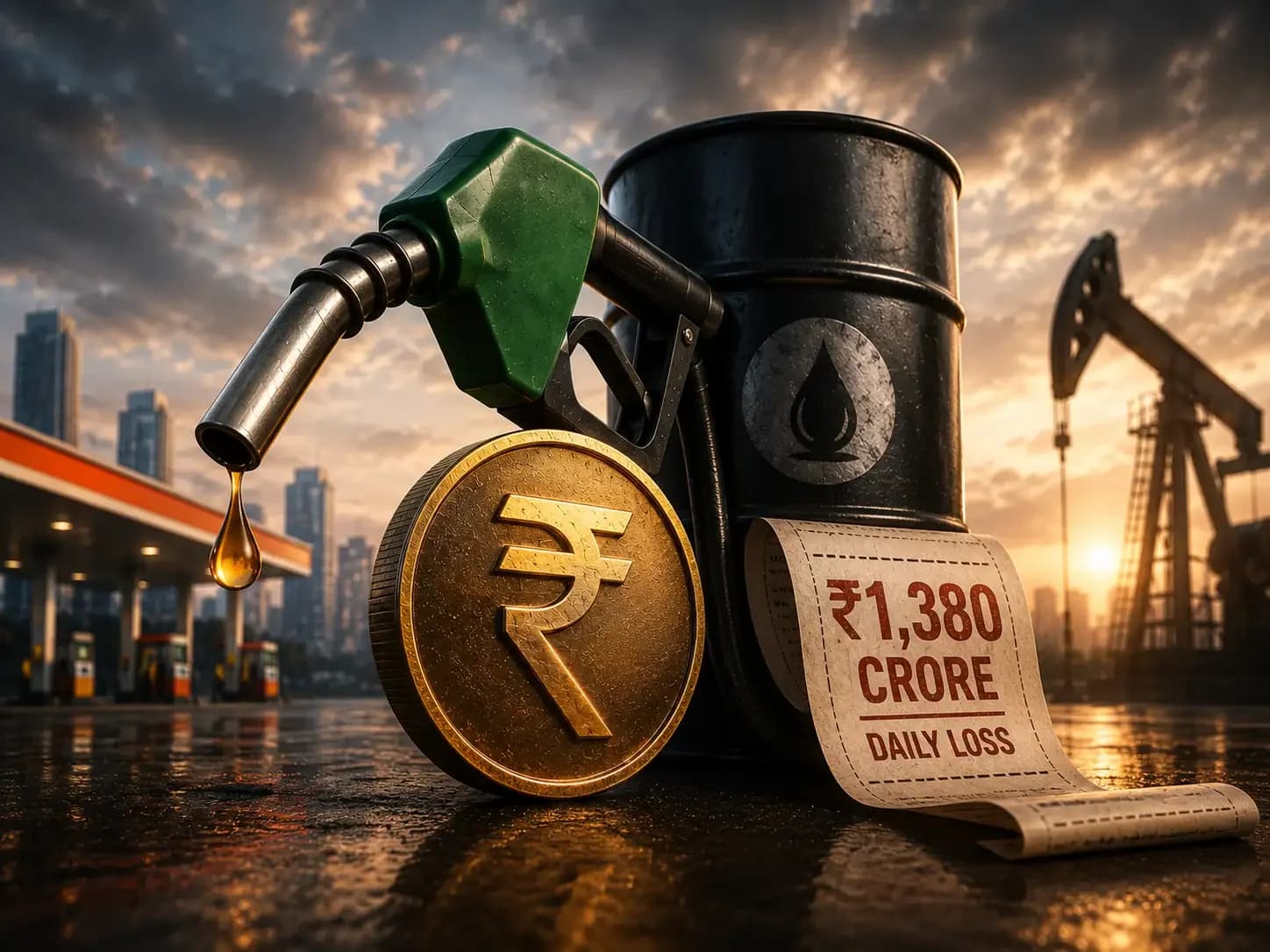
Indian fuel retailers are facing severe financial distress despite recent government intervention. According to reports from The Economic Times, analysts estimate that oil marketing companies (OMCs) are currently losing ₹25 per litre on petrol and diesel on a blended basis, resulting in a staggering daily loss run rate of ₹1,380 crore when including LPG. Even after the government hiked petrol and diesel prices by ₹3 per litre last week, the under-recoveries persist, with analysts warning that another ₹25 per litre price hike would be necessary to break even on marketing margins. The ongoing geopolitical tensions and fluctuations in global oil prices contribute to this precarious situation for Indian fuel retailers, who are caught in a squeeze between maintaining profitability and keeping fuel prices affordable for consumers.
As reported by The Economic Times, HPCL faces the most severe exposure due to higher marketing exposure relative to refining capacity. Nomura estimates the company is currently making losses of $19 per barrel on an integrated basis, while IOCL is losing $4 per barrel and BPCL* $8 per barrel**. This compares unfavorably to the $12–14 per barrel margins all three companies were generating just before the current oil shock began. Elara Capital's Gagan Dixit notes that HPCL is the most vulnerable OMC because of its higher retail marketing exposure relative to refining capacity.
According to calculations by Nomura analyst Bineet Banka, at the current run rate of integrated losses, IOCL, BPCL, and HPCL would completely exhaust their balance sheet equity within 10, 4, and 2 years respectively, if losses continue unchecked. As reported by The Economic Times, Elara estimates that the ₹3 per litre hike will reduce annualized gasoline and diesel integrated losses by approximately ₹34,500 crore on an annualized basis. However, brokerages warn that unless crude oil prices correct, further retail price hikes or additional fiscal support would be required. Market experts generally believe that unless crude oil prices stabilize, Indian fuel companies will have no choice but to increase prices further, creating a precarious balancing act as they need to maintain profitability while ensuring consumers are not priced out of the market.
To cushion OMC losses, the government reinstated the Special Additional Excise Duty mechanism on standalone refiners on March 26, effectively capping refining margins for players with limited retail exposure. According to The Economic Times, the SAED on diesel was revised to ₹16.5 per litre on May 15, its third revision, partially offsetting the approximately ₹27.6 per litre under-recovery on diesel for OMCs. An excise duty cut of ₹10 per litre on petrol and diesel was also announced in March, though analysts caution this relief may prove temporary. The current crisis in fuel pricing reflects global oil market dynamics, with crude oil prices fluctuating due to various geopolitical factors, forcing Indian fuel companies to balance between maintaining profitability and keeping fuel prices affordable for consumers.
As reported by The Economic Times, the current ₹3 per litre hike may be just the opening move, with Nomura drawing parallels to 2022 when fuel prices were held flat for nearly a month during the Russia-Ukraine conflict. The brokerage suggests this could be the start of further gradual hikes to support OMC margins if crude prices remain elevated. For Indian consumers, potential increases in fuel prices could lead to higher transportation costs and inflation, with the ripple effect affecting everything from daily commutes to the prices of goods and services across the economy. The situation is fluid, and any significant geopolitical developments could change the landscape dramatically, making it crucial for investors to monitor global crude oil trends and fuel pricing policies closely in the coming weeks.