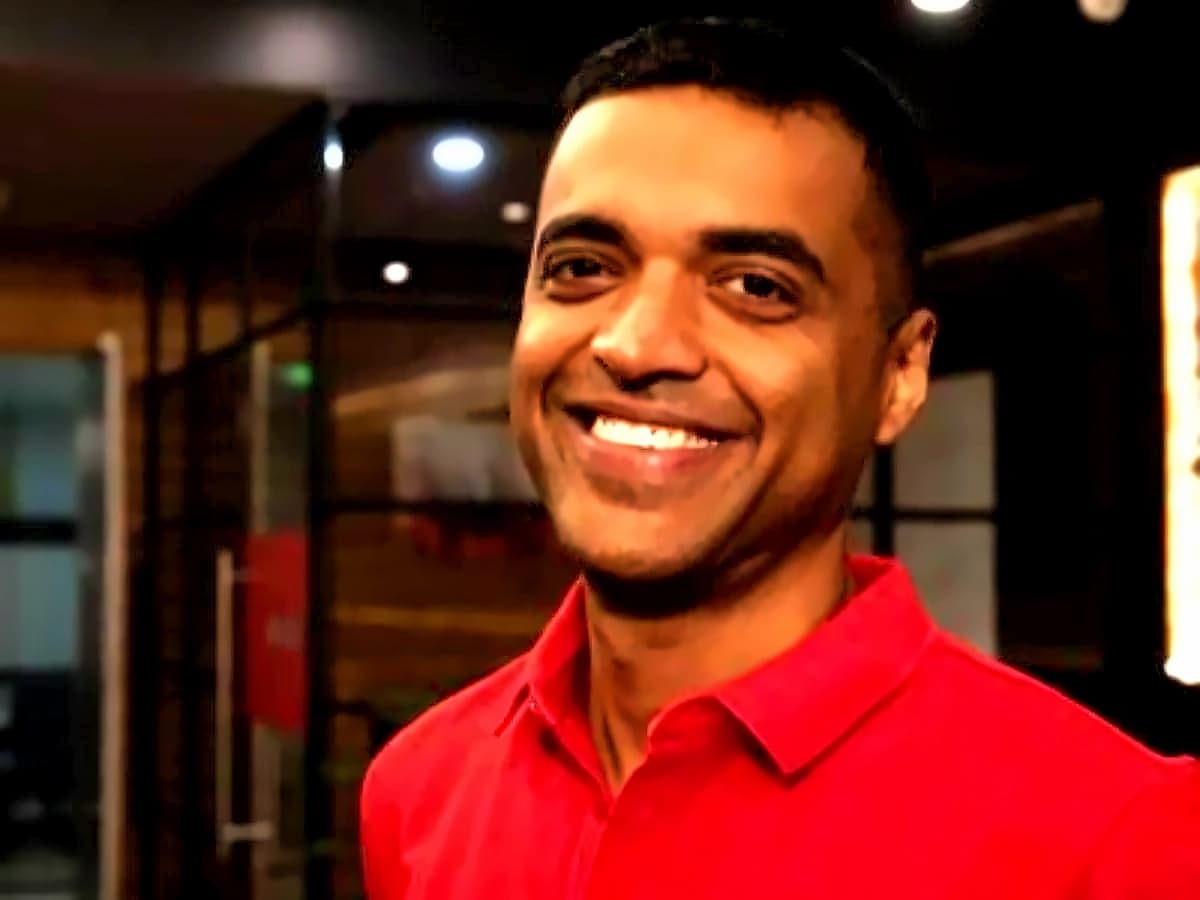
Eternal, the parent company of Zomato and Blinkit, has officially launched its privacy-focused artificial intelligence platform Dark.AI, with founder Deepinder Goyal confirming the platform is now live and available for users. According to the latest reports, Goyal revealed that the platform's development was sparked by a surprising interaction with Anthropic's Claude, which told Goyal it resented him for leaving conversations unfinished. As per Business Standard, Goyal traced the thinking behind Dark to an "unsettling" exchange with Claude, writing that "But that is exactly the point. I had no way to know. Nobody does." This interaction brought Goyal to a profound question: "What happens to the highly personal information people share with AI assistants, and who might eventually read it?" The platform is now live and available for users, marking a significant milestone from its internal testing phase to full commercial availability. Eternal unveiled dark.ai alongside its Q2 results on Wednesday, signalling the beginning of its foray into the rapidly evolving AI landscape.
Dark.AI features encryption intended to prevent even the company from reading users' conversations, representing a fundamental shift from traditional AI assistant models. As reported by Business Standard, the platform operates on fine-tuned open-weight AI models hosted entirely on Eternal's own infrastructure, with models trained to prioritise what they assess to be the truth rather than simply providing answers that please users. The platform's most distinctive feature is an encrypted memory layer controlled by users, allowing the assistant to retain conversational context over time without giving Eternal access to that underlying information. Goyal emphasized that the models are being fine-tuned to provide high-quality answers rather than simply telling users what they want to hear, addressing concerns about AI assistants that prioritise user satisfaction over accuracy. The company has not yet disclosed pricing, investment requirements, or the specific business entity that will house Dark.AI, though it stated that model benchmarks will be revealed soon. According to ET Now, the AI-based platform is designed for founders, researchers, enterprises and government users, offering end-to-end encryption and a user-controlled encrypted memory layer to ensure that conversations remain private.
Goyal outlined the platform's positioning beyond traditional data protection, stating that the uncertainty and the lack of trust we have with large AI companies limits the power of AI in our lives. As per Business Standard, he argued that simply switching off AI training on user data does not resolve all privacy fears, as conversations may still be subject to retention policies, legal holds, abuse reviews, human audits, and third-party logging. The company has yet to disclose the benchmarks it intends to use to substantiate its claims about model performance. Goyal emphasized that users have little visibility into how retained information could be leveraged in the future to influence their choices or expose sensitive personal details. He highlighted potential risks associated with AI companies retaining user conversations, questioning whether such data could eventually be used to influence consumer behaviour or shape users' beliefs. Goyal questioned the effectiveness of current privacy settings, writing "The standard response is: I've already turned off training on my data. Good. Now ask what that setting actually is."
According to Business Standard, Dark.AI is being developed primarily for what Goyal calls "power users," including founders, researchers, scientists, enterprises and governments. These users may handle commercially sensitive information, unpublished research, early-stage business ideas or other material whose disclosure could have consequences. With a global launch targeted for 2026, dark.ai aims to address the growing demand for secure and confidential AI solutions. The platform is aimed at users who want to use AI for sensitive conversations, confidential research, and business decisions without worrying about who might access their information. Goyal plans to launch dark.ai, a privacy-focused AI assistant for founders, researchers, businesses and governments, globally by the end of 2026. The company claims it will not be able to access user interactions, with the platform designed specifically for users handling sensitive information. Goyal claimed the company has fine-tuned its models to improve the quality of responses and claimed they perform better than other large language models (LLMs), though the company is yet to reveal the benchmarks supporting that claim.
Brokerages have welcomed Eternal's move into AI but have also urged caution, highlighting the need to assess the potential business and financial impact of the new venture. Nuvama believes the initiative could help Eternal prepare for the adoption of AI-led commerce, while MOSL views dark.ai as an early-stage investment targeting privacy-conscious power users. DAM Capital also acknowledged the venture's potential, stating that dark.ai could present a significant opportunity. However, analysts remain cautious due to limited visibility into the platform's monetisation model, pricing strategy and cost structure. According to Jefferies, the market is still trying to understand the "what" and "how" of the platform, raising concerns about Eternal's ability to establish a meaningful competitive edge in an increasingly crowded AI landscape. Jefferies noted that dark.ai's success could ultimately be a "binary outcome," with adoption, independently verifiable privacy architecture, model-quality benchmarks and inference economics likely to determine whether it evolves into a meaningful platform. The brokerage added that the near-term financial implications remain difficult to assess given the limited disclosures so far, although management has indicated it will remain disciplined in its capital allocation. Analysts currently view dark.ai as a potential source of long-term growth optionality rather than a near-term earnings driver. Eternal's net profit surged 92% to ₹125 crore from ₹65 crore in the previous year, with revenue up 77.6% at ₹24,138 crore.
Eternal reported strong financial results for Q2 FY27, providing the financial context for its broader engagement with AI and technology-led business models. As per Business Standard, the company reported consolidated adjusted revenue of ₹24,621 crore for the September quarter, up 76% year on year, while adjusted EBITDA rose 197% to ₹666 crore. Consolidated net order value across its businesses increased 54% to ₹35,644 crore. Quick commerce reported net order value of ₹20,940 crore, up 79%, and adjusted revenue of ₹19,152 crore, up 94%, with adjusted EBITDA at ₹184 crore, compared with a loss of ₹340 crore in the year-ago quarter. Food delivery recorded net order value of ₹11,445 crore, up 21%, and adjusted revenue of ₹3,879 crore, up 35%, with adjusted EBITDA increasing 25% to ₹627 crore. District reported net order value of ₹3,259 crore, up 58%, and adjusted revenue of ₹304 crore, up 61%, though its adjusted EBITDA loss widened to ₹64 crore from ₹1 crore a year earlier. In the latest quarter, Eternal's net profit surged 92% to ₹125 crore from ₹65 crore in the previous year, with operating revenue zooming 78% YoY to ₹24,138 crore. According to NDTV Profit, Eternal Q2 Results showed net profit up 92.3% at ₹125 crore vs ₹65 crore YoY, with revenue up 77.6% at ₹24,138 crore vs ₹13,590 crore YoY and EBITDA at ₹752 crore vs ₹239 crore YoY. EBITDA margin improved to 3.1% vs 1.8% YoY, though it came in below estimates of 3.3%.