Energy In Motion (EIM), an associate company of Ravindra Energy, has executed a Letter of Agreement (LOA) with Contemporary Amperex Technology Co. (CATL) to establish a supply partnership for 500 MWh of Lithium Iron Phosphate (LFP) cells and battery pack kits in India. According to reports from Business Standard, this partnership positions EIM as the launch customer for CATL's new generation battery systems in the Indian market. The agreement provides EIM with access to CATL's latest CB710 battery cell and L324D06 battery pack platform, replacing the earlier generation CB230 cells currently deployed in its fleet.
Under the agreement, CATL will supply 0.5 GWh of its LFP cells consisting of the upgraded CB710 cell Model & L324D06 battery pack platform. As reported by Business Standard, this latest cell and pack model for heavy commercial vehicles has significantly higher cycle life and volumetric density compared to the previous cell model CB230 used by EIM. The packs will be configured into 400.6 kWh systems for integration into EIM's E-Tractor 4x2 Ashwa series. The improved battery chemistry is expected to enhance vehicle uptime while lowering lifecycle operating costs for fleet operators, offering significantly higher energy density, longer operating life, and improved durability. For companies building battery-swapping ecosystems, battery chemistry and cycle life directly influence fleet economics, with longer-lasting batteries meaning more charging cycles before replacement and higher energy density allowing trucks to cover greater distances between swaps without increasing battery size.
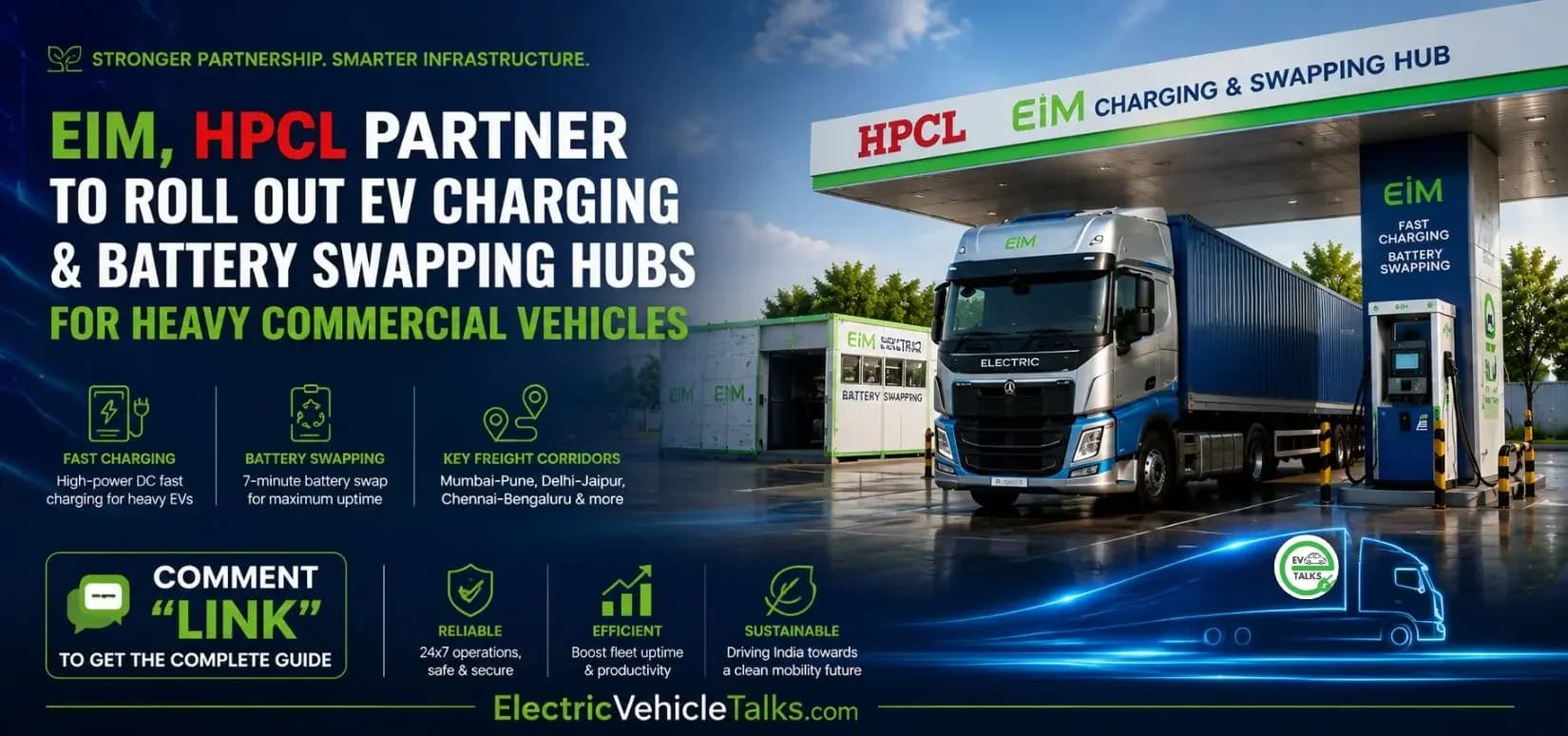
According to Business Standard, EIM will be fitting these battery systems into swappable battery boxes that are customized for India's high ambient temperature operating conditions. The company is building an electric heavy commercial vehicle ecosystem including megawatt-scale charging/swapping stations across the country, with its first electric heavy vehicle, the Ashwa 55-ton e-tractor, launched on August 1st, 2025. The improved battery chemistry is designed specifically for EIM's E-Tractor 4×2 Ashwa heavy electric truck platform, with the company becoming the first customer in India to deploy CATL's next-generation battery architecture for commercial freight applications. Unlike passenger EVs, long-haul freight operators typically prioritise vehicle uptime over charging duration, with battery swapping addressing this challenge by reducing turnaround time while requiring dependable battery supply, standardised battery architecture and a large network of operational swap stations.
As reported by Business Standard, EIM has already commissioned six heavy-duty swap stations in the Delhi-NCR region and JNPA port area with a daily swap capacity of 840 battery swaps/day. The company is targeting 40 operational heavy commercial vehicle swap cum charging stations by the end of March 2027, with the expansion planned across key freight corridors. Each swap station is expected to support a daily battery swap capacity of around 840 swaps, suggesting that reliable access to battery supplies becomes as important as vehicle manufacturing itself. This infrastructure development is crucial for translating the alliance into sustainable long-term growth, as fleet operators increasingly prefer battery-swapping solutions that minimize vehicle downtime and improve operational efficiency compared with conventional charging infrastructure.
The partnership follows Ravindra Energy's recent investment of nearly ₹150 crore in EIM through a rights issue, increasing its shareholding to 49.54 percent and reaffirming electric commercial mobility as a long-term growth priority. According to Trade Brains Technologies, the capital infusion is expected to support fleet expansion, battery procurement, infrastructure development, and repayment of existing inter-corporate borrowings. Ravindra Energy delivered a strong turnaround during FY26, with consolidated revenue more than doubling to ₹543 crore from ₹250 crore in FY25, while net profit surged to ₹81 crore compared with ₹22 crore in the previous financial year. The company's operating margin expanded to around 24 percent from 17 percent year-earlier, with ROCE rising to 15.9 percent and ROE reaching 21.2 percent. The CATL agreement addresses one of the biggest execution risks for any battery-swapping business: securing consistent cell availability from a global manufacturer while scaling operations, with CATL remaining the world's largest battery manufacturer, accounting for roughly 39.2% of global battery market share in 2025.