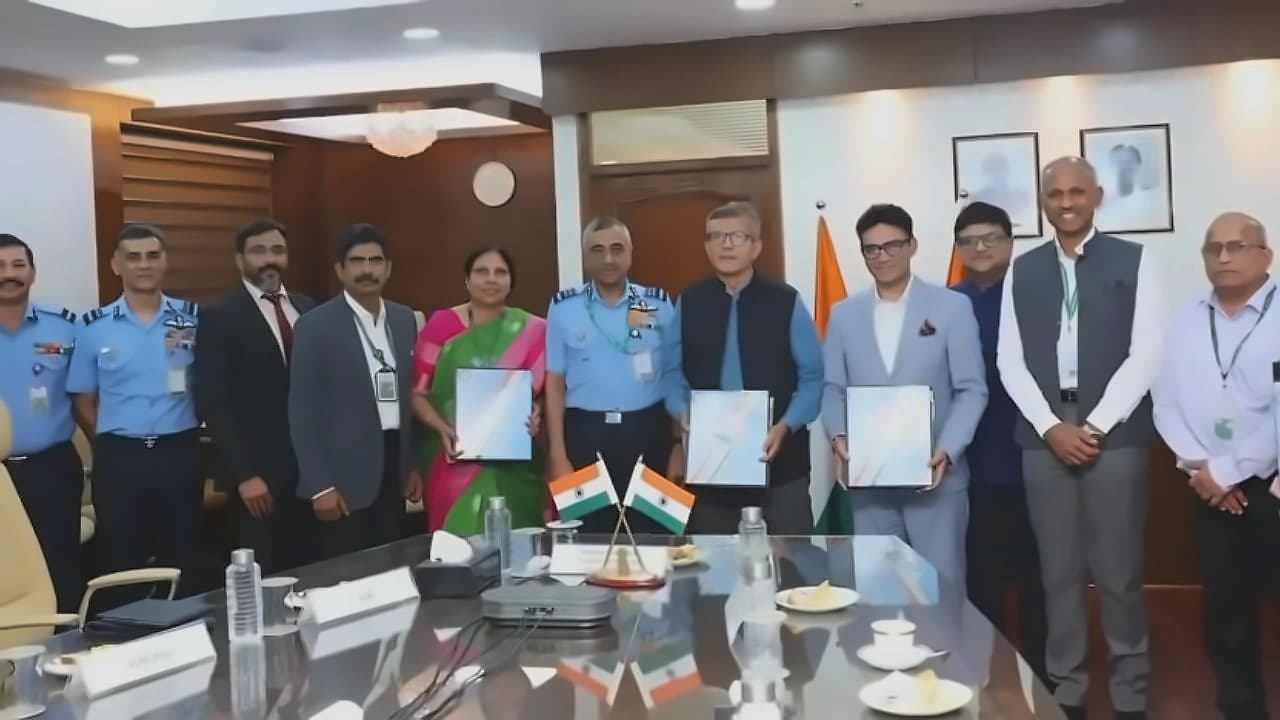
The Defence Research and Development Organisation (DRDO) on July 22, 2026 signed two significant contracts with AI Engineering Services Limited (AIESL) and Adani Defence Systems and Technologies Limited (ADSTL) as part of the AEW&C MK-II programme under the Government's Aatmanirbhar Bharat initiative. According to the defence ministry statement, the contracts were signed by Director CABS with CEO, AIESL and Head-Airborne Platform, ADSTL in the presence of Defence Secretary and DRDO Chairman Rajesh Kumar Singh in New Delhi. The engagement of industries reaffirms the government's commitment to achieve self-reliance for fostering a robust ecosystem towards innovation, research and manufacturing within the country.
The DRDO's Centre for Air Borne Systems (CABS) signed a contract with AI Engineering Services Limited (AIESL) for conversion of six Airbus A321 aircraft from commercial to green configuration, further leading to the development and production of Airborne Early Warning & Control (AEW&C) Mk-II programme. As reported by the defence ministry, CABS, DRDO with support from ADSTL as Development Cum Production Partner (DcPP) is responsible for integration of mission systems on modified AEW&C MK II Platform, delivered by Airbus Defence & Space (Original Equipment Manufacturer). The conversion involves stripping down six A321 aircraft for decisive engineering to increase endurance, with bigger fuselage tanks and advanced system integration recommended by the IAF. This stage prepares the aircraft for the installation of specialised military systems and equipment required for airborne surveillance operations, with the modified aircraft later being delivered by Airbus Defence & Space for further integration by DRDO.
CABS and ADSTL will jointly integrate the advanced mission systems onto the modified aircraft before carrying out flight trials in collaboration with the Indian Air Force. The aircraft will then undergo certification by the Centre for Military Airworthiness and Certification (CEMILAC) and Directorate General of Aeronautical Quality Assurance (DGAQA) before entering service. The deal between Adani and DRDO also includes integrated logistics, maintenance, repair and overhaul (MRO), and technical support for up to 30 years. According to the ministry statement, the AEW&C Mk-II System from DRDO with CABS as the nodal laboratory will provide enhanced endurance, advanced airborne surveillance, secure communication, improved situational awareness and enhanced command and control capabilities. This system will give a significant boost to the air defence capabilities and aid in neutralising threats across extended ranges.
The AEW&C Mk-II programme represents a significant boost to the Aatmanirbhar Bharat initiative, focusing on indigenous defence manufacturing capabilities. The system is expected to provide a significant enhancement over India's existing airborne early warning platforms, featuring longer operational endurance, advanced airborne surveillance, secure communications, improved situational awareness and stronger command-and-control capabilities. These features will enable the Indian Air Force to detect, track and respond to aerial threats over much larger distances, significantly enhancing the country's air defence network. The AEW&C-MKII will place India in the select group of five countries—the United States, France, Israel, China, and Sweden—that have developed such indigenous capabilities critical to modern warfare. By involving domestic companies in both aircraft modification and mission system development, the AEW&C Mk-II programme is expected to strengthen India's aerospace manufacturing capabilities while reducing dependence on foreign suppliers for critical airborne surveillance systems. DRDO said the participation of Indian industry in the programme reflects the government's continued focus on building a strong domestic ecosystem for defence research, innovation and manufacturing.