While most quick commerce players are rapidly scaling warehouses across multiple cities, DMart is taking a different approach with DMart Ready scaling down from 24 cities in Q1 2025-26 to 11 cities in Q1 2026-27. According to reports from The Financial Express, this deliberate choice focuses on profitable operations rather than rapid expansion. Competitors like Blinkit operate in over 300 cities, Swiggy's Instamart in close to 200 cities, and Zepto in more than 80 cities, contrasting sharply with DMart's more measured approach. The latest CLSA report reveals that quick commerce has expanded to 477 cities beyond major metros, with companies increasingly using smaller dark store footprints to assess local demand before scaling presence.
Despite revenue growth, quick commerce players face significant profitability challenges. As reported by The Financial Express, Swiggy reported revenue of ₹6,812 crore in Q1FY27 with 37.3% YoY growth, but maintained a PAT margin of -11.6%. In comparison, DMart Ready achieved revenue of ₹4,093.61 crore in FY2025-26 with a consolidated loss of ₹306.53 crore, giving it a PBT margin of -7.49%. The analysis shows DMart's better return metrics with EV/EBITDA of 45.80 compared to Swiggy's -32.81, and ROCE of 17.18% versus Swiggy's* -24.08%**. Recent developments show Blinkit maintaining the largest network with 969 stores followed by Zepto with 828 stores, while Flipkart Minutes has surpassed Swiggy Instamart in dark store count across India's top 10 cities.
According to The Financial Express analysis, DMart Ready demonstrates significant operational advantages over competitors. The company's delivery burden on orders of ₹2,000 is estimated at only 1.5% compared to Blinkit's 15%, Zepto's 12%, and Instamart's 14%. DMart operates with over 40,000 sq ft hypermarkets versus competitors' average warehouse space of 1,500-4,000 sq ft. The company's average retail space per store is over 40,000 sq ft with a store count of 500, supporting its higher basket size strategy. Recent market data shows that Blinkit accounts for approximately 30% of the combined dark-store network across the 10 cities and more than 34% nationally, with the platform having the largest network in six of the 10 cities.
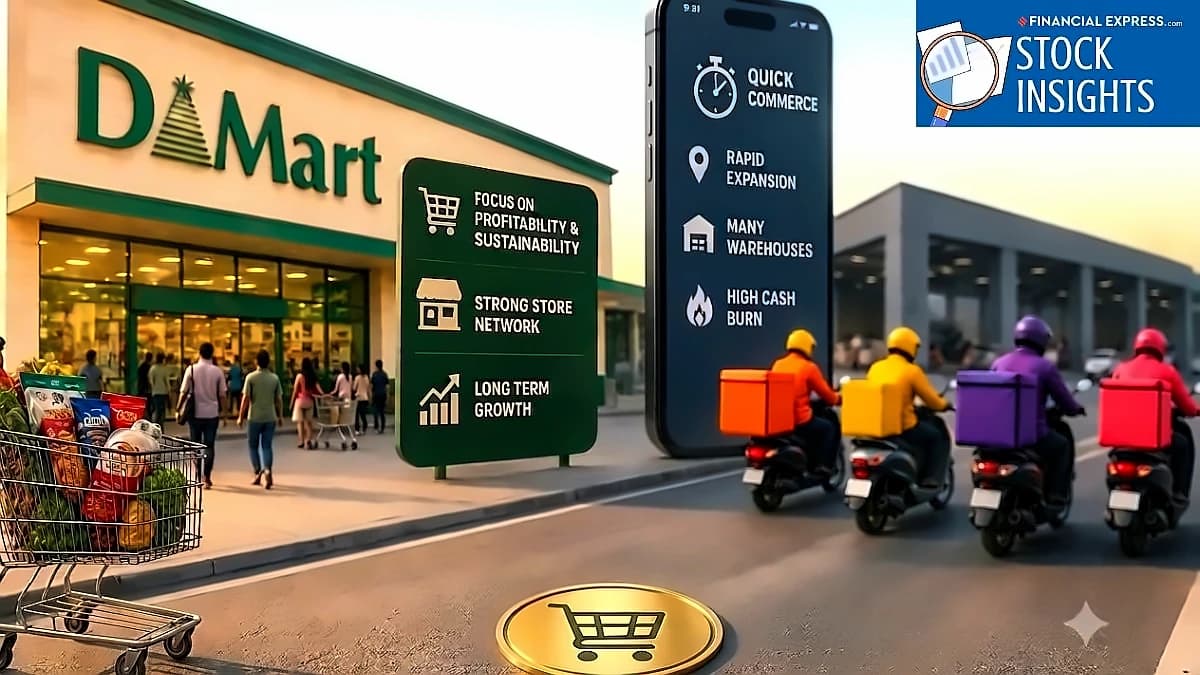
As reported by The Financial Express, DMart continues aggressive physical expansion with over 500 stores after adding 85 stores in the recent quarter. The company projects 15% YoY store count growth and aims to reach 1,000 stores by 2030. This contrasts with quick commerce players' warehouse-focused approach, with Blinkit operating over 2,200 warehouses and Instamart over 1,100 warehouses. The analysis suggests that while quick commerce faces cash burn challenges, DMart's physical store strategy may provide a sustainable path to profitability. Recent developments show that Flipkart Minutes has particularly accelerated its expansion into Tier III markets, with its presence in these cities increasing 42 times over the past year, while Blinkit operates exclusively in more than 180 cities where other major quick commerce players are not present.