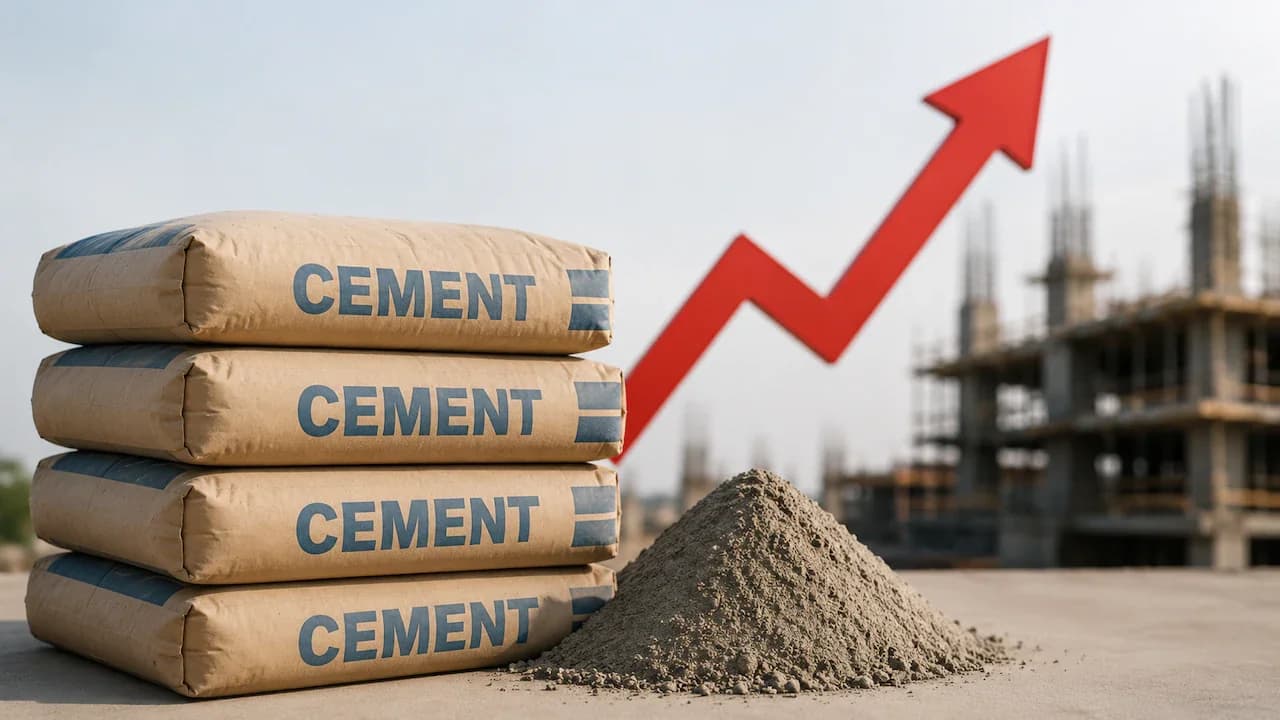
Many listed cement manufacturers saw sequential growth in margin-accretive trade segment sales during the March quarter (Q4FY26). According to reports from BNP Paribas, trade-segment cement is sold through networks of local dealers, hardware stores and retailers, usually in 50-kg bags, while non-trade cement is sold directly in bulk to government or large institutions. The trade segment typically offers higher margins than non-trade due to lower discounting requirements.
Premium cement accounted for 36% of trade sales at Ambuja Cements (plus ACC), 22% at Shree Cement and 24% at Dalmia Bharat in Q4FY26, as reported by BNP Paribas. Ambuja Cements' Q4FY26 premium cement volumes grew 22% year-on-year. Dalmia Bharat's management highlighted plans to continue focusing aggressively on premiumization in FY27 and launched a new premium product, Weather 365. Cement prices in the trade segment are typically higher by ₹25-30 per bag than non-trade segment, supporting realizations.
Despite price hikes implemented in April and May to combat cost inflation, cement companies are bracing for an operating-margin hit in H1FY27, according to BNP Paribas analysis. In the aftermath of the West Asia war, the cost of imported petroleum coke, coal and polypropylene—used to manufacture sturdy cement bags—has risen sharply. Companies incur higher packaging and freight costs in the trade segment compared with non-trade, which continue to act as incremental cost headwinds in Q1FY27.
Aggregate average blended (grey plus white cement) realization per tonne rose by around 2% sequentially in Q4FY26 despite price hikes in both trade and non-trade segments, as reported by BNP Paribas. In Q1FY27, trade cement prices have risen by ₹10-15 per bag in most regions compared with March exit levels, according to Kotak Institutional Equities. However, pan-India prices in June were flat month-on-month at ₹353 per 50-kg bag, as the arrival of monsoon in some regions led to price moderation.
According to Centrum Broking, Q2FY27 is likely to witness a sharper margin contraction than Q1FY27. The report noted that historically, the September quarter has been weak for the cement industry, but the current cycle appears more challenging given elevated fuel and freight costs, limited pricing power, maintenance shutdowns and negative operating leverage. A wave of new supply additions in FY27 and FY28 could weigh on volume growth, utilizations and pricing discipline, with consensus earnings-growth estimates for FY27 and FY28 already seeing steep cuts.