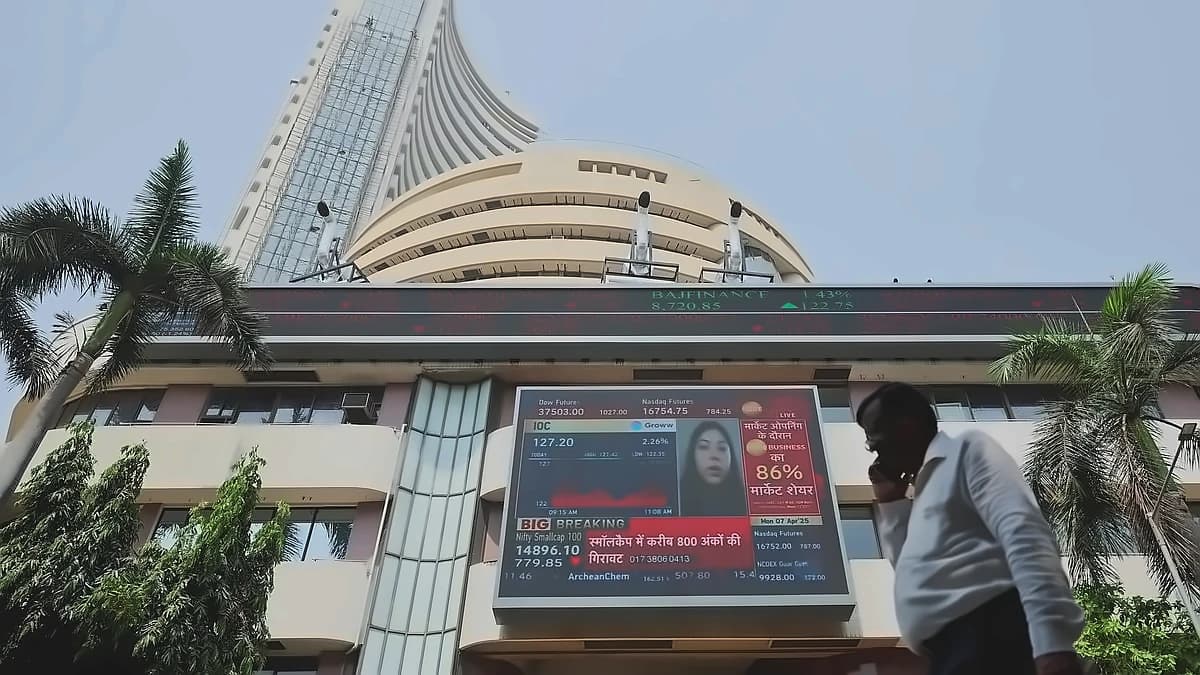
Bajaj Finance shares surged 8.32% to close at ₹1,141.2 on Friday, marking their biggest daily gain in four years and creating wealth of ₹52,889.5 crore for investors. The stock is on track to record its sharpest single-day surge in four years, demonstrating continued strong market confidence in the NBFC's performance. According to CNBC TV18, the stock's 52-week high stands at ₹1,145, while the 52-week low is ₹787.90, with the company currently having a market capitalisation of more than ₹7.1 lakh crore and trading at a price-to-earnings ratio of 36.85. ICICI Securities has now upgraded the stock to 'Buy' with a revised target price of ₹1,250, significantly higher than its earlier target of ₹1,000, citing strong Q1 performance and improved fundamentals.
ICICI Securities has upgraded Bajaj Finance to 'Buy' with a revised target price of ₹1,250, significantly higher than its earlier target of ₹1,000, as per the latest research report dated July 31, 2026. Motilal Oswal turned bullish on Bajaj Finance after Q1, upgrading the stock to a 'Buy' rating and raising its target price to ₹1,300, citing three key factors: the credit cycle has turned enabling lower credit costs and higher earnings, multiple growth engines are firing simultaneously across core lending, digital ecosystem, gold loans, and new businesses, and the current earnings cycle still has room to improve. Nomura continues to like Bajaj Finance among NBFCs and maintains its 'Buy' rating with a target price of ₹1,140, indicating an upside potential of more than 8% from current market price, highlighting that Bajaj Finance delivered better-than-expected profit mainly because credit costs remained lower than anticipated and the company reported one of the lowest increases in funding costs among NBFCs it tracks. CLSA maintained its 'Outperform' rating and increased its target price to ₹1,300, noting that Bajaj Finance proved its 'iron man' status in Q1 FY27 and can comfortably beat its credit cost guidance of 1.45-1.6% for the year. Citi has a 'Buy' call on the stock and raised its target price to ₹1,300, while HSBC also has a 'Buy' call with a target price of ₹1,270, highlighting extremely strong quarterly performance across metrics. Nuvama maintained a 'Hold' rating while increasing its target price to ₹1,175 from ₹1,050, noting that growth has picked up again and asset quality has remained stable, though valuations remain expensive. Bernstein remains cautious with an 'Underperform' rating and target price of ₹840, implying 20% downside potential, despite noting the strong quarterly performance.

Bajaj Finance's Q1FY27 PAT grew 27% year-on-year to ₹5,986 crore, aided by robust growth in net interest income (NII) which was higher by 23% Y-o-Y to ₹12,571 crore, while non-interest income increased 11% Y-o-Y to ₹2,650 crore. According to CNBC TV18, AUM rose by ₹36,969 crore during the first quarter of the ongoing financial year, with the company booking 1.6 crore new loans in Q1, up 20% from 1.35 crore in Q1 of FY26. Operating expenses grew 23% Y-o-Y to ₹5,010 crore and pre-provision operating profit stood at ₹10,140 crore, up 19% Y-o-Y. Credit costs stood at ₹1,990 crore, resulting in annualized credit costs declining 10 basis points quarter-on-quarter to 1.54%, with management including prudent provisions of ₹2,960 crore. Excluding these provisions, loan losses and provisions were ₹17,000 crore, and adjusted credit costs for Q1 FY27 stood at 1.3%. Assets under management (AUM) growth accelerated to 24% year-on-year from 22% in the previous quarter, reaching above ₹4 trillion. Asset quality emerged as the standout, with gross NPAs falling to 0.96% from 1.28% a year ago, while net NPAs improved to 0.49% from 0.63 over the same period. Return on equity crossed the 20% mark, with the company delivering a 27% rise in earnings per share supported by healthy balance sheet growth and improving asset quality metrics.
At the company's annual general meeting (AGM), Vice Chairman and CEO Rajeev Jain announced that Bajaj Finance is aiming for a consolidated loan book of ₹6.5 lakh crore by March 2027, as reported by CNBC TV18. This would mean the shadow bank adds close to ₹1 trillion in new loans to its book over the next nine months. The underlying health of the overall portfolio remains highly resilient, with credit performance across 3MOB, 6MOB and 9MOB continuing to reflect significant improvement, with stress being lower or equal to the pre-Covid-19 benchmark. ICICI Securities now values standalone Bajaj at 5x FY28E P/B (vs 4.5x Sep'27E earlier) and assigns ₹114/share towards its housing subsidiary at their target market cap after a 20% holding company discount. The company's customer franchise rose 17% to 12.44 crore from 10.65 crore a year ago, with the company adding 51 lakh customers during the quarter as per The Economic Times. The company raised its customer addition target to 18-20 million from 15-17 million and reiterated growth plans across gold loans, digital businesses and two new business launches by early 2027. According to Mayank Jain, Market Analyst at Share.Market by PhonePe, one of the key positives in the quarter was the improvement in asset quality, with gross NPAs declining to 0.96% from 1.03% a year ago, while net NPAs improved to 0.39%. Return on equity also improved to 20.4%, with core credit losses falling 14% from a year ago, indicating improved repayment trends.
Bajaj Finance closed as the seventh-most valued company in India after Reliance Industries (₹17.69 lakh crore), Bharti Airtel (₹12.29 lakh crore), HDFC Bank (₹11.52 lakh crore), ICICI Bank (₹10.28 lakh crore), SBI (₹9.48 lakh crore) and TCS (₹8.56 lakh crore), as per CNBC TV18. According to Bloomberg data, 39 analysts currently track Bajaj Finance, with only five having a sell rating. The average 12-month target price for the stock is ₹1,159.15, while Motilal Oswal and CLSA have both assigned a target price of ₹1,300. The stock rallied after the company's quarterly results, announced on Thursday evening, beat market expectations. Bajaj Finance retested its 20-day EMA and witnessed a strong rebound in today's session, reinforcing the underlying bullish sentiment according to The Economic Times. Sudeep Shah, Head of Technical and Derivatives Research at SBI Securities, noted that the stock on July 1 had registered a breakout above a downward-sloping trendline resistance, following which it rallied higher before retesting the earlier resistance zone, which has now turned into a strong support area. The RSI, which had been consolidating around the 60 mark, has turned higher, indicating a revival in bullish momentum, while the DI lines have widened, with DI+ positioned well above DI-, highlighting strong buying interest and sustained bullish control. The zone of ₹1,075–1,070 is expected to act as a strong support, and the overall trend is likely to remain bullish as long as the stock sustains above this zone.