Ashok Leyland has launched India's first air suspension multi-axle vehicle, marking a significant technological advancement in the commercial vehicle sector. According to Sanjeev Kumar, President of MHCV at the company, as reported by NDTV Profit, this innovative vehicle offers four-ton extra payload capacity compared to conventional alternatives. The new range includes three configurations: a 12-tyre vehicle, a 14-tyre vehicle, and a 14-tyre variant with dual tyres. Kumar revealed that the added capacity translates into savings of nearly ₹5 lakh for customers over a six-year period, highlighting the significant cost benefits of the air suspension technology.
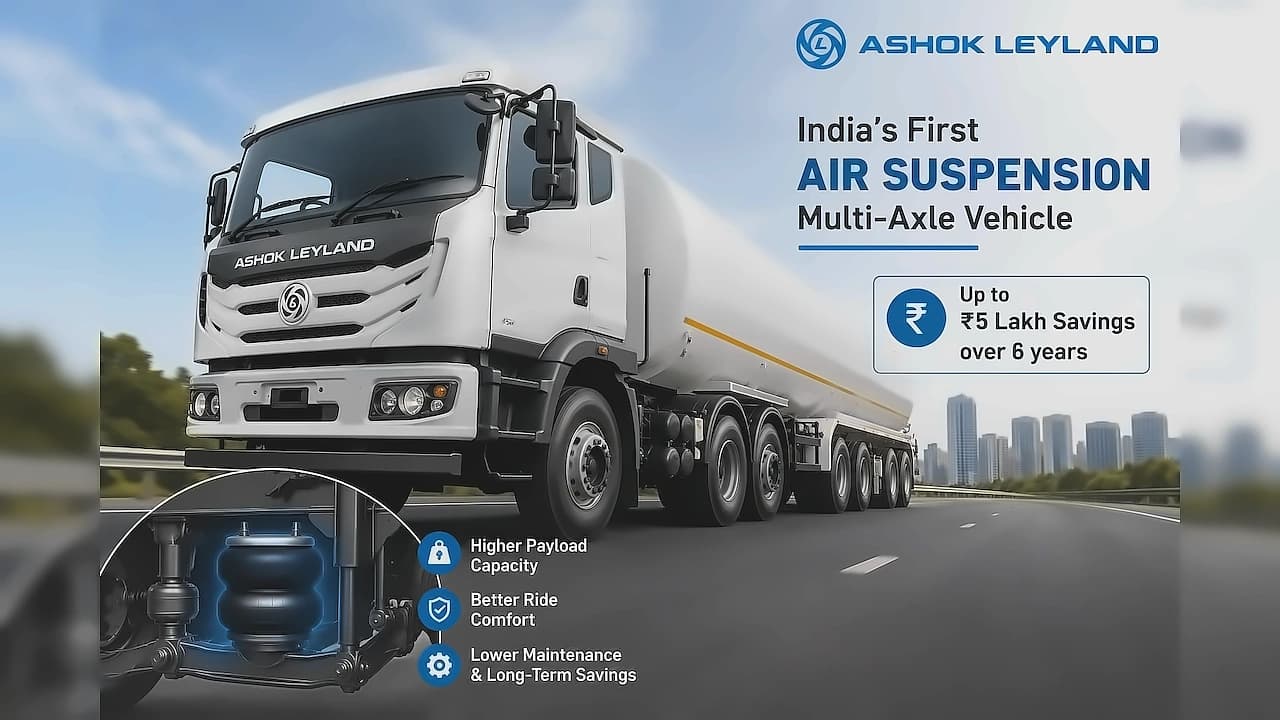
The air suspension multi-axle truck replaces conventional leaf-spring suspension systems with air-filled bellows that automatically adjust to load and road conditions. As reported by NDTV Profit, this technology enables more even weight distribution across vehicle axles, reducing chassis stress and enabling higher payload capacity within existing regulatory weight limits. The system also improves ride quality and reduces wear on tyres and mechanical components, making it particularly suitable for long-haul and heavy-load applications such as tankers and cement carriers. Kumar noted that the technology is particularly relevant for tanker, cement and polymer applications, highlighting its practical benefits for specific industrial sectors.
According to Kumar's statements to NDTV Profit, the new range is expected to strengthen Ashok Leyland's position in India's multi-axle vehicle segment by offering customers greater flexibility. The company's initial focus remains on the domestic market, with exports to be considered only after the product stabilizes. Kumar noted that a product typically takes three to four years to stabilize before international expansion is considered, emphasizing that the company would first look to build sufficient volumes in India before expanding overseas. He characterized the domestic market as the primary focus area for the new technology.
On the broader commercial vehicle industry, Kumar reported that the sector grew in high double digits in the first quarter of FY27, though performance within the M&HCV segment remained mixed. As reported by NDTV Profit, goods carriers rose 20% while passenger carriers declined, with Kumar attributing the passenger carrier dip to bodybuilders facing delays in securing approvals for MDV buses. He characterized this as a temporary blip and predicted improvement over the next two quarters. Kumar also noted that customers valued rate stability over volatility, with crude and diesel prices appearing to have steadied in recent days after fluctuating alongside global crude movements.
Kumar addressed a sharp decline in exports, which fell 18-19% during the quarter, linking this directly to the conflict in West Asia. According to NDTV Profit, Ashok Leyland's manufacturing plant in the Middle East had been shut as a result of the war, with Kumar noting that demand remains strong in the region. He indicated that recovery in exports depends on when normalcy returns to the Middle East, emphasizing that demand is strong over there also despite the current operational challenges.