According to reports from CNBC TV18, Arm Holdings forecast third-quarter revenue of approximately $1.54 billion, just above analysts' average estimate of $1.53 billion. The company provided a range of plus or minus $50 million for the quarter running through December. However, this marginally beat expectations fell short of some projections that neared $1.7 billion, disappointing investors who had hoped for a bigger payoff from the company's AI data centre business push. The latest guidance shows Arm expects revenue of between $1.49 billion and $1.59 billion for the third quarter, with the midpoint of $1.54 billion only slightly above expectations. Market consensus estimates company revenue for the quarter at approximately $1.38 billion, up about 21% year-over-year, with adjusted earnings per share expected at $0.48, up roughly 23% year-over-year.
As reported by CNBC TV18, Arm Holdings shares fell 5.28% in Wednesday's regular trading session, with the stock closing lower on the NASDAQ. The company also forecast adjusted earnings of 56 cents per share, plus or minus 4 cents, for the quarter. The muted reaction underlined the pressure on Arm, which had become a favourite among AI investors as data centre operators and their suppliers increased spending on its designs and licences. According to latest reports, shares fell about 5% in after-hours trading despite beating both earnings and revenue expectations, as investors weighed guidance that was only marginally ahead of forecasts. Ahead of the earnings release, although Arm's pre-market stock price rebounded 3% to around $209, the overall trend remains weak. The stock has pulled back more than 50% from its peak of approximately $440 in June and is once again approaching its lowest levels since late April.
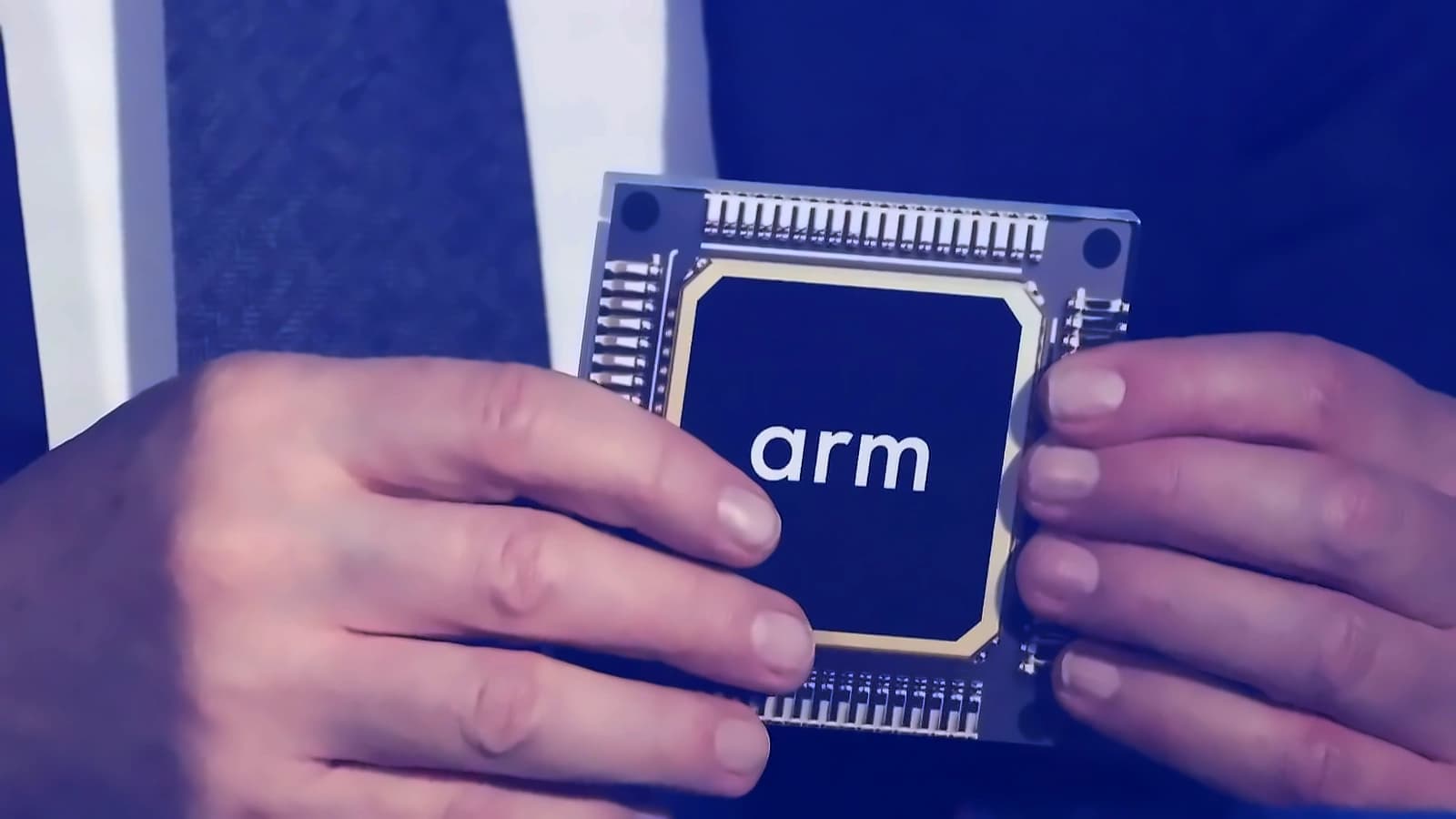
According to CNBC TV18, under Chief Executive Officer Rene Haas, the UK-based company is transforming itself from a provider of chip designs and licences into a full-fledged chipmaker. The company unveiled its own central processing unit (CPU) designed to help run AI data centres and expects it to generate up to $2 billion in revenue in fiscal 2027 and 2028. Haas told Reuters that Arm had worked with Taiwan's TSMC and other chip suppliers to secure enough raw materials to produce the $2 billion revenue target. Latest updates show that purchase orders for the AGI CPU now extend through calendar 2027, with first commercial deliveries on track for the fourth quarter. However, despite strong demand for AGI CPUs, the first-generation product's gross margin is expected to be only in the high-30% to low-40% range, significantly lower than traditional licensing business, meaning that revenue expansion may not necessarily translate into profit margin enhancement in tandem.
As reported by CNBC TV18, in the second quarter, Arm's revenue rose 27% to $1.44 billion, beating Wall Street's projection of $1.38 billion. Adjusted profit was 52 cents a share against expectations of 47 cents. Licensing sales rose 50% to $773 million, while royalty sales climbed 8% to $670 million. However, the company faced a slowdown in the smartphone market, its biggest source of revenue, where memory chip shortages hurt production and raised handset prices. Latest data shows partners shipped more than 10 billion Arm-based chips in a single quarter for the first time, with Arm-based PCs now accounting for about 20% of global PC shipments. In the previous quarter, Arm's revenue grew 22% year-over-year to a record high of $1.289 billion, with royalty revenue increasing 22% to $715 million and license and other revenue growing 23% to $574 million.
According to latest reports, Arm's annualised contract value, a measure of commitments to the licensing business, came in at approximately $1.79 billion, slightly below expectations of around $1.8 billion. While the shortfall is small, for a stock priced for strong growth, merely in-line guidance leaves almost no room for disappointment. The company's adjusted operating expenses are projected at approximately $825 million, broadly in line with estimates. This modest miss on the licensing metric contributed to the muted investor reaction despite the overall strong quarterly performance. From a technical perspective, Arm's stock price remains below its 20-day moving average of $233.66 and 60-day moving average of $257.66, with both moving averages sloping downward. The 14-day RSI currently stands at approximately 35.42, slightly below the signal line of 36.16, nearing the oversold territory of 30. If the earnings report beats expectations and management raises the outlook for AI data centres, AGI CPUs, or the royalty business, an interim bottom could take shape near $195, with the stock price expected to attempt a rebound toward $220 and $234.