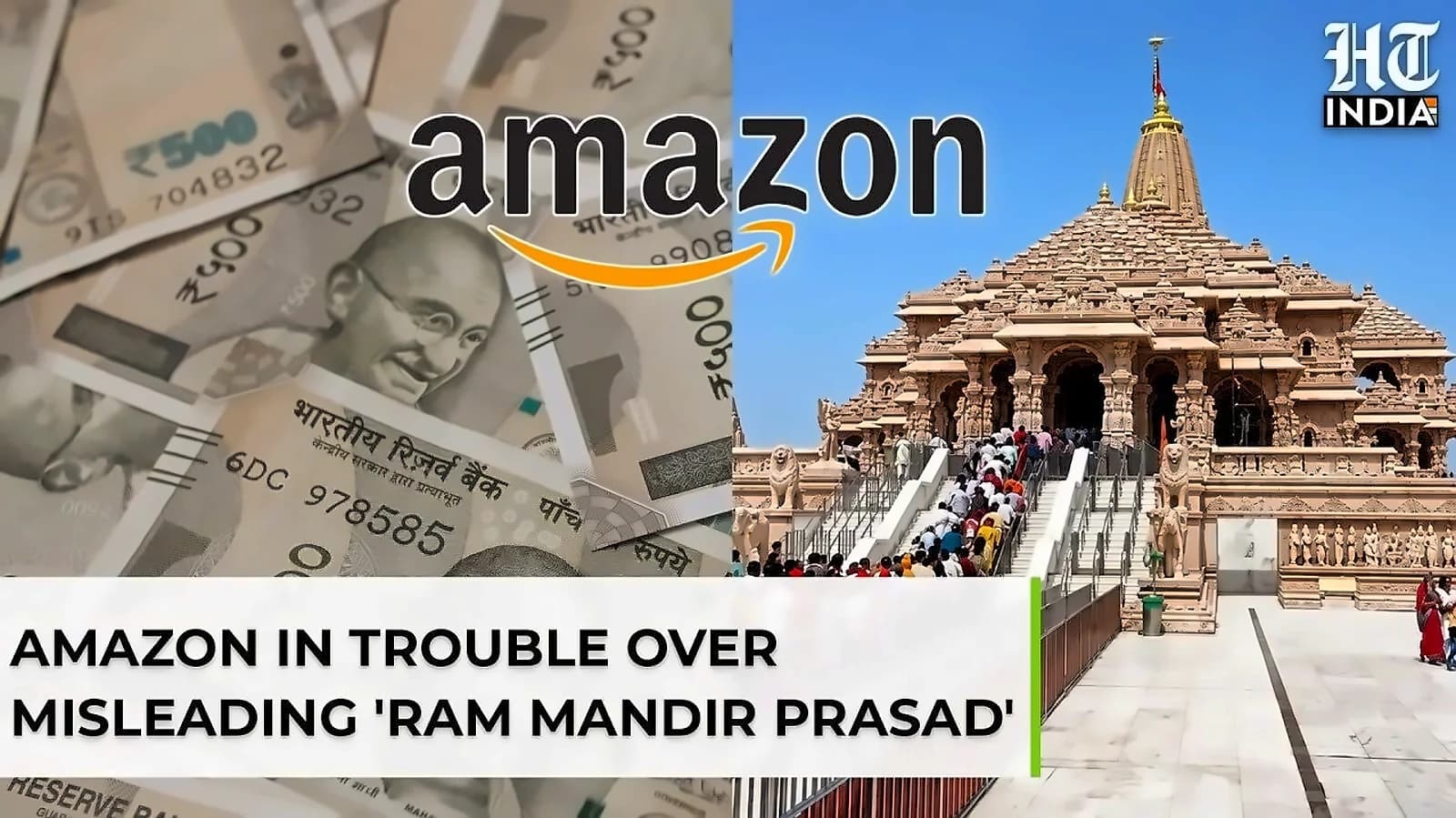
The Central Consumer Protection Authority (CCPA) has imposed a ₹1 lakh fine on Amazon Seller Services Private Limited for allowing commercially produced sweets to be listed and sold online under the label 'Shri Ram Mandir Ayodhya Prasad'. According to reports from Bar and Bench and Business Standard, Chief Commissioner Nidhi Khare and Commissioner Anupam Mishra passed the order on August 4, 2024, noting that the sweets company earned over ₹25 lakh by selling these sweets. The CCPA found that using this expression for ordinary confectionery without authorisation from the Shri Ram Janmabhoomi Teerth Kshetra Trust amounted to a misleading trade practice. The authority issued a show-cause notice to Amazon on January 19, 2024, three days before the Pran Pratishtha ceremony at the Shri Ram Mandir, citing this as a period of heightened religious interest. As per the latest CCPA order, Amazon has been directed to deposit the penalty within 15 days.
The CCPA investigation revealed significant revenue generation from the disputed listings, with one seller, Chandu Trading Company, generating gross merchandise sales of ₹25,26,309 through the disputed listings. According to the latest proceedings, Amazon India earned ₹15,165 as a service fee from the four disputed listings that generated total sales of ₹39,802. As reported by Bar and Bench and Business Standard, Amazon also earned commissions or fees through its marketplace operations from these listings. The products were available for delivery across India, giving them access to a large consumer base without proper authorisation from the temple or the trust. The misleading products included Raghupati Ghee Ladoo Khoya Khobi Ladoo, Ghee Bundi Ladoo and Desi Cow Milk Peda, with all products declaring it as just 'Ram Mandir Prasad' in the ingredient column. The listings carried religious imagery and promotional claims suggesting a connection with the Ayodhya temple, including references to 'Blessings from Shree Ram Janam Bhumi Temple, Ayodhya'.
The CCPA emphasized that the phrase 'Shri Ram Mandir Ayodhya Prasad' has a specific religious meaning for devotees, referring to food offered to and blessed by the deity at the Ram Mandir in Ayodhya. According to Bar and Bench and Business Standard, the authority stated that the commercial appropriation of this phrase for ordinary confectionery products, without any authorization from the Shri Ram Janmabhoomi Teerth Kshetra Trust, constitutes not just a misleading trade practice but an affront to the religious sentiments of crores of consumers. The authority noted with particular concern the timing of the impugned listings, stating that the products falsely claiming to be 'Shri Ram Mandir Ayodhya Prasad' were listed on Amazon's platform prior to the Pran Pratishtha ceremony of the Shri Ram Mandir, Ayodhya, which took place on January 22, 2024. The complaint filed by the Confederation of All India Traders (CAIT) in January 2024 mentioned dishonest trade practices by listing commercially produced sweets on the website under the misleading label, with customers being exploited for monetary gain. The products were marketed as exclusive offerings from the temple and used religious imagery and slogans referring to the deity, with the description potentially leading devotees to believe the sweets were genuine prasad associated with the Ayodhya Ram temple.
Along with the penalty, the CCPA has directed Amazon to prevent products falsely claiming to be prasad, prasadam, mahaprasad, bhog or similar religious offerings from being listed without documentary proof of authorisation from relevant religious institutions. The authority has ordered Amazon India to ensure that products described using terms such as 'prasad', 'prasadam', 'mahaprasad' or 'bhog', or comparable descriptions of religious offerings, are not listed unless the seller can produce verifiable authorisation from the relevant religious institution. The framework currently covers 10 major religious institutions and shrines, including the Shri Ram Janmabhoomi Mandir, Tirumala Tirupati Devasthanam, Shri Mata Vaishno Devi Shrine, Shri Kashi Vishwanath Temple, Shri Jagannath Temple, Shri Kedarnath Temple, Shri Badrinath Temple, Shri Somnath Temple, Shri Dwarkadhish Temple and Shri Mahakaleshwar Temple. CCPA has also ordered Amazon India to strengthen its keyword-based monitoring and takedown mechanisms to identify and remove potentially misleading religious-product listings. The objective is to prevent sellers from commercially using the names of religious institutions or representing ordinary products as authenticated religious offerings without supporting documentation. The CCPA has reserved the right to assess Amazon's compliance and the effectiveness of its new framework after three to four months.
The CCPA has reserved the right to assess Amazon's compliance and the effectiveness of its new framework after three to four months. According to Bar and Bench and Business Standard, the authority noted that Amazon cannot claim safe harbour protection available to intermediaries under Section 79 of the IT Act, as it was responsible for the publication of misleading advertisements related to the product listing. The company must strengthen its due diligence system, including keyword-based detection and takedown mechanisms, and periodically expand checks to cover additional religious institutions. Amazon has defended itself by stating that it took down the disputed products from its website and acted only as a marketplace without any role in listing, pricing, describing, or selling products, but the CCPA rejected this claim. The regulator's directions also put online marketplaces on notice that claims suggesting food products are genuine temple prasad or other authorised religious offerings will require verification rather than being treated as ordinary seller-generated descriptions. CCPA made it clear that cooperation after a violation does not eliminate an e-commerce platform's responsibility to maintain effective systems for detecting misleading advertisements and product claims.