Amazon CEO Andy Jassy announced a $48 billion investment commitment to expand and support Amazon's businesses in India from 2026-2030, following his meeting with Prime Minister Narendra Modi in New Delhi on Thursday, June 25. Jassy reiterated Amazon's long-term commitment to India and announced plans to invest an additional $13 billion to expand AI and cloud infrastructure in the country by 2030. This brings Amazon's total planned investment in expanding and supporting AI and cloud infrastructure to over $21 billion between 2026 and 2030, establishing it as one of the largest global AI and cloud infrastructure investors in India. The investment will expand AWS data centre capacity in Mumbai and Hyderabad, giving startups, enterprises and government organizations access to custom AI chips, managed AI services, secure and reliable cloud technologies and developer tools to innovate faster, scale rapidly, and serve customers globally. According to PTI, the $13 billion investment will support AI and cloud infrastructure across the Mumbai and Hyderabad regions, with both AWS Regions enabling customers to securely store their data within India and giving them access to the world's most advanced AI and cloud technology including high-performance Trainium chips and AWS's leading inference engine Amazon Bedrock.
During his visit to India, Jassy met with several startup founders in New Delhi on Thursday, holding discussions with entrepreneurs building solutions in voice technology, robotics, edtech, health tech, and digital public infrastructure. As reported by Livemint, the company stated that "The discussion focused on India's opportunity to shape the next wave of AI adoption, backed by its linguistic diversity, population-scale digital infrastructure, deep engineering talent, and fast-growing startup community." The startup founders in attendance included Mahanaaryman Scindia (co-founder and CGO, Ethara.AI), Alakh Pandey (co-founder and CEO, PhysicsWallah), Abhijit Kane (co-founder, Postman), Keshav Reddy (founder and CEO, EqualAI), Suvonil Chatterjee (co-founder and CEO, Manav Robotics), Suresh Khadakbhavi (CEO, DigiYatra Foundation), Sudharshan Kamath (co-founder and CEO, smallest.ai), and Vikalp Sahni (founder and CEO, Eka Care). Sandeep Dutta of Amazon was also present at the meeting. The company emphasized that "Indian founders have mastered constraints that can potentially define the next wave of global AI adoption." During the meeting, the company highlighted AWS as the infrastructure layer beneath these efforts, offering "the widest selection of foundation models through Amazon Bedrock and purpose-built chips like Trainium."
Amazon's aggressive expansion into India's $11 billion rapid-commerce segment is creating significant market disruption, with established players facing substantial pressure. Eternal Ltd.'s Blinkit has slipped 28% from its October all-time high as of Thursday's close, while Swiggy's Instamart has plunged about 47% from its September peak, resulting in a combined selloff of more than $15 billion for the two companies. As reported by The Hindu BusinessLine, Amazon and Flipkart are doubling down on India's booming rapid-commerce segment, building out their network of last-mile warehouses called dark stores to push into smaller cities. Flipkart Minutes has scaled to 1,000 dark stores to take its offering to 130 cities in less than two years, with the company looking to set up 1,500 stores in 180-plus cities in the next few months. Blinkit had 2,243 dark stores in the year ended March 31 while Swiggy is trailing at 1,143, according to Macquarie Equity Research. "The challenge right now is that the competition is really high, so near-term profitability is depressed," said Franklin Templeton fund manager Yi Ping Liao, who holds shares in Eternal. "The risk is the duration of the competitive intensity." Rashi Talwar Bhatia, chief investment officer at Ashmore Investment Management India LLP, noted that "Based on store expansion and aggressive discounts offered, we believe Amazon will take away some market share from the incumbents."
Amazon has significantly expanded its delivery capabilities, with the company now offering tens of thousands of products through the ultra-fast delivery network, while also benefiting from a wider same-day and next-day assortment. The company now promises over one million products delivered within the same day, over four million the next day, and millions more with unlimited, free and fast Prime delivery. As reported by Livemint, Jassy emphasized that "We have further accelerated our expansion and will offer ultra-fast deliveries to customers in over 300 cities of India." The company has also launched 100 large fulfillment centres across cities such as Bengaluru, Chennai, Delhi-NCR, Hyderabad and Mumbai as it expands beyond groceries to offer users electronics, fans, humidifiers and other everyday items. This expansion beyond traditional quick-commerce items demonstrates Amazon's commitment to building a comprehensive ultra-fast delivery ecosystem. As part of its expansion plans, Amazon plans to open more than 20 new fulfilment centres and over 100 last-mile delivery stations across India this year, with a focus on improving delivery speeds and reliability, particularly in tier-3 and tier-4 cities. The expanded network will help offer deliveries in minutes, hours and by the next day across the country.
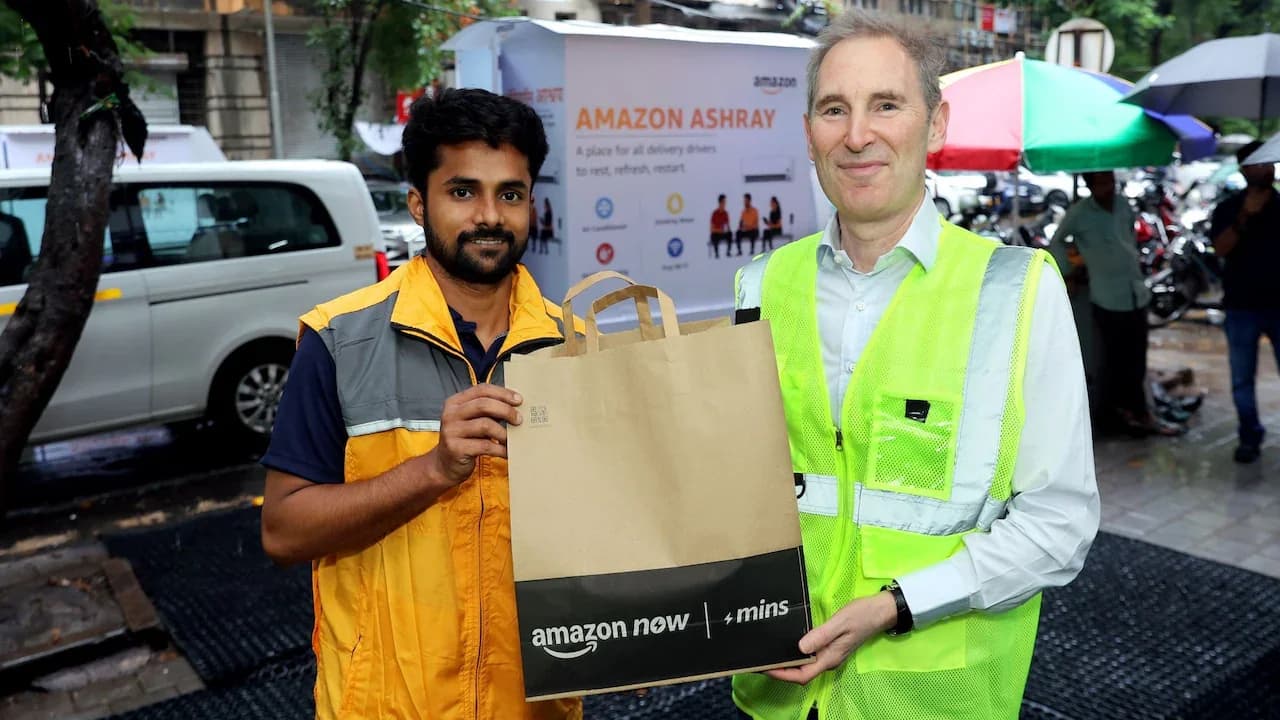
Amazon has announced significant infrastructure expansion plans alongside its massive investment commitment. The company plans to launch more than 20 new fulfilment centres and over 100 new last-mile delivery stations this year, demonstrating its commitment to building comprehensive logistics infrastructure. Amazon also announced the launch of 'Sammaan', a welfare programme aimed at supporting delivery associates across its logistics network. The initiative includes scholarships for associates' children, assistance in accessing government welfare and financial inclusion schemes, insurance coverage, road safety measures and the expansion of Ashray rest centres to 250 locations this year. The rest centres will be accessible to delivery associates across the industry. A portion of Amazon's previously announced $300 million investment in operations and associate well-being will be used to strengthen and scale the 'Sammaan' programme. Amazon's massive investment commitment reflects the company's strong growth trajectory in India, with Jassy noting that "We came to India over a decade ago and have since been serving customers, sellers, developers, start-ups and enterprises through our different businesses. The response has been tremendous, with strong growth especially across our ecommerce, AI, and cloud businesses." Since its launch in India, Amazon has digitised 12 million small businesses, enabled over $20 billion in cumulative ecommerce exports, and supported 2.8 million jobs. The latest announcement comes less than six months after Amazon disclosed $35 billion in new investments for India, with the fresh commitments bringing Amazon's cumulative investments in the country between 2010 and 2030 to over $88 billion. In line with the government's priorities, Amazon has pledged to support 3.8 million jobs, $80 billion in cumulative exports, enabling AI benefits for 15 million small businesses, and AI education for 4 million government school students.
The rapid delivery market is experiencing unprecedented competitive intensity as multiple players vie for market dominance. Mukesh Ambani's conglomerate is leveraging Reliance Retail Ltd.'s vast network of 3,100-plus stores to push into quick commerce across categories under its JioMart platform, serving more than 1,200 cities according to recent shareholder communications. Zepto Ltd. plans to raise as much as $1 billion via an initial public offering, amassing a war chest to take on market leader Blinkit and Swiggy Instamart. However, Zepto's shares in the unlisted market have fallen more than 32% since February, declining to ₹39 rupees from ₹58, as reported by UnlistedZone.com. Macquarie analysts have slashed target prices for Eternal and Swiggy and downgraded Swiggy to Underperform, citing the narrowing competitive moat around the two large quick commerce incumbents. While Blinkit managed to show Ebitda-level profitability in the December quarter, Swiggy's quick commerce operations made an annual loss of about $460 million and Zepto over $600 million. The competition is intensifying with "rising and persistent competitive intensity for years, not quarters" from multiple dimensions including horizontal e-commerce platforms and omni-channel retail, according to Macquarie analysts. Despite the challenging environment, Emkay analysts noted that the demand surge has decisively moved beyond metros and into Tier 2 and Tier 3 towns, underscoring the pan-India appeal of the quick-commerce model.