Adani Ports shares recovered 2.06% to trade at ₹1,698.40 on Friday at 1:31 pm, marking a significant turnaround from the previous decline. The stock had declined 6% in the last two trading sessions following the company's Q1 results announcement, with the stock hitting a low of ₹1,665 on Thursday, down 3% amid volume of around 29 lakh shares on the NSE. At current levels, the stock quotes 12% lower compared to its record high of ₹1,891 hit earlier this month on July 3. However, the stock has gained 13% on a year-to-date basis, demonstrating resilience despite recent volatility. The recovery reflects improved investor sentiment following the company's robust quarterly performance.
Adani Ports and Special Economic Zones delivered robust financial results for the first quarter of FY27, with consolidated net profit attributable to owners rising 10% year-on-year to ₹3,650 crore compared to ₹3,311 crore in the corresponding quarter last year. According to The Economic Times, the company's revenue from operations grew 19% to ₹10,821 crore from ₹9,126 crore in the same period of the previous financial year. Nomura reports that revenue stood at ₹108 billion, up 19% year-on-year, which was 2% below Nomura's estimate but 2% above the Bloomberg consensus estimate. The strong performance reflects the company's continued operational capabilities and market presence in the infrastructure sector. The company's EBITDA increased 19% year-on-year to ₹6,541 crore compared with ₹5,495 crore in the year-ago period, as reported by The Economic Times. EBITDA margin stood at 60.4%, marginally higher than the previous year's 60.2%, demonstrating the company's improved operational efficiency and cost management capabilities during the quarter.
Adani Ports demonstrated robust operational performance in July 2026, with cargo volumes increasing 15% year-on-year to 46.3 million metric tonnes (MT). According to CNBC TV18 and Business Standard, growth during the month was across all cargo categories, including dry cargo, which increased 21% from the previous year. The company has handled 184.4 million metric tonnes (MMT) from the beginning of the ongoing fiscal year till July, up 15% from the same period last year. The growth was led by containers and cargo, which were 15% up each from the previous year. Logistics rail volume for July stood at 51,020 twenty foot equivalent units (TEUs), which increased 5% sequentially but declined 16% from the year-ago period. In all of FY27 till July, logistics rail volumes stood at 1.96 lakh TEUs, which were down 18% from the previous year. The company maintained its full-year guidance of ₹25,000 crore to ₹26,000 crore for revenue.
The domestic ports business remained the key earnings driver, with revenue rising 12% year-on-year aided by better cargo mix, higher realisations and cargo volumes. Domestic ports handled 115.3 MMT of cargo during the quarter, up from 112.9 MMT in the year-ago quarter, as reported by The Economic Times. Domestic ports revenue rose 12% year-on-year to ₹6,660 crore, driven primarily by a 10% increase in realisations to ₹604 per tonne, even as cargo volumes grew a modest 2% to 115 million tonnes, slightly below estimates. EBITDA margin for the business stood at a best-in-class 74%. The company's all-India cargo market share stood at 27.6% during the quarter, with container cargo market share at 44.8%. APSEZ is undertaking one of the largest port capacity expansion programmes in its history, with domestic port capacity at 653 MMT as of June 30, 2026, targeted to increase to 1,000 MMT by December 2030. However, domestic cargo volumes remained subdued due to temporary disruptions, including the shutdown of a key customer at Krishnapatnam and ongoing impact of the Middle East crisis on trade flows, as noted by Prabhudas Lilladher.

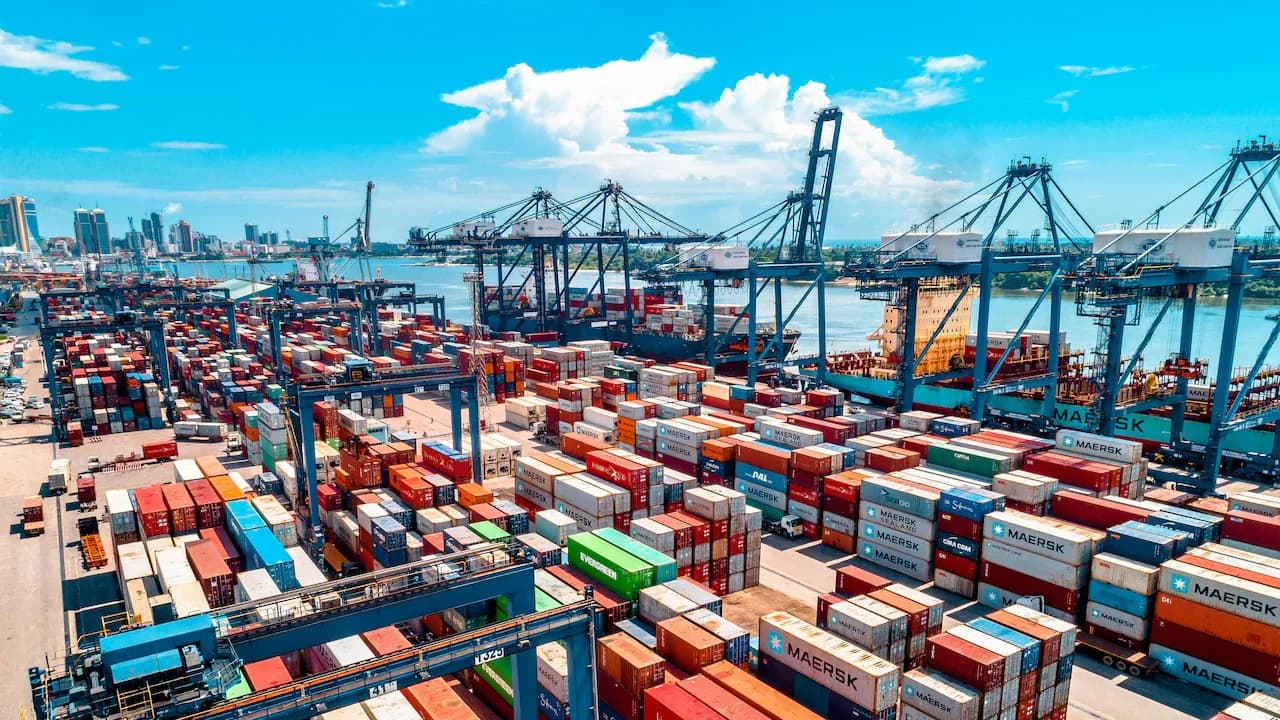
The international ports segment delivered exceptional results during Q1 FY27, with revenue surging 80% year-on-year to ₹1,747 crore and EBITDA jumping 256% to ₹730 crore, driven by strong performance in Australia and Colombo operations. International ports handled 22.8 million metric tonnes (MMT) of cargo during the quarter, up from 7.7 MMT a year earlier, aided by the integration of NQXT Australia and continued ramp-up at Colombo. Australia contributed 10 MMT of cargo, followed by Colombo at 6.9 MMT, Tanzania at 3.7 MMT and Israel at 2.2 MMT. Notably, EBITDA margin at Colombo expanded sharply to 41.8% from 21.1% a year earlier, while Colombo's revenue increased five-fold and Tanzania's revenue rose 36%. The company said the growth was driven by strong performance at its operations in Australia and Colombo, reflecting the increasing contribution of its international portfolio. Nomura notes that ports performance remained superior as traffic grew 15% year-on-year led by a 196% year-on-year increase in international port traffic due to NQXT consolidation and maturing of assets. Prabhudas Lilladher highlights that better cargo mix (higher liquid share), increased ancillary services and improved domestic port NSR supported EBITDA growth despite muted volume growth. The company's marine revenue was up 67% on the back of ongoing offshore vessel additions and European subsea expansion.
APSEZ achieved significant credit rating improvements during the quarter, with S&P Global Ratings upgrading APSEZ's long-term issuer credit rating and issue rating on its senior unsecured notes to "BBB" from "BBB-" with a "Stable" outlook. The company also maintained its strong domestic credit ratings, with CARE Ratings and ICRA Limited reaffirming APSEZ's highest possible domestic rating of "AAA". As per NDTV Profit, the company's gross debt stood at ₹56,776 crore with cash balance at ₹12,428 crore, while net debt to EBITDA ratio was 1.9x (proforma net debt to EBITDA calculated using TTM NQXT EBITDA at 1.8x). The company's debt maturity profile remains well diversified, with an average debt maturity of 5.1 years as of June 30, 2026, compared with 5.2 years as of June 30, 2025. In January 2026, JCR assigned APSEZ an "A-/Stable" rating, positioning it among a select group of Indian corporates rated above the sovereign level by an international rating agency. Equirus Securities maintains a 'LONG' rating on Adani Ports with a Sep'27 target price of ₹2,088, based on 15x one-year forward EV/EBITDA, noting that net debt/EBITDA remained comfortable at 1.9x, indicating balance-sheet headroom to fund domestic capacity expansion.