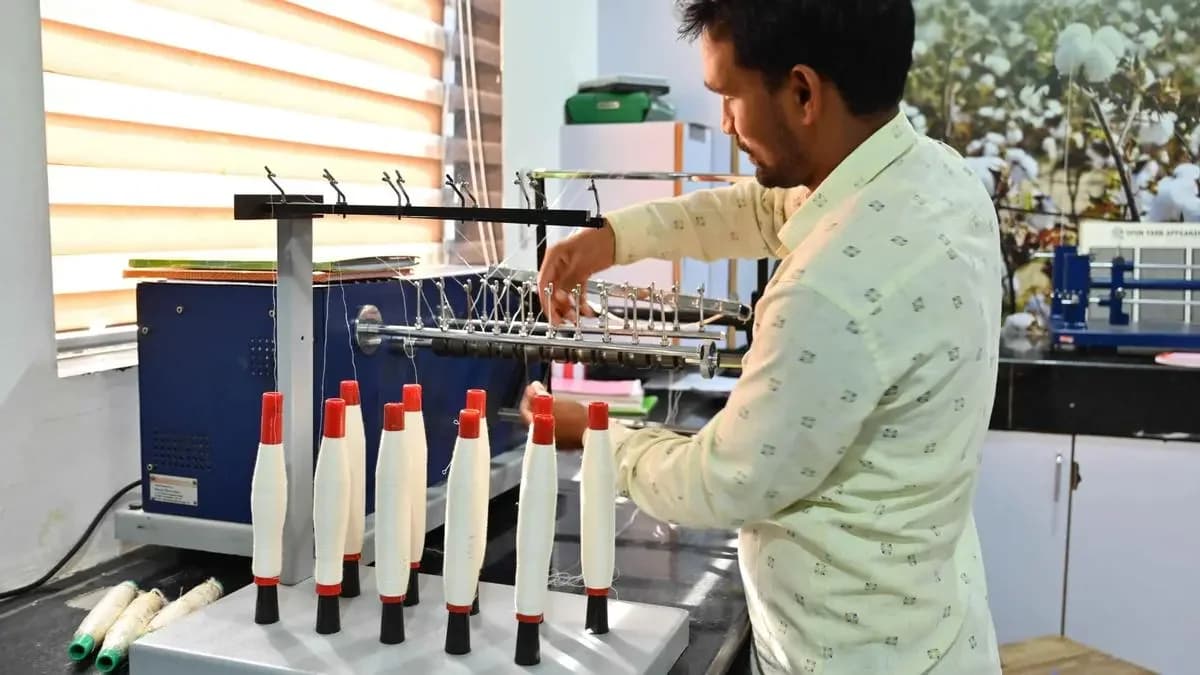
Aastha Spintex shares surged 9.9% to hit the upper circuit during Tuesday's trading session after the company announced a 1:1 bonus issue with September 28 set as the record date for eligibility. The stock was trading ₹81.73 per share with a market capitalization of ₹360.77 crore at 12:22 pm on Tuesday, having touched an intraday high of ₹81.76 and low of ₹74.51. According to the latest announcement, the board has approved the bonus entitlement in the ratio of 1:1, meaning every eligible investor will receive one fully paid-up equity share of face value ₹10 each for every existing share held. This corporate action will result in the issuance of up to 4,41,42,190 equity shares, with the newly issued shares ranking pari passu with existing shares in all respects.
As per the company update, the rooftop solar project has now moved into on-site execution, with work on the rooftop already underway. According to the Daily Progress Report dated September 16, 2026, 13 personnel were deployed at the project site. Module Mounting Structure (MMS) marking work was approximately 70% complete, while MMS installation work was approximately 40% complete. The project involves a 1,000 kW AC capacity and 1,350 kW DC capacity, equivalent to 1.35 MW DC, and is being implemented in CAPEX mode where the system will be owned by the applicant while electricity generated will be used by Falcon for its own requirements. As reported by Investing.com India, this permits the installation of a 1,000 kW AC / 1,350 kW DC (1.35 MW DC) rooftop solar PV system under the Gujarat Integrated Renewable Energy Policy - 2025, with the system providing captive solar generation to offset industrial grid electricity consumption during peak hours.
The company has completed the acquisition of Falcon Yarns Private Limited, more than doubling spinning capacity from 7,700 MT to 17,457 MT with 61,824 spindles. According to Investing.com India, this expansion provides the necessary volume to support a steady, short-term manufacturing pipeline. The company has also secured shareholder approvals at its 13th AGM on September 16, 2026 for a 1:1 bonus issue, a modest dividend, and a higher authorized capital. As per Investing.com India, the company is executing a rapid structural transformation from a regional yarn spinning house into a vertically integrated, energy-efficient textile manufacturing platform. The recent integration of Falcon Yarns expands the firm's capacity, increasing its infrastructure from 25,920 spindles to 61,824 spindles, with the company now handling the processing steps directly at the source and supplying domestic and export B2B buyers.

The solar project is being developed as captive renewable power for Falcon's manufacturing operations and is not intended to follow a merchant-power model. According to the company's statement, once commissioned, captive solar generation could reduce the amount of electricity sourced from the grid during solar-generation hours, though actual savings will depend on irradiation, plant availability, captive consumption, tariff structure and other operating factors. The project is expected to increase the renewable-energy component of power consumed at the Falcon manufacturing site and support its broader focus on operational efficiency and sustainability. As reported by Investing.com India, the company has historically emphasized renewable energy with ~60% or higher contribution at the main facility via solar and wind assets, and the new Falcon rooftop project extends this focus. The company's business model functions through regional raw seed cotton sourcing, in-house ginning & compacting bales, high-grade spinning (Ne 26 to Ne 40 yarns), and strategic shift into weaving into grey & value-added fabric brands.
According to Investing.com India's quantitative analysis, the company projects revenue growth from ₹443 crore in FY26 to ₹642-1,255 crore by FY30, with core operating margins expanding from 9.48% to 18.01% over the same period. The analysis assumes full implementation of strategic initiatives including the Falcon Yarns capacity integration, captive solar power savings, and downstream fabric integration. As per Investing.com India, the company's projected net profit growth driven by asset integration and cost management is expected to drive net profit CAGR higher than equity capital dilution CAGR. The company operates primarily as a domestic-heavy player with direct export revenue accounting for less than 10% of total revenue, which insulates it from immediate global trade disruptions. With the global textile market valued at $740-790 billion (projected to hit $1 trillion by 2031) and India's local market at $152-225 billion compounding at 10-12% CAGR, the company is well-positioned to capitalize on structural shifts in the textile landscape.