Indian companies are significantly expanding their international workforce strategies, with 77% of firms surveyed by Deel stating they plan to increase global hiring over the next 12-18 months. According to the report, this expansion is driven by access to specialised talent, proximity to customers, and round-the-clock operations. The survey, conducted across Delhi/NCR, Mumbai, Bengaluru, Chennai, Hyderabad, Pune, and Kochi, covered decision-makers and HR leaders across IT, BFSI, fintech, telecom, healthcare, retail, education, media, entertainment, and professional services sectors. As per ET Now, the findings underscore that for Indian companies, going global is a talent and market-access strategy, not a cost play, as companies are willing to pay more to hire the right talent from high-income economies for roles that directly influence roadmap and revenue.
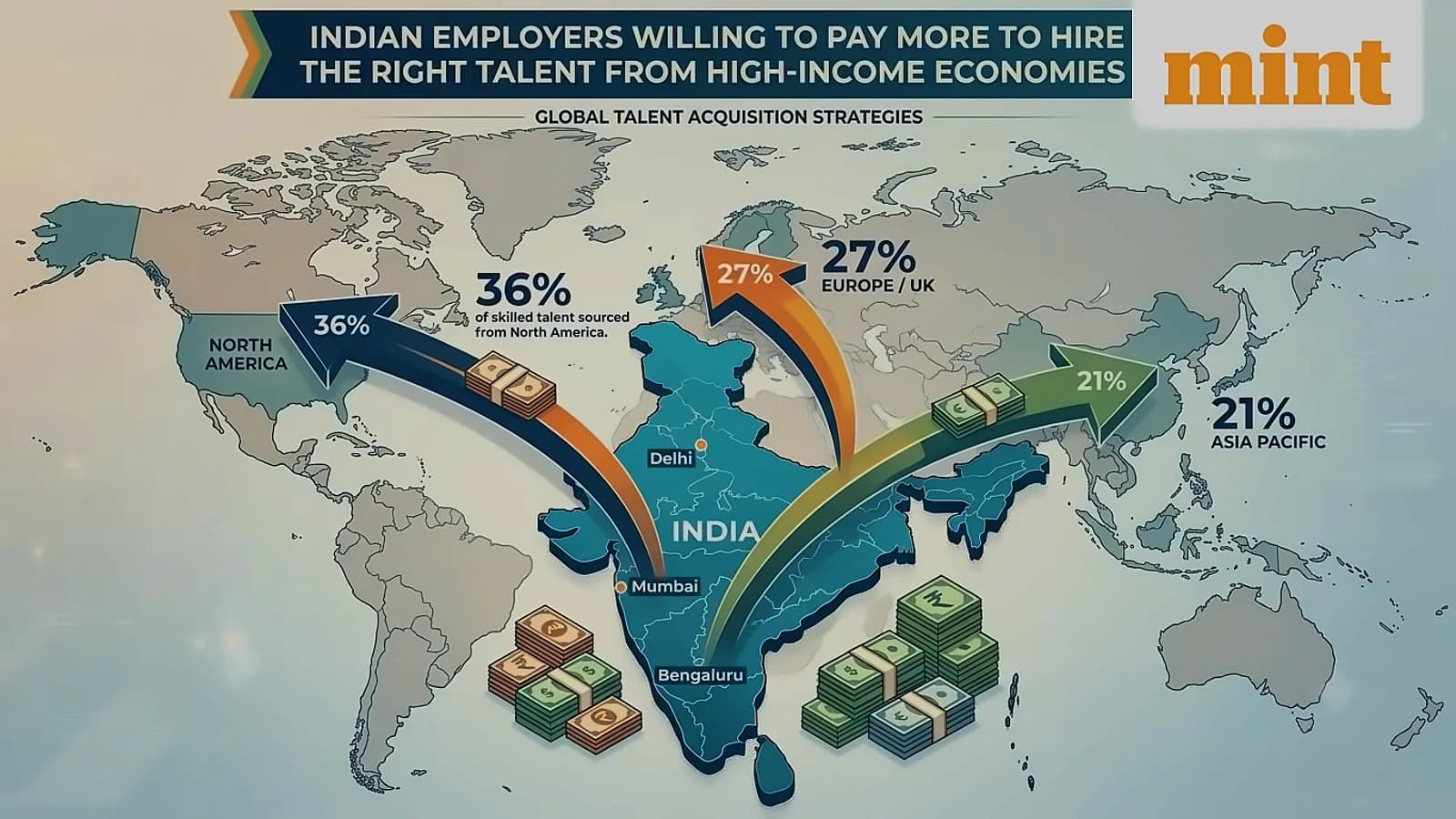
The survey revealed that over half of companies (54%) have more than a quarter of their workforce already based outside India. Additionally, 58% of respondents operate in four or more countries, with 20% operating in over 10 countries. Among companies hiring globally, 34% cite access to specialised or emerging skills as their top reason, followed by 33% who hire to be closer to customers and local markets, and 20% who cite the ability to run 24/7 operations. North America remains the top destination for Indian companies' global workforces, cited by 36% of respondents, ahead of Europe/UK (27%) and APAC (21%). According to ET Now, the survey covered 1,008 decision-makers and HR leaders across seven major Indian cities, with the findings indicating that employers are willing to offer higher pay to attract the right talent from high-income economies for revenue-critical roles.
According to the report, around nine in ten (89%) of companies hiring globally are looking for advanced technology and engineering talent, including core developers, AI/ML specialists, and R&D professionals. This is followed by sales and business development (80%) and product and design (45%). The findings underscore that for Indian companies, going global is a talent and market-access strategy, not a cost play, as companies are willing to pay more to hire the right talent from high-income economies for roles that directly influence roadmap and revenue. As per ET Now, this represents a significant shift in how Indian companies are structuring their workforce to support growth in international markets.

The report identified that compliance, not cost, has emerged as the biggest obstacle to scaling. Three quarters (76%) of respondents cite compliance and administrative burden as their primary challenge, with local entity setup taking longer than expected (42%), visa, immigration or work permit delays (31%), and payroll, tax or statutory filing errors (27%). Seven in ten (70%) companies say compliance-related delays pushed back a product or market launch, while 67% report strain on leadership time, team morale or company reputation. Nearly six in ten (59%) experienced delayed revenue because new hires were not productive on time, and 49% lost or delayed a deal, contract or project. According to ET Now, Rakesh Gaur, Head of Sales for India at Deel, emphasized that "managing compliance across fragmented systems isn't just inefficient - it's a compliance liability. The ones that win will consolidate their operations onto a platform built for global growth."
The survey found that 34% of companies already use an Employer of Record (EOR) model, while another 24% use a mix of employment models combining EOR, contractors, and owned entities. Among companies using EOR solutions, 40% say it saves them both time and cost, and a further 35% say it primarily saves time. However, fragmented operations remain a challenge, with nearly half (46%) of companies using a central HR system but still managing global payroll manually, and 44% juggling between two to five separate HR or workforce platforms. According to ET Now, the advantages of EOR solutions are evident, with companies using the model experiencing significant improvements in operational efficiency and cost management.