
Canada's Foreign Affairs Minister Anita Anand has confirmed that any decision to join the U.S. critical minerals trading bloc will be part of broader USMCA negotiations rather than a standalone sectoral agreement. Speaking after attending Wednesday's critical minerals summit, Anand told The Globe and Mail that 'We're only signing deals that are favourable to Canada. We are not looking to sign sector-by-sector-deals, and we are looking forward to the comprehensive CUSMA review.' She emphasized that 'signing sector-by-sector deals, especially in critical minerals, could potentially undermine the broader effort on CUSMA' and that 'it's important for Canada to understand the full ambit of the proposal'. Anand noted that Canada is a major producer of critical minerals and that 'we're only signing deals that are favourable to Canada's economic and security interests'. The minister also revealed that consultations between the U.S. and partner countries on the critical mineral trade zone pact are scheduled to take place until April 1, with negotiations on the pact expected to commence after that.
U.S. Vice President JD Vance announced plans to establish a critical minerals trading bloc with more than 55 allies and partners, marking a significant escalation in Washington's efforts to loosen China's grip on materials crucial to advanced manufacturing. Speaking at the inaugural Critical Minerals Ministerial in Washington, Vance told officials from European, Asian and African nations that the bloc will guarantee American access to American industrial might while expanding production across the entire zone. According to Reuters, the meeting brought together visiting ministers to discuss the strategic initiative, with Secretary of State Marco Rubio hosting the gathering that included officials from South Korea, India, Thailand, Japan, Germany, France, Britain, Australia, and the Democratic Republic of Congo. Canada's Foreign Affairs Minister Anita Anand was among the delegates, with Vance telling her directly that 'she and U.S. officials are on the same team' as he pushed for the creation of a critical minerals preferential trade zone. The Agreement on Trade and Critical Minerals as proposed by the Trump administration would create a 'preferential trade zone with adjusted price floors and co-ordinated tariffs'.
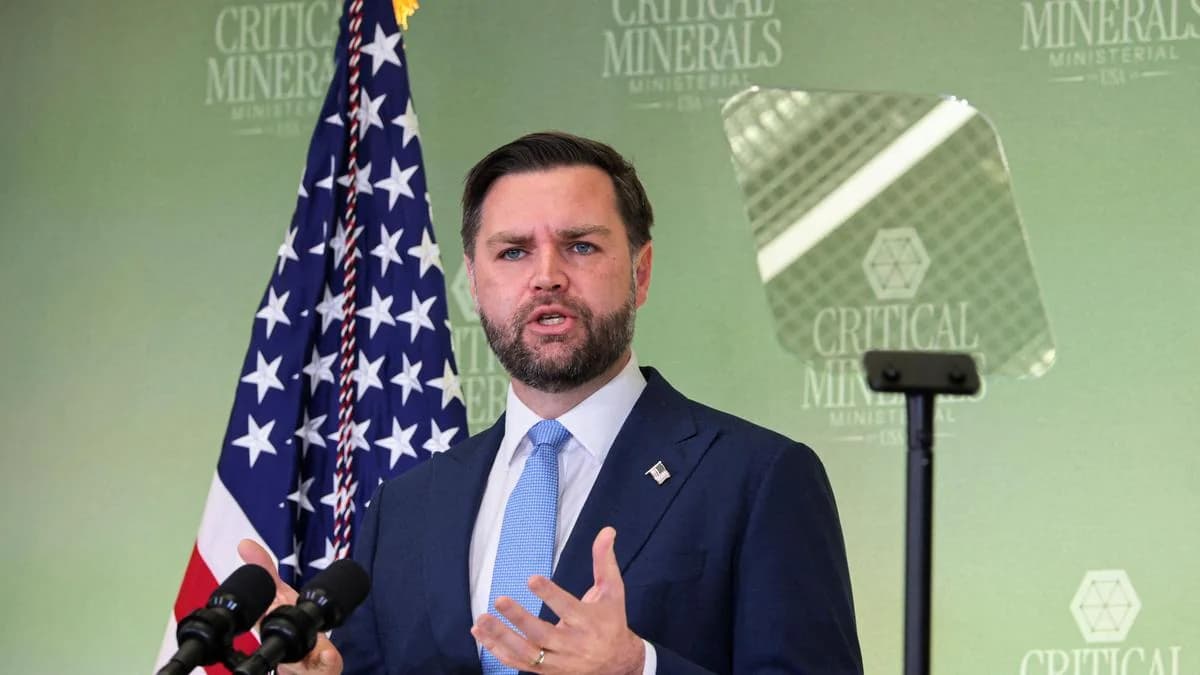
The Trump administration has secured price floor agreements with the European Union, Japan, and Mexico to counter China's dominance in critical minerals markets. As reported by Bloomberg News, Vice President JD Vance announced that these key partners have committed to setting up new policies including price floors to help solve critical mineral supply chain vulnerabilities. Each country has also pledged to work toward a binding multilateral agreement on trade in critical minerals, marking a significant advancement in the administration's efforts to reduce dependence on China. The US-EU memorandum of understanding is targeted for completion within the next 30 days to boost critical minerals supply chain security. Vance emphasized that 'this entire effort will be stronger and far more competitive if we build it together' through international cooperation. The U.S. also announced Wednesday it was drawing up critical mineral action plans with Mexico, the European Union and Japan that include setting price floors.
The trade bloc proposal follows President Donald Trump's Monday launch of Project Vault, a strategic stockpile of critical minerals backed by $10 billion in seed funding from the U.S. Export-Import Bank and $2 billion in private funding. As reported by Bloomberg News, the administration has announced plans for a nearly $12 billion critical minerals stockpile to ensure American businesses and workers are never harmed by shortages. US Trade Representative Jamieson Greer announced bilateral plans with Mexico and trilateral agreements with the European Union and Japan to strengthen critical mineral supply chains. The US-Mexico arrangement will also include identifying specific critical minerals of interest and exploring price floors for metals imports, according to the USTR. Vance specifically outlined that the bloc aims to create 'a preferential trade zone for critical minerals, protected from external disruptions through enforceable price floors'.
China has wielded its chokehold on the processing of many minerals as geo-economic leverage, at times curbing exports, suppressing prices and undercutting other countries' ability to diversify sources of materials used to make semiconductors, electric vehicles and advanced weapons. According to Reuters, Vance told the gathering that the US-China trade war of the past year has exposed how dependent most countries are on critical minerals, the sale of which Beijing largely dominates. Marco Rubio emphasized that the minerals are 'heavily concentrated in the hands of one country' and have become 'a tool of leverage in geopolitics', though he did not explicitly reference China. Under Secretary of State for Economic Affairs Jacob Helberg noted that 'everything is geographically concentrated in China, which really isn't a value judgment — it's an objective fact'. The problem was exacerbated last year when Beijing imposed retaliatory duties and export restrictions on various critical mineral exports to the U.S., after Trump ramped up his tariff-driven trade war. President Trump's administration has stepped up efforts to secure U.S. supplies of critical minerals after China rattled senior officials and global markets last year by withholding rare earths required by American automakers and other industrial manufacturers.
While Canada remains open to joining the U.S. critical minerals bloc, the country has developed its own strategic approach to ensure stable access to critical minerals. At the 2025 G7 Leaders meeting in Kananaskis, Alta., Canada established a Critical Minerals Production Alliance, or buyers' club, intended to help pay for and stabilize critical mineral extraction projects while avoiding restricting access to these resources on a preferential basis. As reported by The Globe and Mail, Anand said Canada needs to study the proposed U.S. structure further, including the suggested inclusion of 'right of first refusal' language. She noted that 'it's important for Canada to understand the full ambit of the proposal, especially because we are only signing deals that are favourable to Canada's economic and security interests'. The minister emphasized that Canada has long recognized the need to ensure more stable access to critical minerals for global supply chains, with critical minerals being minerals and metals that are economically and strategically essential to modern economies and national security, but whose supply is vulnerable to disruption.
While the initiative gained support from multiple nations, at least two diplomats say president Donald Trump's stance on Greenland makes it hard for them to want to support the U.S. in this endeavor. The U.S. State Department believes that Europe will ultimately join, because countering China is more important than current concerns about Trump's policies. Rare-earth minerals are used to manufacture batteries, clocks, wiring, military hardware and semiconductors, among many other technological products, making their control crucial for national security. Rubio named Canada as one of the countries he believes has enormous potential to produce and refine these minerals, though it's not clear what the Trump administration would want from Canada in any critical mineral agreement. The summit and initiative build on years of efforts by prior administrations, including the US Energy Resource Governance Initiative and the Biden administration's Minerals Security Partnership. Canada signed a Joint Action Plan on Critical Minerals Collaboration with the U.S. in 2020, but there is no mention of price floors in the public description of that agreement.