Sugar stocks experienced sharp declines on September 1 after the government announced stricter stockholding limits for dealers to curb hoarding and speculative trading. The Ministry of Consumer Affairs, Food and Public Distribution reduced the maximum quantity of sugar that dealers can hold to 200 tonnes from 400 tonnes, effective September 15, 2026. According to the ministry, the revised limit will remain in force until November 30, 2026. Under the new rules, dealers will not be permitted to hold sugar stocks for more than 30 days from the date of receipt and will be barred from holding more than 200 tonnes at any time and at any location in the country. As per the Press Information Bureau (PIB) release, the measure is aimed at further curbing hoarding, discouraging speculative trading and preventing excessive accumulation of sugar stocks, with the government stating that the move will facilitate the orderly movement of sugar through the supply chain and ensure its continuous availability to consumers at reasonable prices. The stock holding limit of 400 tonnes, first imposed on August 1, will however remain unchanged for Kolkata and its extended metropolitan areas, considering the specific market requirements of the region, as the region sources sugar from Uttar Pradesh and Maharashtra and supplies it onward to the eastern and north-eastern parts of the country. The government has also implemented nationwide testing and verification through monitoring and physical inspections of sugar mills, dealers and traders, which have revealed instances of stocks being held beyond prescribed limits, concealment of stock information, and irregularities in the movement and sale of sugar.
Sugar company stocks experienced exceptional gains in August, with Avadh Sugar & Energy leading the pack at 59.35%, hitting a record high of ₹804.15 compared to ₹504.65 on July 31. The stock surge comes as sugar prices remain elevated despite recent government intervention, with the BSE Sensex trading 0.35% lower at 76,995 levels during the session. Dwarikesh Sugar Industries rose 38.01%, while Dalmia Bharat Sugar And Industries gained 35.63%. Uttam Sugar Mills and Mawana Sugars advanced 33.66% and 32.52% respectively, as per The Economic Times. However, sugar stocks traded firmly in the red following the government's announcement of stricter dealer stock limits. According to the government, these measures have resulted in approximately a 20% decline in ex-mill sugar prices in recent days, with retail prices also showing a downward trend and further reductions anticipated. Ex-mill sugar prices have dropped nearly 20% on August 28, 2026, following the Government's intervention, though retail prices remain elevated by 37% from ₹46.02 per kg last year to ₹63 per kg this year.
The central government has released a 13 lakh tonne sugar quota for the first fortnight of September 2026, covering the period from September 1-15. According to an official order, this quota includes 1 lakh tonne of imported sugar and represents a significant shift in government distribution strategy. The government has moved away from its long-standing practice of monthly release orders, instead implementing fortnightly release orders for mills. Under the fortnightly quota system, mills will be required to sell at least 40% of the allocation in the first week and the remaining quantity in the succeeding week, as per Arvind Kumar Rawat, a director in the Food Ministry's sugar division. This will leave an availability of at least 5.2 lakh tonnes during September 1-7, during which the Janmashtami festival will be celebrated on September 4, with the second week equally important due to Ganesh Chaturthi falling on September 14. A system for regular declaration and updating of sugar stocks has already been established on the online portal of the Department of Food and Public Distribution, with the government assuring that physical trade and distribution will continue without interruption.
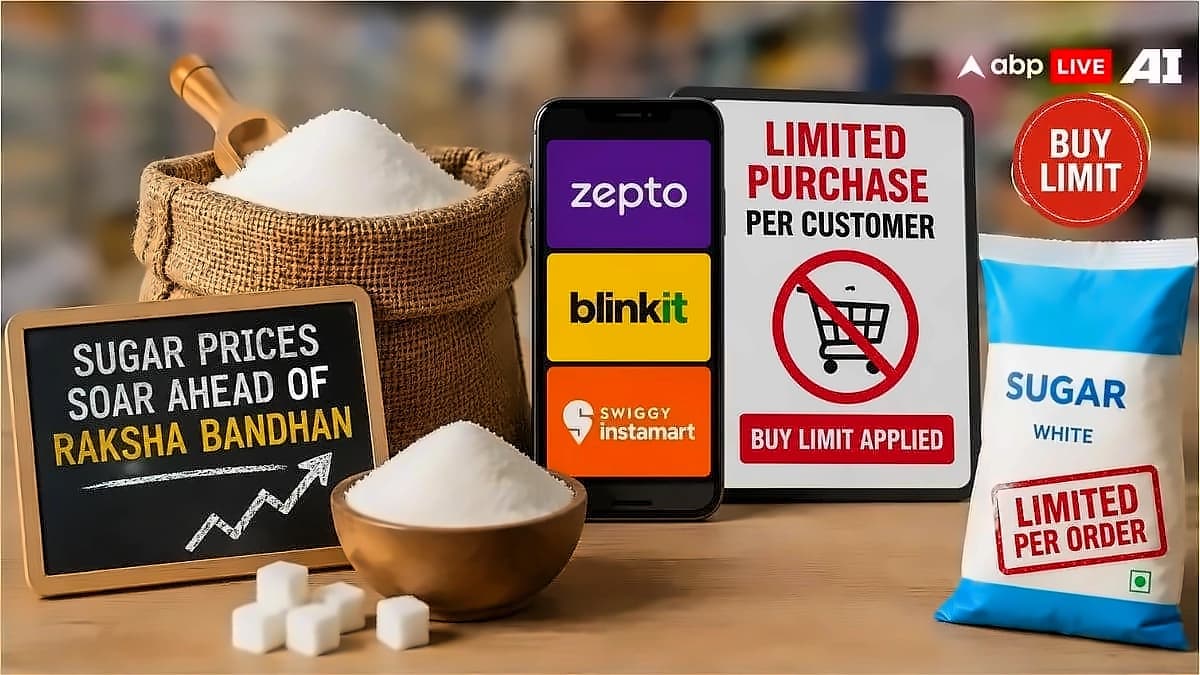
Quick-commerce platforms Zepto, Blinkit, and Swiggy Instamart have implemented varying purchase limits on sugar products to prevent bulk buying. According to reports, Swiggy Instamart allows customers to order up to two packets (2 kg) of sugar from certain brands in some cases, while Blinkit has restricted purchases of certain sugar packs to no more than 2 kg. Zepto is permitting customers to purchase one 2-kg pack of particular brands. In Delhi-NCR specifically, Blinkit has reportedly limited purchases of certain brands to one 5-kg pack per transaction, while BigBasket has capped orders for some brands at six 1-kg packs. Swiggy Instamart customers in parts of Delhi-NCR can order up to two 1-kg packs of one brand, while another brand has a limit of four 5-kg packs. These restrictions vary significantly depending on the product, platform, location, brand, and available stock. In some areas including Delhi and Noida, sugar was also reportedly shown as out of stock on certain online platforms, indicating supply constraints during the festive season.
Ex-mill sugar prices have dropped nearly 30% to ₹47 per kg on Monday from a peak of ₹67 per kg on August 18, following a series of government interventions. However, retail prices have yet to decline significantly, with retail sugar selling at ₹64.23 per kg on Sunday against a wholesale rate of ₹59.72 per kg. According to industry sources, retailers who bought stock at earlier higher rates are unwilling to sell at a loss and will continue pricing their existing inventory at older rates until it is exhausted. A retailer typically holds 10-15 bags of sugar, each weighing 50 kg, and only once fresh stock is procured at the lower rate will retail prices adjust accordingly. As per Dilip Patil, Managing Director of Samarth SSK Ltd and Co-Chairperson of the Sugar Bioenergy Forum, the sugar market has witnessed exceptional volatility with prices that had moved towards ₹6,500 per quintal subsequently falling towards the ₹4,800–₹5,000 range. The National Federation of Cooperative Sugar Factories (NFCSF) confirmed that ex-mill prices have fallen nearly 20% to around ₹55 per kg. Industry data shows some cooling at the mill level, with the ex-mill price of sugar in Maharashtra falling 30% to ₹45-46 per kg on September 1, from a peak of ₹67 per kg on August 18. The Consumer Affairs Ministry data shows the all-India average retail price stood at ₹63.28 per kg on August 31, up 37% from ₹46.02 per kg last year, while wholesale prices also rose 36.28% year-on-year to ₹58.40 per kg.
Shares of the three companies recommended by DAM Capital showed strong performance, with Balrampur Chini leading gains at 10.63% higher at ₹648.90, followed by Dalmia Bharat Sugar trading 35.63% higher at ₹509.10 and Triveni Engineering gaining 27.01% to ₹294.99. However, sugar stocks fell sharply after the government announced stricter dealer stock limits. Dwarikesh Sugar Industries was the biggest loser, dropping 7.02% to ₹48.74, while Triveni Engineering & Industries declined 5.76% to ₹278.60*. According to The Economic Times, Ugar Sugar Works rose 24.45%, Bajaj Hindustan gained 26.06%, Dhampur Sugar Mills advanced 26.57%, and DCM Shriram Industries rose 19.40%. On September 1, Dhampur Sugar Mills declined as much as 4.5% to ₹171.10 per unit, while Balrampur Chini Mills fell as much as 5.12% to ₹658 per equity share. Triveni Engineering & Industries shares tumbled as much as 6.3% to ₹277.10 per unit, and Dalmia Bharat Sugar slipped as much as 5.17% to ₹459.10 per equity share. The rally reflects investor confidence in the sector's improved fundamentals driven by elevated sugar prices and government policy support, but the recent government measures to curb hoarding have created market volatility. As per Fortune India, the limits could possibly put more pressure on sugar prices and weigh on margins for sugar producers, causing stocks to take a hit as investors reassess their prospects from the sector.