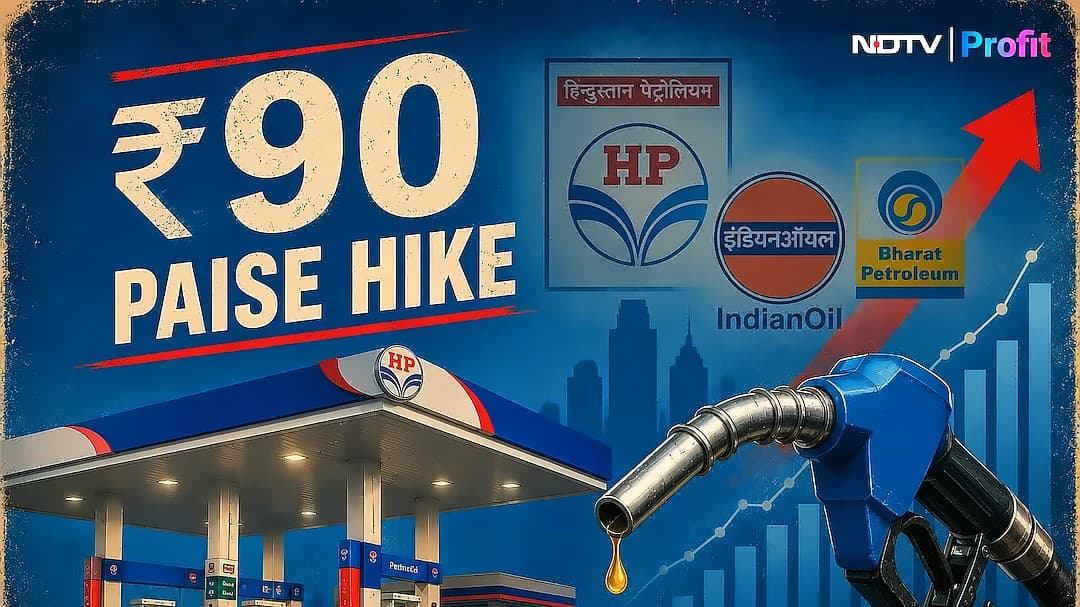
Oil marketing companies (OMCs) raised petrol and diesel prices by approximately ₹3 per litre across the four metros on Friday, marking the first fuel price hike in over four years since April 2022. According to reports from Business Standard, petrol in Delhi moved from ₹94.77 to ₹97.77 per litre, while diesel increased from ₹87.67 to ₹90.67 per litre. However, this modest increase provides only limited relief to OMCs, who were losing ₹14 per litre on petrol and ₹42 per litre on diesel as of early this week. As per The Indian Express, Petroleum Minister Hardeep Singh Puri revealed that combined losses of the three major OMCs - Indian Oil, Bharat Petroleum, and Hindustan Petroleum - are projected at ₹1 lakh crore in the April-June quarter at current price levels, potentially wiping out their collective profits for the entire 2025-26 financial year. The latest increase comes shortly after assembly elections concluded in Assam, Kerala, Tamil Nadu and West Bengal, with the move reflecting increasing financial strain on OMCs as global crude prices remain elevated amid geopolitical tensions in West Asia.
The retail price of petrol is composed of multiple layers, as detailed in the Business Standard report. The formula includes crude oil cost, freight and insurance, refining cost, OMC margin, central excise duty, dealer commission, and state VAT/local taxes. Delhi serves as the benchmark for fuel price build-up data, with final retail prices varying across cities due to different state taxes and local levies. According to the analysis, taxes together often form one of the biggest components of the retail fuel price, with the Centre imposing excise duty as a fixed amount per litre rather than a percentage of the retail price.
India imports nearly 90% of its crude oil requirement, making international crude prices extremely important for domestic fuel costs. The West Asia crisis has significantly impacted India's energy security, with the Indian crude oil basket averaging over $114 per barrel in April, up from $70 per barrel last year. As reported by The Indian Express, given that India imports 1.8-2 billion barrels of crude oil annually, every $1-per-barrel increase in oil prices bumps up the country's oil import bill by up to $2 billion on an annualised basis. According to Commerce Ministry data, crude oil imports in 2025-26 stood at about $135 billion, with the oil import bill potentially reaching upwards of $200 billion for the year if oil prices sustain at $100 per barrel. The crisis was compounded by the February 28, 2026 conflict in West Asia, which rapidly spread to multiple Gulf nations and halted almost entire sea freight navigating through the Strait of Hormuz, which moves 20 million barrels per day of crude and natural gas - about 20% of global petroleum consumption. According to Nomura, India is among the three most vulnerable Asian economies to high oil prices in terms of import bill and current account balances.
Under India's deregulated fuel pricing system, OMCs such as Indian Oil Corporation, Bharat Petroleum Corporation Limited, and Hindustan Petroleum Corporation Limited decide retail fuel prices. The government had previously slashed excise duty by ₹10 per litre on petrol and diesel in late March to blunt the impact of high international prices, resulting in the government foregoing revenue of about ₹14,000 crore a month or close to ₹1.7 lakh crore on an annualised basis. According to The Indian Express, discussions on potential fuel price hikes had gathered pace within the government, with a consensus building that a price increase was necessary. Prime Minister Narendra Modi recently appealed for conservation of petroleum fuels, while the government chose a staggered approach to avoid the shock factor of a single steep hike. However, the increase remains significantly lower than what several market analysts had anticipated, with brokerages expecting a sharper first round of hikes to partially offset losses being incurred by fuel retailers.
The latest price hike adds 15-25 basis points to headline inflation, according to DBS Bank, with fuel prices having a direct bearing on the CPI basket. As per The Indian Express, a one-shot steep price hike would not have been politically palatable, and a staggered approach provides the government opportunity to pass on higher prices to consumers gradually. Industry sources expect more calibrated price hikes in the coming days, with some analysts anticipating a 3-5% increase. However, analysts caution that this may not be the end of the road for fuel price increases. If crude oil continues to trade above $100 per barrel over the coming quarters, further rounds of hikes may become unavoidable. Emkay Global Financial Services estimates that cumulative fuel price increases could eventually reach ₹18-20 per litre over the next three to six months if global energy prices remain elevated. The broader economic implications are also beginning to come into focus, with a ₹10-per-litre increase in fuel prices potentially lifting retail inflation by nearly 75 basis points once secondary effects such as transportation costs and higher input prices are factored in. This could weigh on consumer demand and pressure sectors sensitive to fuel costs, including automobiles, cement and related industrial segments.