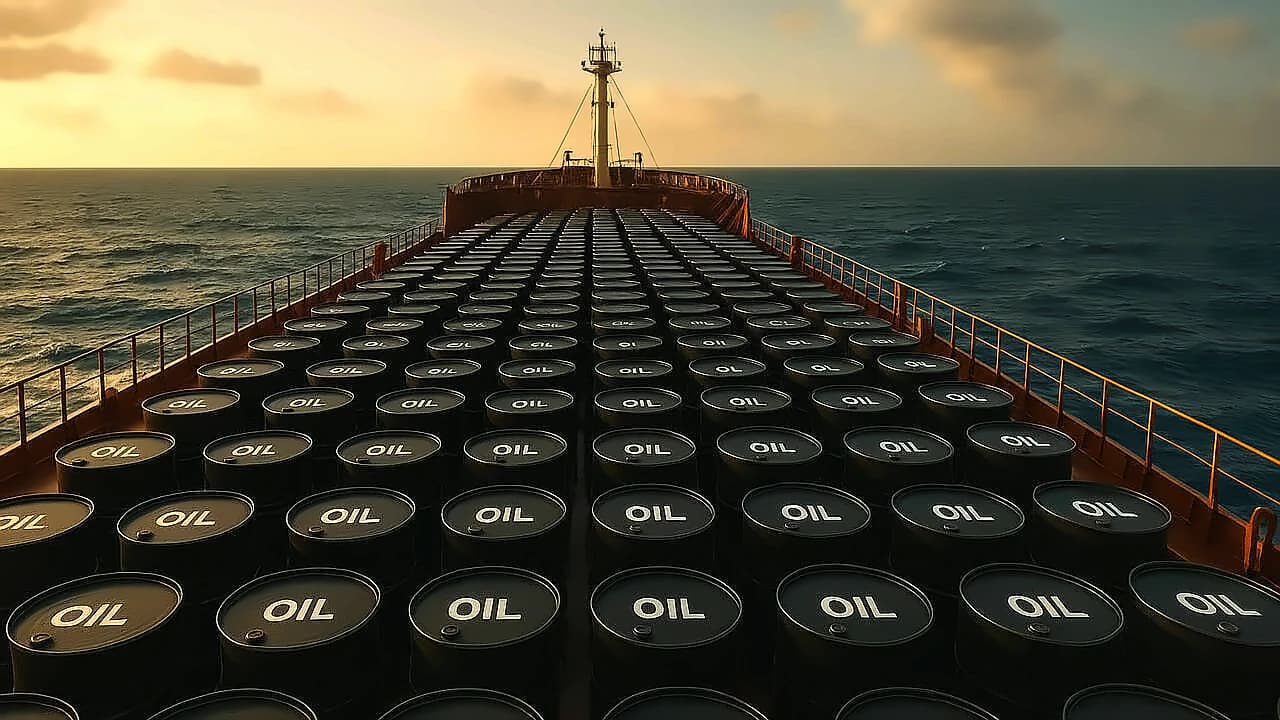
Brent crude futures edged higher on Wednesday, moving closer to the $90-a-barrel mark, with prices up 0.81% at $89.63 a barrel. According to The Economic Times, Brent crude gained 72 cents to $89.63, while US West Texas Intermediate (WTI) crude rose 71 cents to $83.91. The sustained rally comes amid ongoing uncertainty over the reopening of the Strait of Hormuz, with oil prices climbing more than 6% this week as hopes of increased shipping traffic through the key waterway have faded. Oil prices rose after Mohsen Rezaei, Secretary of Iran's Supreme National Security Council, said the Strait of Hormuz would not reopen until Washington met Tehran's conditions, calling for the US to unfreeze Iranian funds held overseas as a condition for reopening the strategic shipping route. Oil prices have climbed more than 40% this year, with some refined product prices rising even more sharply, as reported by the US Energy Information Administration's Short-Term Energy Outlook. Mirae Asset Sharekhan predicts that in the absence of any resolution between the US and Iran, each passing week would see floor prices increasing for global oil prices, with Brent potentially reaching $100 by mid-September.
Petrol prices across major Indian cities on August 12 show significant variations, with Delhi recording the lowest rate at ₹102.12 per litre, while Kolkata leads at ₹113.43 per litre. As reported by NDTV Profit, Mumbai petrol costs ₹111.12 per litre, Chennai ₹107.75 per litre, Hyderabad ₹115.69 per litre, and Bengaluru ₹110.93 per litre. Diesel prices show similar patterns, with Delhi at ₹95.20 per litre, Kolkata at ₹99.78 per litre, Mumbai at ₹97.78 per litre, Chennai at ₹99.57 per litre, Hyderabad at ₹103.82 per litre, and Bengaluru at ₹98.79 per litre. For India, which imports more than 85% of its crude oil requirements, a sustained rise in global oil prices could widen the import bill and add to inflationary pressures. Higher crude prices could also increase the likelihood of further domestic fuel price revisions.

US President Donald Trump has demanded compensation from Iran for damage incurred by the US, complicating the ongoing standoff over the Strait of Hormuz. According to Reuters, Brent crude climbed 1.6%, or $1.4 to $89.15 a barrel, edging closer to the $90 a barrel level after Trump's latest demands. The escalation comes after a small cargo ship was attacked on Tuesday by Yemen's Iran-aligned Houthis in the Bab el-Mandeb Strait, killing three crew members. Maritime security sources told Reuters that a small cargo ship was believed to have been targeted in the Red Sea, with the fatalities on the Tanzania-flagged Tihamah representing the first deaths in a Houthi strike on a ship since Middle East conflict was triggered by US-Israeli attacks on Iran at the end of February. Trump has formally demanded compensation from Iran for casualties caused by Iranian-linked proxy conflicts, subsequently expanding that claim to encompass damages across Lebanon, Syria, Yemen and Gaza. Both sides are now tabling reparations demands the other cannot domestically accept, with Iran's parliament also moving to legally restrict US- and Israel-linked vessels in the Strait of Hormuz.
The International Energy Agency's latest monthly report shows that global observed oil inventories fell by 69 million barrels in July, driven by renewed disruptions to crude flows through the Strait of Hormuz and the Caspian Sea. According to Mirae Asset Sharekhan, since the start of the conflict, monitored stocks have fallen by an estimated 410 million barrels, equivalent to roughly 2.7 mb/d on average. Onshore stocks fell by a more modest 6 million barrels as the pace of emergency stock releases slowed, while global refinery crude throughput improved in July as US and European refiners returned from annual maintenance, but overall runs remained nearly 5 mb/d below year-earlier levels at 80.9 mb/d. Global refining capacity is still expected to fall by 370 kb/d by the end of Q3, while throughput may decline by an average of 2.5 mb/d in 2026 before rebounding by 3.5 mb/d in 2027.
If negotiations continue to lose momentum, Brent could move towards $100 by mid-September, according to Mirae Asset Sharekhan. The analysis notes that the cumulative rally of roughly 12% across six sessions is not a recovery built on improving fundamentals, but a risk-premium repricing triggered by the market's recognition that resolution is structurally further away. The compensation demand is where the negotiating architecture has materially deteriorated, with the 14-point memorandum of understanding that Washington and Tehran agreed to in June included plans for a $300 billion fund, backed by the US and regional partners, for the rehabilitation and economic development of Iran post-conflict. However, what replaced it this week is a structurally different problem, with Iran entering negotiations seeking reparations for the February campaign, a position Tehran has held consistently. The physical market is sending a more cautious and constructive signal, with the EFP premium of Dated Brent physical barrels over futures rising above $4, indicating buyers are paying more for immediate barrels. The Brent 1-to-12 month spread has widened to $13 in backwardation, signaling strong near-term demand and concern about supply availability.
Supply concerns have increased after Saudi Arabia's state oil company Saudi Aramco delayed the restart of its 400,000-barrel-per-day Jazan refinery to August 30. The delay came after the Houthis claimed responsibility for two attacks on the facility on Sunday. The UAE's ADNOC said on Friday that 15 of its vessels had been attacked while passing through the Strait of Hormuz since the conflict began. The situation around both Hormuz and Bab el-Mandeb remains a key risk for oil markets, with even temporary restrictions, or the threat of further attacks, raising insurance costs and prompting ships to use longer routes. US Strategic Petroleum Reserve levels are at their lowest since 1983, reducing Washington's ability to absorb a prolonged supply disruption through emergency releases, leaving the oil market more sensitive to any further escalation. Freight and war-risk insurance premiums remain at multiples of pre-conflict levels, embedding a cost layer into physical barrels that futures moves do not automatically dissolve.