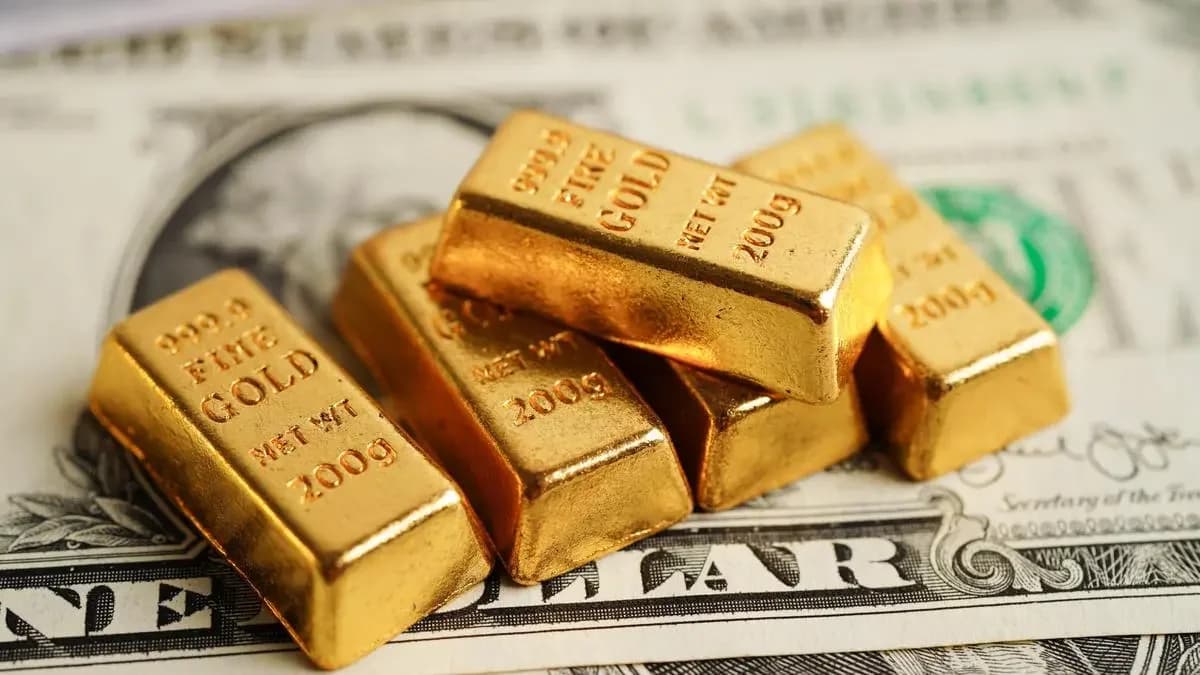
International brokerage house Goldman Sachs maintains its $4,900 per troy ounce target for gold by year-end 2026, representing nearly 10% upside from current levels despite gold's recent decline. According to Goldman Sachs Research, the yellow metal is "expected to rise amid strong demand from central banks seeking to diversify their foreign currency reserves," coupled with the market scaling back expectations of US rate hikes in 2026. The forecast was reaffirmed in a note published August 28, with senior commodities analyst Lina Thomas and Global Commodities Research co-head Daan Struyven anchoring the call on official buying. The bank had previously cut its target by $500 in June as bets on 2026 rate cuts faded, but the reduced figure still indicated gains, just smaller ones.
Gold has fallen 5.5% from its three-month high of $4,697 reached on August 25, trading near $4,436 at press time. The slide has pushed the metal under its 200-day moving average of $4,529, with gold now recording multiple closes below this line - the first since early June. The metal briefly traded below $4,400 on Monday, its weakest level since August 19. According to Barchart, the SPDR Gold Shares fund entered a technical correction the last time gold logged multiple closes below the average, though this precedent covers only one prior episode. Renewed bets on a Federal Reserve rate hike have driven the latest leg down, with higher rates weighing on gold because the metal pays no yield.
Central bank gold accumulation has accelerated significantly, with Goldman Sachs Research estimating that central banks may potentially buy 50 tonnes of gold on average every month this year, significantly higher than the average of 17 tonnes per month before 2022. According to Goldman Sachs, "central bank purchases accelerated to 100 tonnes per month in June 2026 (on a three-month seasonally adjusted basis) from 66 tonnes the previous month." China's central bank was identified as the largest identifiable buyer in the market in June. As per Goldman Sachs Research, "central banks globally have been diversifying their holdings using gold, which is considered less likely to be frozen than reserves held in foreign currencies." This demand represents "a key structural positive" that will support a multi-year uptrend in gold prices.
While Goldman Sachs maintains its bullish outlook, Fidelity's analysis values gold around $5,000 against the global M2 money supply, about 13% above the press-time price. However, the near-term risk remains significant - Goldman's June note put gold at $4,400 by year-end if the Fed hikes, and the metal traded there on Monday. A sustained break below this level would also test the debasement trade, which ties gold and Bitcoin demand to currency erosion. Monarch PMS had previously predicted gold prices could reach $4,700 an ounce by year-end, with the precious metal expected to trade between $4,300-$4,700 an ounce as its base case scenario, carrying a 55% probability according to the wealth management firm's analysis.
According to Goldman Sachs, "we expect the Fed-related headwind to abate further, as our economists expect a lower inflation trend to keep the Fed on hold this year." Historically, gold prices tend to be under pressure when interest rates rise. The firm's valuation framework places gold's modelled value at $3,248-$4,595, with a $3,922 midpoint, while silver's modelled range is $54-$77, with a $65 midpoint. The bank's June note had put gold at $4,400 by year-end if the Fed hikes, and the metal's recent trading near this level demonstrates the sensitivity to interest rate expectations.