Indian mango exports to the US have experienced a dramatic 130% increase in a single year, with GI-tagged Indian mangoes now dominating the premium segment of the $1 billion US mango market. As reported by Goodreturns, Seattle stores have sold out Kesar mangoes within hours as demand for premium Indian Alphonso and Kesar varieties surges across America. This transformation represents what industry experts are calling 'Mango Diplomacy' - a soft power initiative that extends beyond traditional fruit exports to cultural and diplomatic engagement. The surge in US demand reflects the growing global appreciation for Indian mango varieties and their premium positioning in international markets. Recent developments show that Indian mango demand remains strong in Seattle, celebrated in the presence of the Consulate General of India, with the upcoming Indian Mango Festival in Seattle expected to further broaden market reach. However, recent social media conversations on platforms like Instagram reveal that some consumers in the US still express preferences for Egyptian mangoes, with users describing Indian varieties as having a 'cucumber-like taste' compared to the unique flavor profiles of Egyptian and other regional mango varieties.
India dominates the global mango economy with 26.3 million tonnes produced in 2024, according to reports from Goodreturns. This output is more than six times that of Indonesia, the second-largest producer, with China following at around 5 million tonnes. Despite being the world's largest producer by volume, India accounts for 43% of global consumption and consumes nearly half of its own production. The global mango export market crossed $1.66 billion in 2024 and is expected to grow at 8% annually through 2029. With the Indian mango market projected to reach nearly $2.46 billion in 2026, the scale of India's agricultural dominance is becoming increasingly apparent globally. However, the global mango market shows significant regional variations, with different countries claiming superior mango varieties based on local preferences and flavor profiles.
The most striking aspect of the global mango economy is the export value disparity between India and Mexico. As reported by Goodreturns, Mexico shipped mangoes worth $575 million in 2023, nearly four times India's export earnings of $154 million in the same year. This paradox exists despite India's massive production advantage, with the country exporting far more mango pulp than fresh mangoes. Saudi Arabia and the Netherlands are the biggest buyers of Indian mango pulp, which ends up in European smoothies and Middle Eastern nectars. The export value gap highlights the need for India to focus on higher-value fresh fruit exports rather than relying primarily on processed products. Recent market data shows USA imported over 2,043 MT in just the first months of FY26, demonstrating the sustained demand for premium Indian varieties.
The global mango market shows dramatic price variations, with Japan's Miyazaki mango fetching up to $3,600 per kilogram at auction, equivalent to approximately ₹3 lakh for a single fruit weighing 350 grams. In contrast, a dozen Dashehris can be purchased for ₹80 in Lucknow's Aminabad market. The Alphonso variety commands premium pricing, with a single kilogram of Alphonso pulp retailing at £8-£12 in British supermarkets. India's domestic mango prices have become volatile, with season-to-season price swings of 30-40% now common due to climate volatility. Recent market data shows USA imported over 2,043 MT in just the first months of FY26, demonstrating the sustained demand for premium Indian varieties.
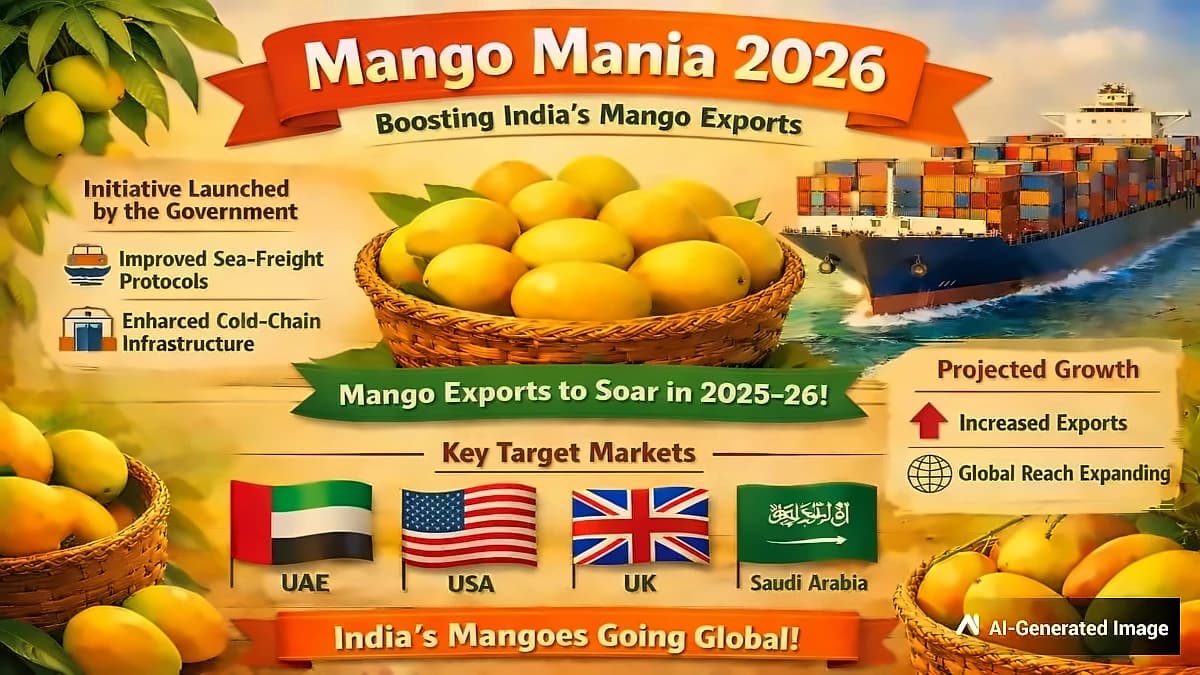
The 2024 mango season was characterized by regional price variations, with India experiencing heatwaves and unseasonal rains that reduced flowering and pushed domestic prices higher. Europe faced record-high prices due to Peru's El Niño-hit season, while Brazil stepped in with a bumper export year. For 2025, India started with bumper production keeping domestic prices lower, though New Zealand's increased imports created price competition. The global mango market, valued at an estimated $107 billion by 2030, is moving towards premiumization where origin, variety, and branding matter as much as sweetness. India's government launched Mango Mania 2025, an initiative to boost exports through improved sea-freight protocols and cold-chain infrastructure, with APEDA targeting new markets in Japan, South Korea, and Australia. This strategic focus aligns with Commerce Minister Piyush Goyal's ambitious $1 trillion export target for this year, positioning mango exports as a key contributor to India's global trade leadership.