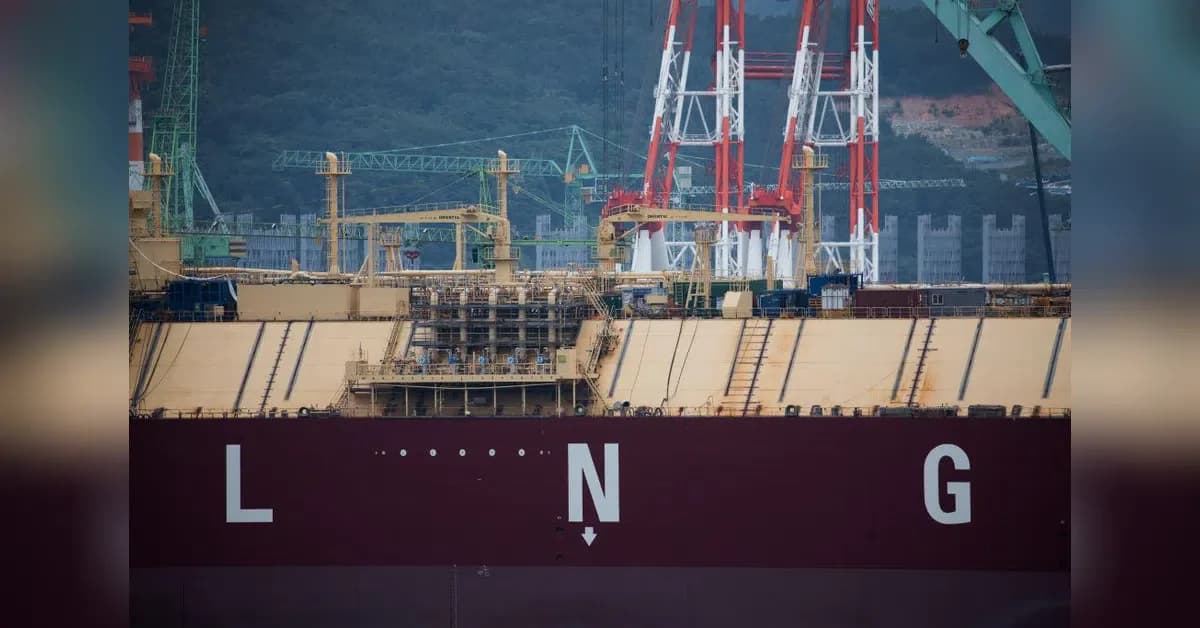
Global liquefied natural gas demand is expected to rise by around 65% by 2050, reaching nearly 700 million metric tonnes annually, according to Shell's 2026 Energy Outlook report. The energy major, which is the world's largest trader of the superchilled fuel, attributes this growth primarily to Asia as countries seek lower-emission alternatives to coal and data centres boost power demand. LNG trade, which reached 422 million tonnes in 2025, had been set to increase significantly in 2026 before severe disruption to shipping through the Strait of Hormuz. As per Business Standard, Shell expects global demand for LNG to increase to nearly 700 million tonnes a year by 2050, with countries prioritising "flexible and reliable" energy security. The forecast reflects growing energy needs across developing economies as countries seek reliable fuel sources to support industrial growth, electricity generation, and economic development.
The US-Israeli war on Iran has disrupted the global LNG outlook, with severe disruption to shipping through the Strait of Hormuz shutting in around one-fifth of global monthly LNG supply since the West Asia conflict began. As a result, total global LNG trade in 2026 could be similar to last year's level if shipping through the strait returns to normal this summer, before returning to growth in 2027, according to Shell's Energy Outlook 2026 report. The ramp up of new liquefaction facilities in North America, improved performance at existing plants and slower Asian imports of LNG have partially offset the impact of reduced supply from the Middle East. Despite the disruption, the company noted that the LNG industry has proved resilient and able to adapt to changing market conditions. "The conflict created a system-wide shock, with disruption cascading across all segments of the economy, but the LNG industry has proved resilient and able to adapt to changing market conditions," said Cederic Cremers, president of Integrated Gas at Shell. He added that the long-term outlook remains strong and LNG will continue to be a stabilising force in the global energy system.
Asian LNG imports for the first half of 2026 are down nearly 4% to 127.70 million tonnes compared with the corresponding period last year, according to data from analytics firm Kpler. Although Asian LNG spot prices rose above $20 per million British thermal units at the peak of the West Asia crisis, they remained well below levels seen in 2022 following Russia's invasion of Ukraine, reflecting greater resilience in the LNG market. With long-term supply agreements accounting for around two-thirds of total LNG trade, the average price buyers paid for LNG in May was around $11-12 per MMBtu, compared with $7-11 in January before the conflict began. Asian spot LNG prices were last at $15.35/mmBtu, a near four-month low as the market stayed hopeful about a peace deal to end the conflict. Rising urbanization, population growth, and increasing electricity demand continue to strengthen the need for stable and flexible energy supplies across the region.
Emerging segments of demand are growing rapidly, with Shell forecasting that LNG bunkering will grow seven-fold to 27 million tonnes by 2035, more than the amount of LNG imported by India last year. LNG growth is then expected to be strong to meet "rapidly growing" demand for energy with lower emissions than coal, while data centres are emerging as a new source of power demand. In more mature Asian markets such as Japan, data centres are emerging as a new source of power demand, while LNG will continue to play a key role in European energy security and help balance intermittent renewable power generation as domestic gas production declines. LNG has become an increasingly important component of the global energy mix because it produces lower carbon emissions than coal when used for electricity generation.
To meet rising demand, significant additional investment will be needed in new LNG export projects through the 2030s and 2040s, with around 200 million tonnes per year of new supply required in addition to projects already under construction. About 180 million tonnes per year of new LNG supply is forecast to enter the market by 2030, improving the availability and affordability of gas and opening up demand in new markets. Forecasts show South and Southeast Asia will account for around 40% of global LNG imports by 2050 to meet rapidly growing demand for energy with lower emissions than coal. The ability to benefit from new supply will depend on the availability of infrastructure in importing countries, including regasification capacity and pipeline connectivity, especially in South and Southeast Asia. Energy companies are responding by investing billions of dollars in new LNG export terminals, shipping fleets, and import facilities, with several large-scale projects already under construction in North America, the Middle East, Africa, and Australia to meet expected long-term demand.