India's coconut product exports achieved a remarkable milestone in FY26, reaching ₹7,038.35 crore (USD 794.70 million) according to the latest government update. This represents a substantial 62% increase over the previous year's exports of ₹4,349.03 crore, as reported by Business Standard. The growth underscores the growing global demand for coconut products from India and positions the sector as an important contributor to the country's agricultural export portfolio. The export trajectory has exhibited a fluctuating yet overall upward trend over the past decade, driven by rising global demand for natural, sustainable, and value-added products.
The current export performance represents significant progress from the sector's modest beginnings in 2001-02, when coconut exports were limited to just ₹25.3 crore. As reported by Business Standard, during that period, exports were largely restricted to traditional products such as coconut shell charcoal, coconut oil, coconut, and desiccated coconut. The sustained growth over the past two decades demonstrates the sector's evolution and expansion into diverse coconut-based products, with export value increasing from ₹1,450.24 crore (USD 216.71 million) in FY16 to ₹3,469.44 crore (USD 419.2 million) in FY24. While the export trajectory witnessed periodic fluctuations, including declines in FY18, FY20, and FY24, the overall trend remained positive, supported by increasing industrial applications and demand for eco-friendly alternatives in global markets.
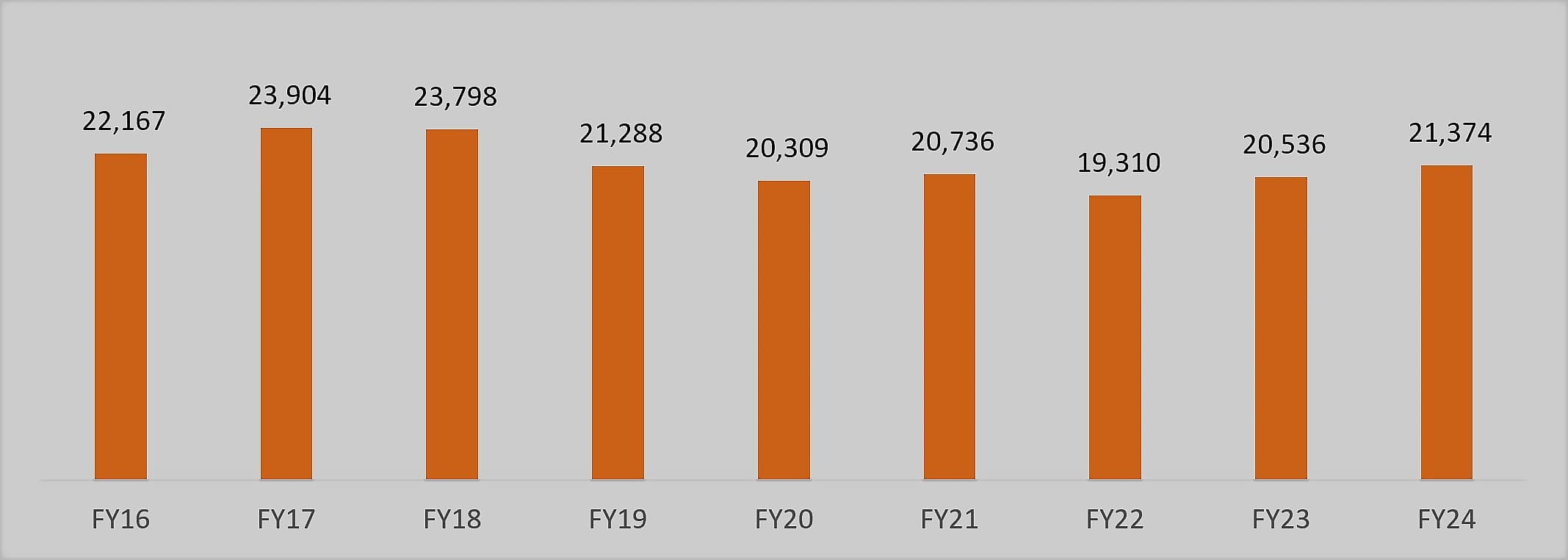
According to the government update reported by Business Standard, the coconut sector has emerged as an important contributor to India's agricultural exports, supporting the country's broader export ambitions. The substantial increase in export value reflects both the sector's growth potential and India's expanding role in global coconut product markets, highlighting the significant progress made since the sector's modest beginnings nearly two decades ago. The Union Budget 2026 emphasizes the development of high-value crops such as coconut, cashew, and cocoa to enhance farm incomes, promote diversification, and strengthen India's agri-value chains, with initiatives like the Coconut Promotion Scheme aiming to improve productivity through better planting materials and replanting of low-yield trees.
Based on FY24 product composition, activated carbon remained the dominant export category at ₹2,108.41 crore (USD 254.7 million), accounting for a significant share of total exports, followed by coconut oil (refined) at ₹334.23 crore (USD 40.4 million) and copra at ₹173.88 crore (USD 21.0 million). Other notable contributors included fresh coconut at ₹187.48 crore (USD 22.6 million) and shell charcoal at ₹68.96 crore (USD 8.3 million). India exports coconut to more than 140 countries around the world, with the major importers being Vietnam, the UAE, Bangladesh, Malaysia and the USA. For FY21, the top five countries accounted for 66% of exports, with Vietnam leading at 25% share, followed by UAE and Bangladesh at 14% and 12% respectively.
The Coconut Development Board (CDB) has implemented comprehensive schemes to develop the sector, including the Coconut Promotion Scheme introduced in Union Budget 2026-27, which aims to enhance productivity, replant ageing trees with high-yield varieties, and strengthen processing and value chains. The Minimum Support Price (MSP) for milling copra and ball copra has been increased from ₹5,250 (USD 60.92) and ₹5,500 (USD 63.83) per quintal respectively for marketing season 2014 to ₹11,582 (USD 134.41) and ₹12,100 (USD 140.37) per quintal for marketing season 2025, registering growth of 121% and 120% respectively. Overall coconut prices hit a seven-year high in January 2025, rising 38.7% YoY compared to a 33.8% increase observed in December 2024, with green coconut prices surging by 14.4% in January 2025. India is the third largest coconut-producing country in the world, accounting for about 30.37% of the world's total production during FY25, with a production of 21,373.62 million nuts.