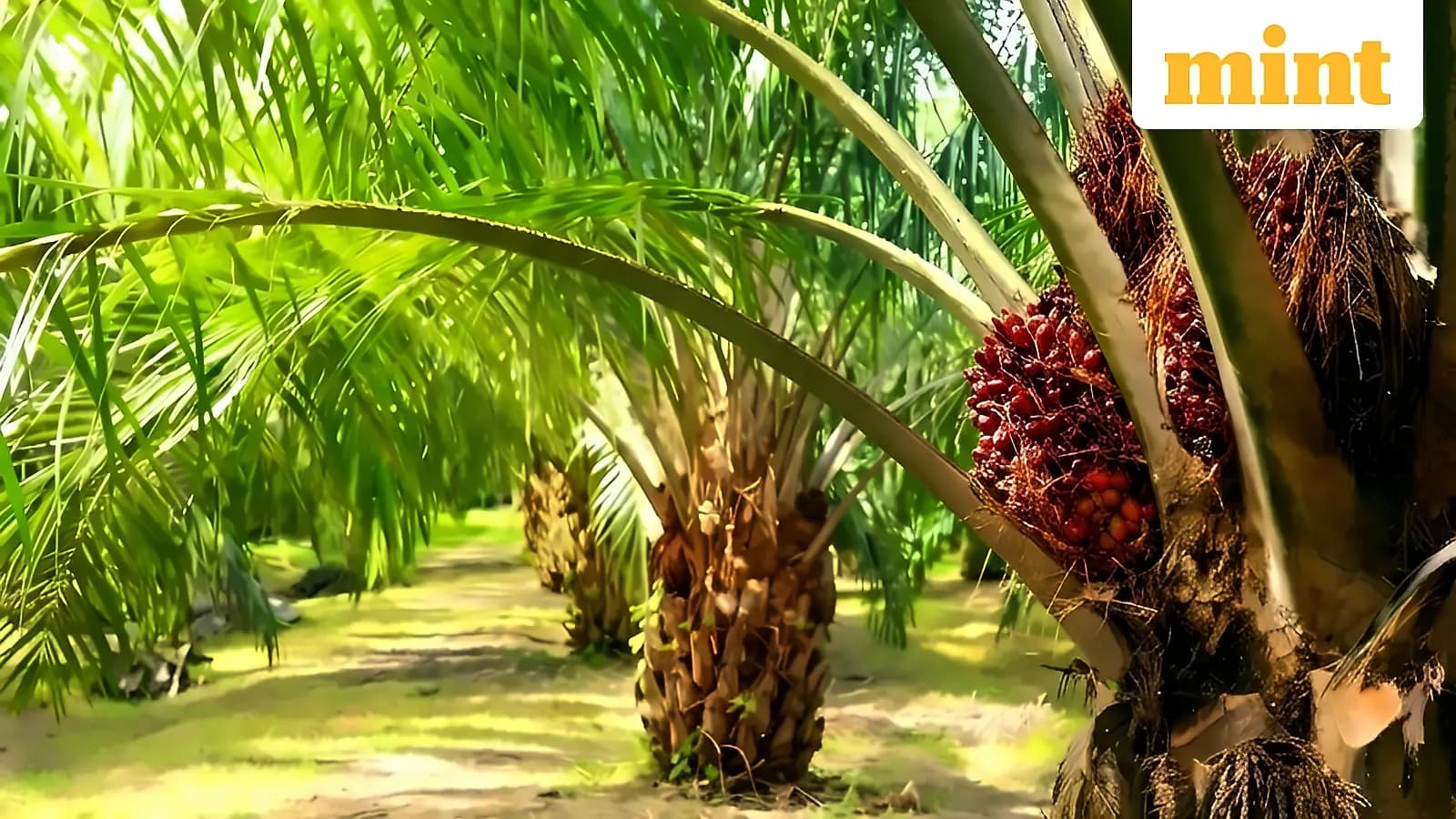
India's 'National Mission on Edible Oils–Oil Palm (NMEO-OP)' has achieved 47% of its targeted area coverage in the current fiscal year, with 1.19 lakh hectares expected to be covered by March 2026. According to The Hindu BusinessLine, Bihar has joined the mission to help reach this fiscal year's target, marking a significant expansion from the mission's original launch in August 2021 with a budget of ₹11,040 crore. The mission targets 25.45 million tonnes of edible oil production by 2030–31, which is expected to cover roughly 72% of the country's projected requirement. Within this framework, the mission aims to raise crude palm oil production to 2.8 million tonnes.
The latest data shows 55,614 hectares covered under oil palm in the current fiscal year, with six northeastern states contributing 23,347 hectares and nine other states accounting for 32,267 hectares. As reported by The Hindu BusinessLine, Telangana leads with 14,919 hectares, followed by Andhra Pradesh with 12,652 hectares, Odisha with 2,119 hectares, and Chhattisgarh with 1,465 hectares. The North-East region has achieved 64% of its target with 23,347 hectares covered out of 36,319 hectares targeted, while other states have covered 32,267 hectares or 39% of their 82,959 hectare target. The mission's structure, viability pricing support, and dedicated focus on processing infrastructure have given industry confidence for long-term investment planning.
Farmers are demonstrating strong returns from oil palm cultivation despite the four-year gestation period. According to The Hindu BusinessLine, Fresh Fruit Bunch (FFB) prices have increased significantly from around ₹12,500 per tonne in 2023 to nearly ₹20,000 per tonne today, substantially improving farm-level returns. Kishor Yelati from Chintampalle village in Andhra Pradesh's Eluru district earns ₹1.2–1.7 lakh per hectare during the gestation period through intercropping with maize and groundnut. During the first two years, he grew maize and in the third year, groundnut. With the palms now yielding, he grows cocoa alongside oil palm and earns about ₹1.2–1.7 lakh per hectare, excluding expenses. The crop's 20-year productive lifespan provides steady income for farmers, with the government providing price assurance through a twin-pricing mechanism including monthly formula prices and annual viability prices.
Major private companies are significantly expanding their oil palm operations through the mission framework. According to The Hindu BusinessLine, Godrej Agrovet, India's largest oil palm processor, has a national footprint of 80,000 hectares and is targeting 150,000 hectares with ₹300 crore investment in its Integrated Oil Palm Complex in Khammam, Telangana. Sunil Kataria, CEO and MD of Godrej Agrovet Ltd, stated that the company added close to 17,000 hectares last year alone and expects to double its footprint to around 150,000 hectares. The complex brings together seed and genetics, a nursery, an R&D centre, and a processing mill, with a refinery also planned at this location. Patanjali Foods has covered over 110,000 hectares involving 80,000 farmers and targets 500,000 hectares by 2030. The mission supports private investment through cluster-based approach with over 600 value chain clusters identified across the country.
The mission offers comprehensive financial support to farmers, including ₹1,00,000 per hectare for planting material, management, and topographical challenges in the North-East region, plus ₹2,90,000 for harvesting tools. Under the Viability Gap Payment (VGP) provision, the government provides differential support when industry prices fall below government-set rates. As per The Hindu BusinessLine, between 2021-22 and 2025-26, states utilised nearly 80% of the ₹1,447 crore released by the Centre. However, utilisation has been less than 40% of the ₹757.62 crore allocated for the current fiscal year, with Andhra Pradesh, Kerala, Nagaland, and Mizoram spending over 50% of their releases. Andhra Pradesh remains the clear leader nationally, contributing 83% of India's total crude palm oil production with 30,364 hectares added in 2025–26. Industry experts suggest the mission requires balanced ecosystem approach combining scientific innovation, institutional capacity, and private sector engagement to achieve up to 50% self-sufficiency by 2047.