Oil prices jumped more than 2% on Monday, with Brent crude futures rising $2.90 (2.77%) to $107.51 per barrel and WTI futures climbing $2.27 (2.27%) to $102.32 per barrel as of 2313 GMT, according to Reuters. Prices had initially risen more than 3% at market open before settling at the current levels. Brent rose $3.62, or 3.46%, to $108.23 a barrel by 2214 GMT on Sunday, while WTI increased $3.15, or 3.15%, to $103.20 a barrel during the same period, as reported by The Times of India. Oil prices had been expected to rise on Monday amid growing concerns about risks to supply from Saudi Arabia, the world's largest oil exporter, whose East-West oil pipeline was shut on Friday by a drone strike that originated in Iraq. Oil surged 8% higher on the week due to the disruptions, rising above $100 for the first time since July. IG market analyst Tony Sycamore warned that unless this week's talks in Oman produce something operational — or the East-West pipeline is brought back online quickly — the risk is that crude oil continues to extend its gains toward the $119.48 high of early March.
Saudi Arabian state media released video footage on Sunday showing damage to homes and a mosque from what it said was a Houthi attack on the country's southern Jazan province, as reported by The Times of India. The Houthis claimed to have used drones and missiles to target Saudi Arabia, including a military base just over the border with Yemen, with Houthi military spokesperson Brig. Gen. Yahya Saree not providing evidence or saying when the attack occurred. Saudi authorities sounded sirens Sunday afternoon in the southern city of Abha and Khamis Mushait province, warning residents to take shelter from potential incoming fire, as both areas were repeatedly attacked by the Houthi in recent weeks. The Saudi civil defence overnight said a projectile fell in a different area near the border with Yemen along the Red Sea, injuring two people and damaging a mosque and several other buildings, with the statement blaming the Houthis. The Houthis are targeting Saudi oil infrastructure and shipping as part of a recently declared blockade, but they have said they do not intend to threaten other countries' commercial shipping.
The Houthis' capture of Mokha on Thursday was their biggest territorial gain in years against their Saudi-backed Yemeni opponents, bringing them within 32 kilometres of the US military base in Djibouti on the other side of the Bab el-Mandeb Strait. The advance puts them just 32 kilometres from the US military base in Djibouti, on the other side of the Bab el-Mandeb Strait, which is the main US base in Africa and one of several foreign military bases in Djibouti, including those of China, France and Japan. The Houthi's advance puts them just 32 kilometres from the US military base in Djibouti, on the other side of the Bab el-Mandeb Strait, which is the main US base in Africa and one of several foreign military bases in Djibouti, including those of China, France and Japan. The Houthis' capture of Mokha and an island on the Bab el-Mandeb Strait, a crucial shipping alternative to the Strait of Hormuz, represents a significant escalation in the conflict. The Strait of Hormuz is particularly important for Saudi Arabia's ability to reroute exports, making the continued disruption of alternative routes a concern for traders.
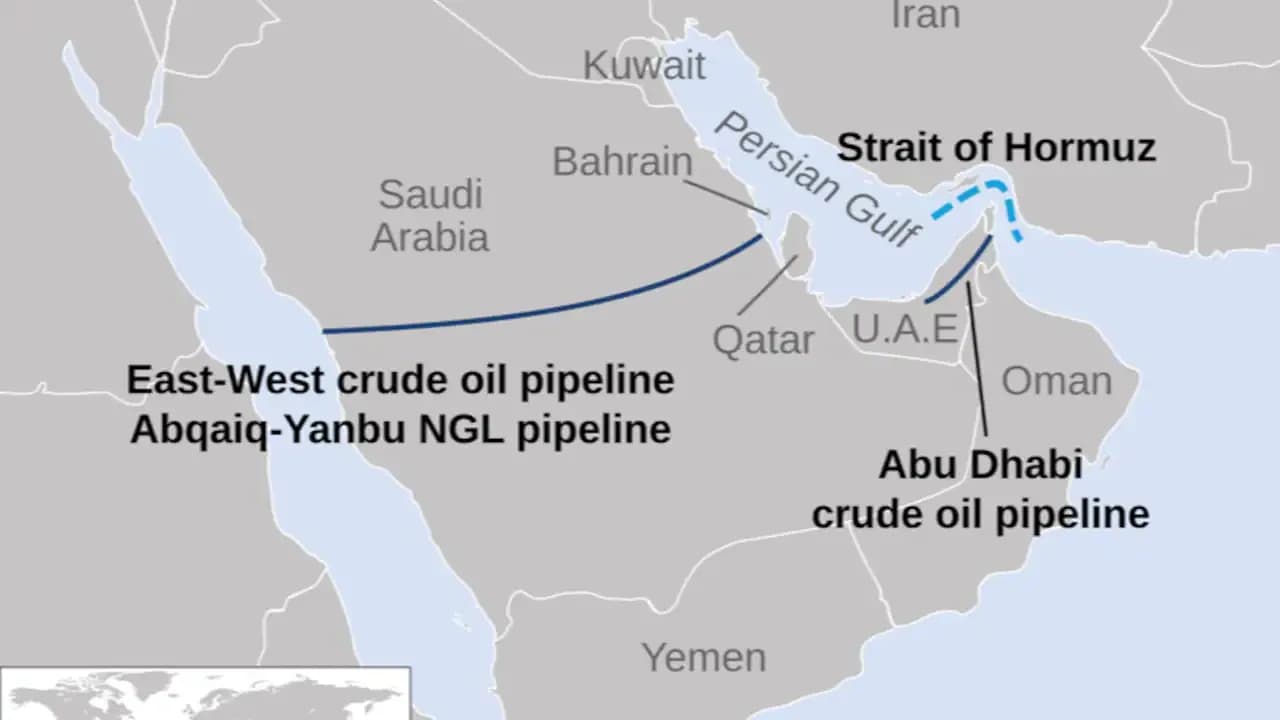
Saudi Arabia's Ministry of Energy confirmed Friday that it has shut down the major East-West oil pipeline as a precautionary measure following Thursday's attack, according to The Times of India. The ministry statement did not specify who carried out the attacks, calling the shutdown a 'precautionary measure' to protect the critical energy infrastructure. Built in the 1980s, the East-West pipeline has played a key role in Saudi Arabia's ability to continue exporting oil following the disruption of the Strait of Hormuz during Iran's war with the US and Israel. The loss of the pipeline, which helped Saudi Arabia re-route its exports avoiding the Strait of Hormuz, threatens up to 4% of global oil supply. Satellite imagery reviewed by CNN appears to show extensive fire damage at a pumping station near Al Mesba'ah, Saudi Arabia, with separate imagery from Thursday showing a smaller fire at another pumping station near Al Dhekra, with thick black smoke rising from the site. The pipeline's shutdown could put up to 4% of global oil supply at risk.
The conflict in Yemen intensified on Sunday, as government forces launched attacks against Iran-backed Houthi rebels along the Red Sea and Houthis fired into neighbouring Saudi Arabia, according to Business Standard. The Yemeni government vowed to send more forces to the Red Sea coast and one official conceded a 'painful' defeat last week when Houthis captured the port city of Mokha and an island on the Bab el-Mandeb Strait. The National Resistance, a government-allied force that had controlled coastal areas, said more than 500 government fighters were killed on the west coast over the past four weeks -- its first comprehensive toll. It also said more than 1,000 Houthis had been killed in Hodeida and Taiz provinces, with a spokesman for the Houthis not responding to requests for comment. The UN migration agency said Sunday that more than 82,000 people in Yemen have been displaced since the beginning of September, with Ahmad al-Masawi, the director of the Al Salam camp in the southern port city of Aden, saying 'The displaced people are in a very bad condition'. As Yemen risks descending into another civil war, the United Nations estimated that more than 80,000 people in the impoverished country have been displaced by the fighting since the start of September.