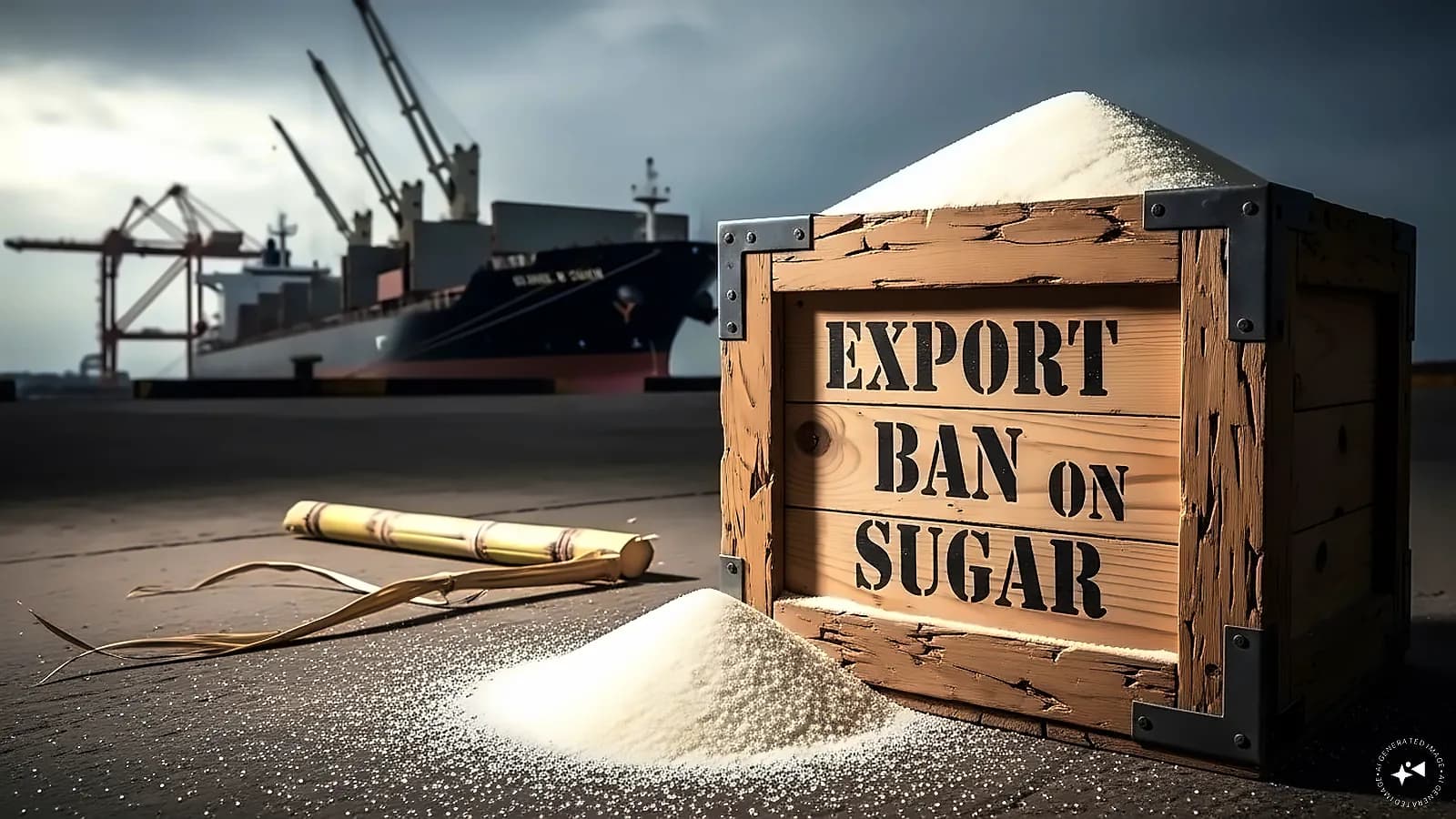
Sugar stocks experienced significant declines of 2-7% following the government's announcement of a complete ban on sugar exports until September 30, 2026. The Directorate General of Foreign Trade (DGFT) announced on May 13 that India has banned sugar exports with immediate effect, applying to raw sugar, white sugar and refined sugar. According to the notification, the ban is expected to impact sugar companies' export-related operations and revenue projections for the remainder of the fiscal year. Sugar stocks like Balrampur Chini Mills, Dalmia Bharat Sugar, Bajaj Hindusthan Sugar, Shree Renuka, Triveni Engineering & Industries, EID Parry and Bannari Amman Sugars will remain in focus following the government's announcement.
The government has allowed 1.59 million tonnes (mt) for export during October-September of 2025-26, out of which 0.53 mt were reported to have been shipped out of the country till March-end. However, industry sources indicate that the actual shipment of sugar in the current season could have been about 0.75 mt and total contracts (including quantity already shipped) could have been 1 mt. This means the government may save about 0.2 mt of sugar from going out of the country to make it available in the domestic market. The notification also allows export to other nations to meet their food security requirements based on government requirements.
According to the DGFT notification, loading of sugar on ships would be permitted if it had commenced before May 13 or the consignment had been handed over to the customs department before the publication of this notification. The export will also be allowed where the shipping bill has been filed and the vessel has berthed or arrived and anchored in an Indian port, with its rotation number allocated by the Port Authority, before the date of publication of this notification. The government has also clarified that shipments could be allowed on diplomatic requests from some foreign countries under permit system. Approval for loading in such vessels shall be issued only after confirmation by the concerned Port Authority regarding berthing/anchoring prior to this notification. Exports to the European Union and the United States under CXL and Tariff Rate Quota (TRQ) arrangements will continue as per prescribed procedures under relevant public notices, while sugar exports under the Advance Authorisation Scheme (AAS) would continue to be governed by the provisions of the Foreign Trade Policy (FTP), 2023, and the Handbook of Procedures, 2023.
According to the BMI report, the global sugar price has averaged US cent 14.6/lb (of 0.454 kg) in the first quarter of CY2026 (January-March), with quarterly averages projected at USc 16.2/lb in Q2 (April-June), USc 16.6/lb in Q3 (July-September) and USc17.2/lb in Q4 (October-December). The annual average for CY2026 is seen at US cent 16.2/lb. July NY sugar (SBN26) on Wednesday moved up 2.47 per cent and August London ICE white sugar (SWQ26) increased 3.10 per cent. Sugar prices have started rallying after analysts flagged tighter global supplies amid reduced output in Brazil and India from initial expectations. The export curbs are expected to support global raw and white sugar prices, while potentially opening export opportunities for rival producers such as Brazil and Thailand in Asian and African markets.
India's net sugar production is seen to be around 28 mt (excluding quantity diverted towards ethanol), which is same level as annual domestic consumption, in the 2025-26 season. Though this is higher than 26.1 mt in the previous season, the industry was expecting the production to be over 30 mt. India had faced a sugar shortage in 2022-23 season as a result of which export was restricted and despite a bumper output in 2023-24, no shipment was permitted. In 2024-25, the country exported 0.9 mt of permitted 1 mt. A recently released report highlighted that sugarcane output rose around 10 per cent year-on-year, supporting the sugar and ethanol ecosystem, although gains remained uneven and were largely limited to mills with integrated ethanol capacity.