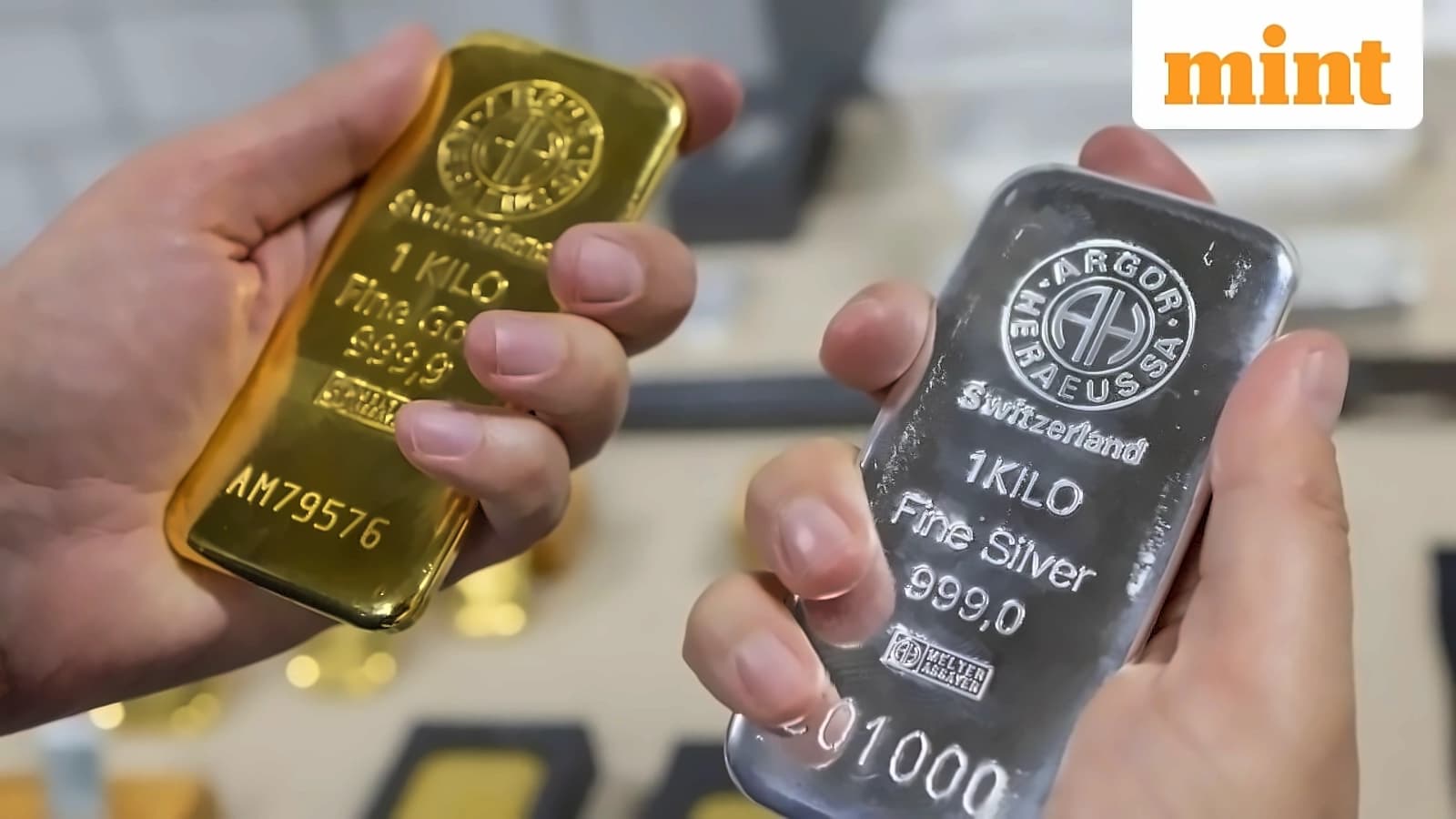
Gold prices extended their fall for the second consecutive day in India, with 24-carat, 22-carat, and 18-carat gold prices plunging by ₹3,900 to ₹2,900 across major cities. According to GoodReturns, in two days straight, the 100-gram and 10-gram gold prices crashed by at least ₹21,300 and ₹2,130 respectively. 24-carat gold prices stood at ₹14,967 per 1 gram, ₹1,49,670 per 10 grams and ₹14,96,700 per 100 grams in Chennai, which is highest among other cities. 22-carat gold is priced at ₹13,719 per 1 gram, ₹1,37,190 per 10 grams and ₹13,71,900 per 100 grams in Chennai, followed by Delhi at ₹13,700 per gram. 18-carat gold prices are most expensive in Chennai at ₹11,269 per gram, followed by Delhi at ₹11,212 per gram. MCX gold price is near ₹1.50 lakh per 10 grams mark, while MCX silver price is near ₹2.23 lakh per kg mark, tracking the cautious trend in the global bullion market.
Gold prices rose 0.1% to $4,180.19 per ounce on Monday, building on the 1.5% weekly gain as the precious metal benefited from a softer dollar and lower oil prices. According to Business Standard, gold crossed $4,200 per ounce in the global market as inflation concerns eased, while US gold futures for December delivery gained 0.1% to $4,228.80. The gains came as inflows into gold-backed ETFs have reached a four-year high, providing strong institutional support. Tim Waterer, chief market analyst at KCM Trade, noted that softer oil prices on the back of Trump's reported energy ceasefire between Russia and Ukraine, combined with a more subdued dollar, have given gold a window of opportunity to the upside to start the week. "As oil eases, it takes some of the immediate inflation and interest rate anxiety out of the market, which helps gold from a yield perspective," he added. The recovery was further supported by a surprise announcement by US President Donald Trump that Russia has agreed to release diesel to global energy markets, easing worries about a supply squeeze for the key fuel.
Market sentiment continues to react to the latest Federal Open Market Committee (FOMC) minutes, which showed all 19 policymakers favoured a September rate hike. As reported by Reuters, the minutes revealed different reasons for the unanimous support, with traders now pricing in an 18% chance of an October hike and 82% probability for December according to CME's FedWatch tool. Traders see a 17% chance of a rate hike in October and an 86% probability of an increase by December, according to the latest CME's FedWatch tool. Federal Reserve Governor Chris Waller said Thursday that he expects the Fed will need to hike rates multiple times to bring down inflation faster if economic data comes in expected. However, he cautioned that there could be some flexibility in the timing of the hikes as hikes should be in place in an acceptable period of time. US consumer sentiment slumped further in early October as the rising cost of living because of the Middle East conflict soured households' views of the economy, adding to the mixed economic signals. As per Trading Economics, gold remained under pressure as the US dollar climbed to an 18-month high ahead of key inflation reports that could shape the Federal Reserve's next interest rate decision.
US President Trump made a surprise announcement of an energy ceasefire between Russia and Ukraine on Sunday that he said was "effective immediately," but Ukrainian President Volodymyr Zelenskiy said he was still waiting to see details of the deal. According to The Hindu BusinessLine, oil prices fell on expectations of more Russian supplies, providing significant support to gold prices after the metal had slumped to $4,066, two-month low on October 7. Brent oil prices, which were up 6% for the day, gave back 50% of the intra-day gains following Trump's comments. Oil producers in the Gulf of Mexico have curtailed production in the tune of more than 510,000 bpd, which is around one-fourth of the regional supply, as Isaias, a tropical storm strengthened into a hurricane. Iran seems to be losing control of the Strait of Hormuz as oil flows through the Strait of Hormuz have reached 80-90% of the pre-war level, though product flows at 70% are still constrained. Easing oil prices and lower expectations of a Federal Reserve rate hike could offer some support to gold, though persistent geopolitical tensions and strong US economic data may cap gains.
In the domestic market, MCX gold futures for December 2026 delivery were trading near ₹1,50,850 per 10 grams, while silver futures were trading near ₹2,25,300 per kilogram. According to GoodReturns, gold futures are trading near ₹1.50 lakh per 10 grams mark, while MCX silver price is near ₹2.23 lakh per kg mark. Gold futures had opened ₹97 higher at ₹1,51,596 per 10 gram but declined ₹654 to the current level from the previous close of ₹1,51,499. Gold futures had touched a high of ₹1,80,779 per 10 gram earlier this year, while silver futures had reached a high of ₹4,20,048 per kg earlier this year. Gold has support at ₹1,50,870-₹1,50,240 and resistance at ₹1,51,915-₹1,52,330, while silver has support at ₹2,24,070-₹2,22,385 and resistance is seen at ₹2,27,010-₹2,28,265. Gold is down 4.5% year-to-date and 13.6% over the last six months, marking the first annual decline since a 3.5% drop in 2021, following consecutive years of positive returns.

Market experts are providing mixed signals on gold's near-term prospects while identifying key technical levels. According to Ajay Kedia, director at Kedia Advisory, gold was technically witnessing short covering with open interest falling 2.71% to 16,126 contracts as prices rose. "Gold currently has support at ₹1,50,870, followed by the next support at ₹1,50,240. Resistance is seen at ₹1,51,915 and ₹1,52,330. If gold sustains above ₹1,51,915, the recovery could extend towards ₹1,52,330," he noted. Vikram Subburaj, CEO of Giottus, said, "For buyers, gold offers the clearer set-up, but purchases can be staggered until ₹1,50,000 is crossed convincingly. Silver may deliver a sharper rebound, but its 2.17% range on Thursday shows why positions should be smaller and leverage lower." Nikos Tzabouras from Jefferies noted that gold continues to face a challenging environment, leaving it vulnerable to renewed declines, despite the current recovery. "Macro-geopolitical uncertainty and inflationary pressures persist, markets still expect Fed rate hikes ahead and bond yields remain elevated, keeping the opportunity cost of holding gold uncomfortably high," he added. The market will focus on next week's US CPI data on Wednesday, followed by the Producer Price Index (PPI) and retail sales data on Thursday, with traders bracing for the possibility of one more US Federal Reserve rate hike this year.
Central bank buying, a major support for gold in recent years, is expected to moderate this year due to high prices. As reported by CNBC TV18, purchases surged from an average of 450 tonne in 2020 and 2021 to 1,082 tonne in 2022 following the Russia-Ukraine war. Heavy buying by China kept volumes high at 1,037 tonne in 2023. In 2024, tariffs and a strengthening dollar led more countries to join in, pushing central bank purchases to a record 1,092 tonne. China's Central bank added 21 tons of gold in September, largest monthly increase in its official reserves since September 2023 when it purchased 24 tons, with PBoC's gold reserves rising to 2,196 tonnes as of the end of September. Global central bank gold buying in 2026 is being led by China and Poland. Mirae Asset MF notes that central banks continue to buy gold to diversify their reserves, while de-dollarisation continues to support demand as emerging economies diversify their reserves and reduce reliance on the US dollar. Total known global gold ETF holdings have swelled to 101.24 Moz, highest since July 2022, and up 1.23% (1.29 Moz, or 72 tons) YTD, with ETF holdings now 10 tons above the previous cycle high of 100.92 Moz. Among other metals, spot silver rose 0.4% to $61.02 per ounce, platinum gained 0.8% to $1,701.40 and palladium climbed 0.8% to $1,156.81.