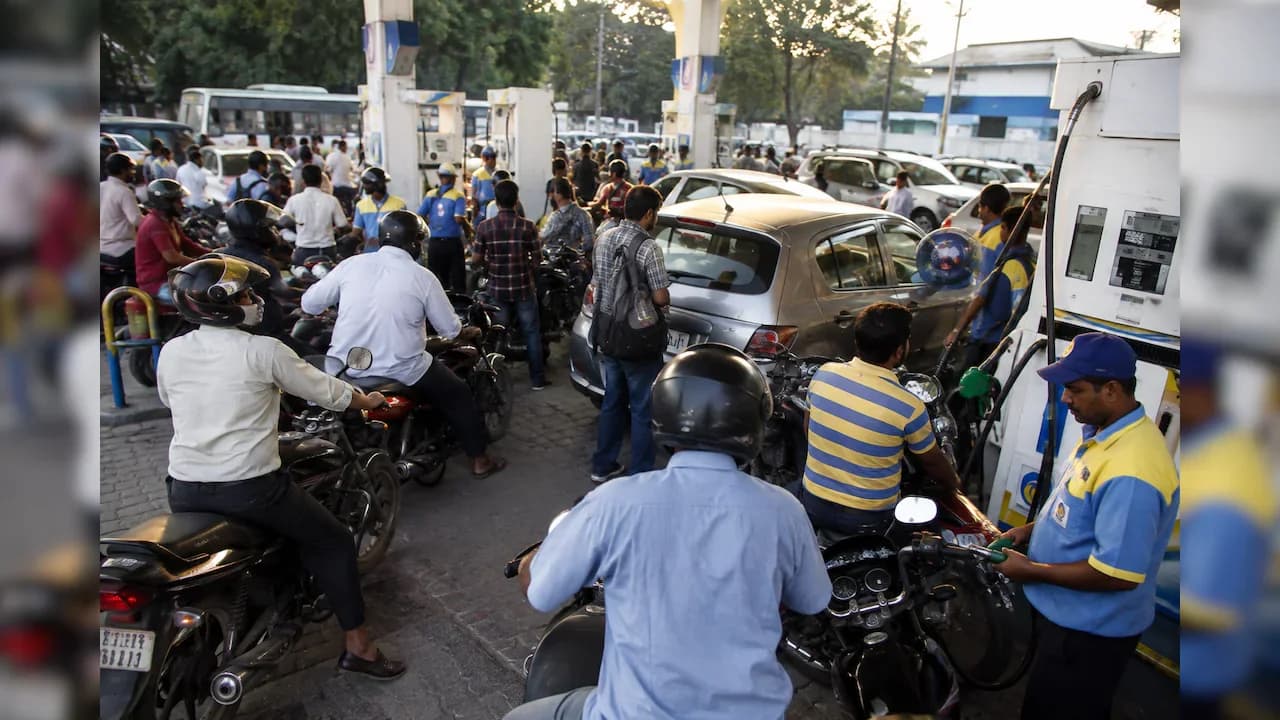
Fuel prices across major Indian cities remained unchanged on August 20, showing continued stability despite ongoing geopolitical tensions. In Delhi, petrol is available at ₹102.12 per litre and diesel at ₹95.20 per litre, with no price revision from the previous day. Mumbai maintains petrol at ₹111.12 per litre and diesel at ₹97.78 per litre, while Kolkata records petrol at ₹113.43 per litre and diesel at ₹99.78 per litre. Chennai has petrol at ₹107.75 per litre and diesel at ₹99.57 per litre, and Bengaluru offers petrol at ₹110.93 per litre and diesel at ₹98.79 per litre. Hyderabad shows petrol at ₹115.69 per litre and diesel at ₹103.82 per litre, with Kolkata remaining the most expensive for petrol and Delhi offering the lowest rates. The pricing structure reflects slight variations due to different tax structures across cities.
Oil prices experienced continued volatility as Middle East uncertainty weighed on market sentiment. Brent crude futures rose 0.7% to close at $91.62 per barrel on Wednesday, while US West Texas Intermediate crude traded 1% higher to settle at $85.83 a barrel. Brent crude futures were up 0.29% at $91.88 a barrel as of Thursday morning, hovering near the $92-a-barrel mark. Oil prices had surged after Iran and the US ruled out extending the memorandum of understanding signed in June to end their conflict, with the agreement expiring on Monday. The United Arab Emirates decided to suspend all financial and economic transactions with Iran, adding to regional tensions. Shipping through the Strait of Hormuz also remained slow as most ship owners avoided the waterway due to a lack of clear signaling on its reopening, as reported by Essential Business Intelligence.
The government implemented significant policy changes from August 15 that could impact future fuel pricing dynamics. The central government has abolished the windfall tax on export of petrol, while export duty on diesel has been reduced from ₹25.5 to ₹24 per liter. Tax on ATF (Aviation Turbine Fuel) has been reduced from ₹22 to ₹19.5 per liter. However, these changes do not yet seem to have any effect on the prices of domestic petrol and diesel, as reported by Essential Business Intelligence. The government and oil companies continue monitoring global oil market fluctuations, with the continuous increase in cost of crude in the international market being a matter of concern for India. Higher crude prices could also raise the prospect of domestic fuel price revisions.
India's heavy dependence on crude oil imports creates significant economic vulnerability, with the latest developments highlighting ongoing concerns. India imports more than 85% of its crude oil requirements, making it highly sensitive to global oil price movements. A sustained rise in global oil prices could widen the import bill and add to inflationary pressures. For India, a sustained rise in global oil prices could increase the import bill and add to inflationary pressures, as reported by Essential Business Intelligence. The government and oil companies are constantly keeping an eye on the ups and downs of the global oil market, particularly aware that if the availability of cheap crude from Russia reduces, then further pressure on the import bill may increase, potentially affecting domestic fuel prices in the future.