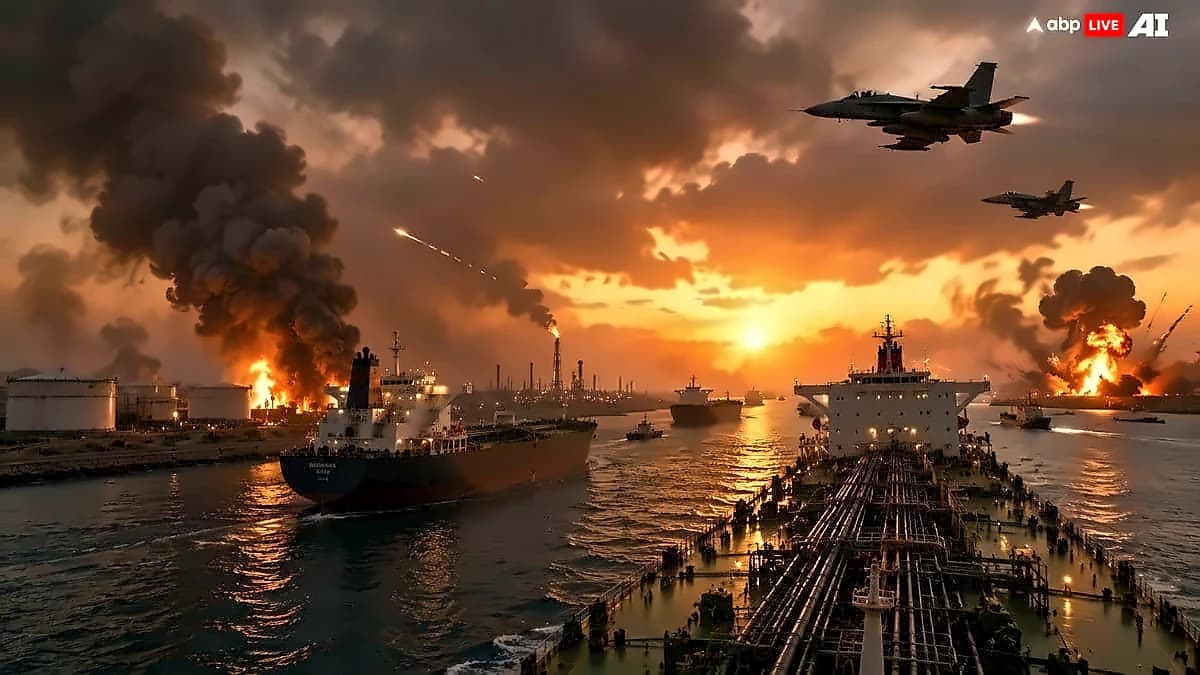
Oil prices extended their rally on Wednesday after reports that the US is preparing for an 'extended' blockade of Iran, escalating fears over global supply disruptions. US West Texas Intermediate futures jumped around 7% to trade above $107 per barrel, while Brent crude surged nearly 7% to cross $119 a barrel, its highest level in recent weeks. According to The Wall Street Journal, citing US officials, President Donald Trump has instructed aides to prepare for a prolonged blockade of Iran. Separately, Axios reported that Trump rejected Iran's proposal to reopen the Strait of Hormuz and indicated that the US naval blockade will remain until a nuclear deal is reached. Iran, meanwhile, has said it will continue disrupting traffic through the vital shipping route, adding to market volatility as the conflict enters its prolonged phase. Latest reports show West Texas Intermediate increased 2.6% to $109.64 a barrel, gaining for the fourth day, while Brent ended above $118 in the earlier session, its highest level since June 2022. On Tuesday, Trump discussed steps the US could take to prolong its blockade while minimizing the impact on American consumers at a meeting with oil and trading executives, the White House said.
In a move that sent immediate ripples across commodity markets, the UAE announced it will exit both OPEC and the broader OPEC+ alliance effective May 1, 2026, according to Mint citing state-run WAM news agency. The UAE's Energy Ministry described the move as a "policy-driven evolution," emphasizing that the country would begin gradually boosting its oil production in line with its long-term national energy strategy. "We thank OPEC for decades of cooperation," officials said, signaling that while ties remain cordial, the country is seeking greater autonomy over its output policy. The move removes one of OPEC's few members with the ability to quickly increase production, with the UAE having produced around 3.4 million barrels of crude a day just before the US-Israeli war with Iran began on February 28, and analysts saying it has the capacity to produce roughly 5 million barrels a day. "This exit of OPEC fits into the UAE's need for flexibility with key energy consumers as well -- including a future relationship with China and a more competitive relationship with Saudi Arabia," said Karen Young, a senior research scholar at Columbia University's Centre on Global Energy Policy. However, the UAE said it would continue to supply oil "in a gradual and measured manner," in line with global demand and market conditions, even after leaving the alliance.
US President Donald Trump has provided new insights into Iran's current situation, stating in a Truth Social post that "Iran has just informed us that they are in a 'State of Collapse." Trump added that "They want us to 'Open the Hormuz Strait,' as soon as possible, as they try to figure out their leadership situation." According to Upstox, Trump has been positive about Iran's potential to come up with a peace deal, but in a separate post, he mentioned that "Iran having nuclear weapons can potentially hold the entire world hostage." Iran is expected to submit a revised proposal to end the war in the next few days, with mediators anticipating this development according to CNN reports cited by CNBC-TV18. The revised proposal comes after Iranian foreign minister Abbas Araghchi's recent three-nation tour of Pakistan, Oman and Russia, where discussions focused on safe transit and regional security guarantees. Tehran wants the crucial waterway for oil shipments open "as soon as possible" as they work to resolve their leadership situation, though US President Trump is reportedly "unhappy" with the proposal as it fails to address nuclear programme issues. The latest surge comes after a Wall Street Journal report late Tuesday said that U.S. officials, including President Donald Trump, have asked aides to prepare for an extended blockade of Iran. The report said Trump plans to maintain pressure on Iran's economy and oil exports by restricting shipping to and from its ports.
The Strait of Hormuz has been virtually impassable since the conflict began in late February, driving up energy prices after flows of crude, natural gas and oil products were cut off, as reported by CNBC-TV18. Blockades of the Strait of Hormuz by the US and Iran has reduced daily transits to near zero, with the International Energy Agency calling the conflict in the Middle East the biggest supply shock in history. Vitol Group says the market is facing a supply loss of around 1 billion barrels. Iranian officials remain defiant. Mohsen Rezaee, military adviser to the Supreme Leader, vowed the nation will respond if the US blockade continues, according to state TV. Parliament Speaker Mohammad Bagher Ghalibaf accused Trump of seeking to force Tehran to surrender through economic pressure and internal divisions, Tasnim news agency reported. A ceasefire has held since early April with the US and Iran locked in an impasse over peace talks, although the naval blockade appears to be putting pressure on Tehran. Kpler Ltd. reports that Iran is rapidly running out of crude storage space, which is threatening to accelerate production cuts. The conflict has led to the United Arab Emirates deciding to leave OPEC next month after six decades of membership after the shortage caused by the war will require agility to respond to market demands. World oil supplies are sharply constrained by the war in Iran, which has closed off the Strait of Hormuz, a waterway through which one-fifth of global oil supplies — including much of the UAE's — is transported.
The UAE's withdrawal from OPEC represents a significant shift in global oil market dynamics, with OPEC accounts for roughly 40% of the world's oil output, but its market power has been waning in recent years as the United States ramped up production. While the US pumps more than 13 million barrels a day, Saudi Arabia had been producing more than 10 million barrels of oil a day before the war. "A structurally weaker OPEC, with less spare capacity concentrated within the group, will find it increasingly difficult to calibrate supply and stabilize prices," said Jorge Leon, head of geopolitical analysis at Rystad Energy. The UAE's exit reflects "the ties binding OPEC members together have loosened," particularly after Qatar withdrew from the cartel in 2019. Despite the spike in energy prices, Wall Street losses remained modest with the S&P 500 falling 0.2% after retreating from a record high, the Dow Jones dropping 335 points (0.7%) and the Nasdaq Composite slipping 0.3%. Markets were also cautious ahead of the Federal Reserve's interest rate announcement, with most investors expecting the Fed to keep the federal funds rate unchanged as higher oil prices risk fuelling inflation. The yield on the 10-year US Treasury note rose to 4.40% from 4.36% following the latest jump in oil prices. Investors are also closely watching the US Federal Reserve, which is concluding its April policy meeting, for any signals on inflation pressures driven by rising energy costs.
Analysts are warning of potential further price increases as the current crisis deepens. According to a Haitong Futures note cited by Reuters, the current ceasefire phase increasingly appears to be preparation for further conflict. It added that if U.S.-Iran talks fail to make meaningful progress by the end of April and hostilities resume, oil prices could rise to fresh highs for the year. Macquarie estimates crude prices may remain supported in the $85 to $90 range in the near term, with a gradual move towards $110 as supply conditions improve. It also warned that prolonged disruptions through April could push Brent as high as $150 per barrel. Nuvama Institutional Equities said an extended closure of the Strait of Hormuz, which handles around 20 million barrels per day, could lift crude prices into the $110 to $150 range. The UAE's abrupt decision to leave OPEC, though unlikely to have a major immediate market impact, is part of a broader shift in Middle Eastern energy politics. Despite the current price surge, corporate earnings continued to influence stock-specific moves with Visa rising 9% after reporting stronger-than-expected results and Starbucks jumping 9.1% after beating estimates.