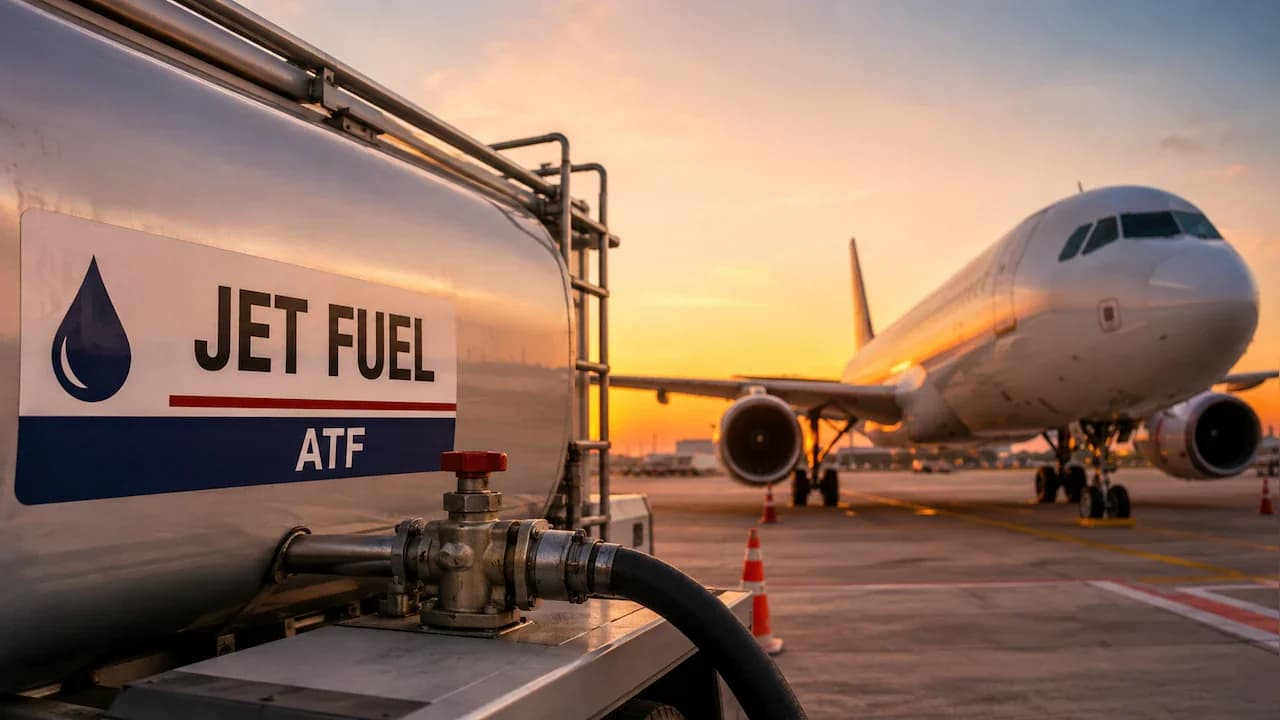
Aviation turbine fuel (ATF) prices for domestic airlines have been increased by 5.46% or ₹6.28 per litre, according to sources at Indian Oil Corporation Ltd. (IOCL). The price has been raised from ₹115 per litre to ₹121.28 per litre, marking the second consecutive monthly increase. This follows a ₹5 per litre hike on August 1, when ATF prices for domestic airlines rose from ₹110 per litre to ₹115 per litre. The latest increase translates to ₹6,280 per kilolitre for domestic airlines, as reported by multiple sources. Additionally, commercial LPG prices increased by ₹9.50 per 19-kg cylinder to ₹2,747.50, adding to the cost burden for businesses and establishments such as hotels and restaurants. ATF prices vary from city to city depending on local taxes such as VAT, with August prices reaching ₹86,077.14 per kilolitre in Mumbai, ₹95,512.26 per kilolitre in Chennai and ₹95,164.90 per kilolitre in Kolkata. ATF prices for domestic routes in August 2026 have increased by around 20% on a year-on-year basis, following the ₹5,000 per kilolitre hike announced by OMCs, which is likely to exert additional cost pressure on airlines.
The new ATF prices are part of the government's 'Price Stabilization Fund' scheme for scheduled domestic airlines, with an allocation of ₹10,000 crore announced for the scheme. Under this voluntary scheme, support will be given to oil marketing companies (OMCs) to facilitate stable ATF pricing during the ongoing period of exceptional fuel price volatility arising from the West Asia crisis. The corpus shall compensate OMCs for losses arising from elevated international ATF prices whenever the prevailing import parity price exceeds the benchmark price determined under the approved mechanism. This scheme allows airlines to lock their fuel rates for up to 3 years, with those carriers who did not opt for the scheme continuing to buy fuel at market-linked prices. ATF prices are generally revised on the first of every month based on benchmark international prices and foreign exchange rates, with the latest revision following the escalation in West Asia tensions.
The latest increase will raise fuel costs for domestic airlines and could put pressure on airfares. However, changes in ticket prices also depend on passenger demand, competition and available network capacity. Jet fuel accounts for about 35% to 40% of an airline's overall operating expenditure in India, making ATF prices a key cost for domestic carriers. The second straight hike represents a significant cost burden for the aviation sector, with the ₹6,280 per kilolitre increase expected to raise fuel expenses substantially for airlines. For passengers, airfares may face upward pressure if fuel prices remain high, though airlines do not automatically raise fares after every ATF revision. Passenger demand, competition between carriers, travel dates and seat availability still decide what travellers eventually pay, with someone booking around festivals or a long weekend likely to see the difference quickly. ICRA analysts noted that fuel remains a dominant cost, accounting for 30-40% of airline operating expenses, with 35-50% of airline costs being dollar-denominated—including fuel, aircraft lease rentals and maintenance expenses.
The aviation industry faces significant profitability challenges due to the fuel price surge. According to IATA's 2026 outlook report dated June 7, 2026, Middle East disruptions and high ATF prices could halve the airline industry's profitability. Profits are expected to shrink from $45 billion in 2025 to $23 billion this year, with margins falling from 4.2% to 2.0%. IATA's Director General Willie Walsh noted that net profit per passenger is expected to fall to $4.50, half of what it was last year. Smaller carriers with weak balance sheets are struggling, while Gulf carriers face operational uncertainty following near complete airspace shutdown during the war outbreak. Global crude oil prices surged to a seven-day high above $91 per barrel amid recent escalations between the United States and Iran in West Asia, with Brent prices reaching a seven-day high of $91.56 per barrel on Tuesday's market. ICRA maintains a negative outlook on the Indian aviation industry, reflecting the expected weakening of the RASK-CASK spread and hardening ATF prices, with domestic air passenger traffic growth forecasted at 3-6% in FY27 and international air passenger traffic for Indian carriers projected to witness a 3-6% decline.
Aviation stocks witnessed sharp declines following the ATF price announcement. IndiGo shares slumped as low as 3.6% to ₹5,042.5 apiece on the NSE while SpiceJet fell 2% to ₹10.12 on the BSE after the latest ATF price hike. As of 12 p.m. IST, IndiGo pared some losses to trade 3% lower at ₹5,090 and SpiceJet was down 1.26% at ₹10.19. IndiGo's shares have slipped nearly 1% since the beginning of the year, with its market capitalisation standing at ₹1.97 lakh crore. SpiceJet, with a market capitalisation of ₹1,558.15 crore, has tanked 65% so far since the beginning of 2026. Indigo remains the largest domestic airline with market share over 66%, followed by Air India with nearly 24% share and Akasa Air with around 6.4% share, while SpiceJet holds nearly 2% market share. The July-September quarterly results will reveal the impact of renewed tensions between US and Iran on the aviation sector.