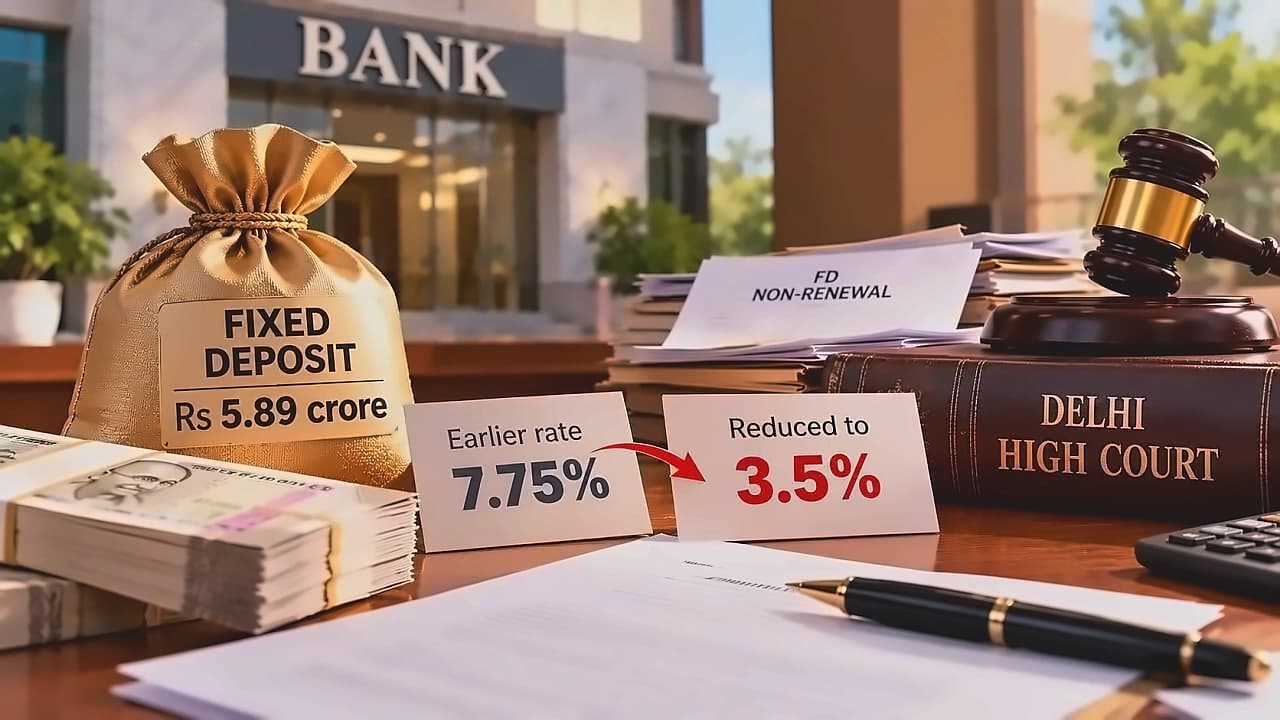
The Delhi High Court has ruled in favour of a fixed deposit holder after a bank cut the interest rate on his ₹5.89 crore FD from 7.75% to 3.5%. According to reports from The Times of India, in its September 23, 2026 ruling, the court directed the bank to pay the highest applicable interest rate on the deposit, granting relief to the FD holder. The ruling came after the bank reduced the rate from January 30, 2018, without providing valid justification to the deposit holder. The deposit holder's FD had been opened following a court order from 2008 which arose from a dispute between two parties, with the Delhi High Court directing that the ₹5.89 crore held in the deposit holder's bank account be kept secured in a bank until the dispute was resolved by the court.
Representing the bank, its lawyer argued that Clause 3.3 of the RBI circular allowed the bank to decide the interest rate applicable to the fixed deposit. According to The Times of India, the lawyer also invoked Clause 3.4 of the circular, contending that if a fixed deposit receipt was not renewed upon maturity, the deposit would earn interest at the prevailing savings bank rate. However, the Delhi High Court observed that Clause 3.3 of the RBI circular gives banks the freedom to set interest rates, but this discretion comes with a condition: banks cannot discriminate between deposits accepted on the same date, whether they are held at the same branch or at different branches of the bank. The court noted that Clause 3.4 of the circular didn't rescue the bank either, as no tenure was specified for this FDR and nothing on record showed the bank had informed anyone that the FD had matured or needed renewing.
The court noted that the bank failed to establish that the interest rate on all comparable fixed deposits had also been brought down to 3.5%. As reported by The Times of India, there was no evidence to show that the bank had informed the affected parties, namely the deposit holder and the third party, that the deposit had matured and needed to be renewed. The bank had also not approached the arbitrator or the High Court for directions on renewing the FD, and it had not informed either forum that the winding-down of its operations had prompted it to reduce the deposit's interest rate to the savings bank rate. The bank's affidavit stated that 30 branches had been closed in a phased manner and that Gurgaon and Mumbai branches were operational, but it didn't disclose the rates of interest offered to customers on deposits at these branches.
According to Siddartha Karnani, Partner at King Stubb and Kasiva, banks may reduce the interest paid on fixed deposits, but their actions must remain within the limits prescribed by the RBI and comply with its rules. As reported by The Times of India, Karnani explained that under the RBI's rules, when a term deposit reaches maturity and the money is not paid out, the unclaimed amount earns interest at the savings account rate. The rules were amended in July 2021, with the revised provision stating that an overdue deposit earns interest at either the savings account rate or the rate originally agreed upon, whichever is lower. Karnani emphasized that the bigger lesson is that when money is held under a court order, banks cannot quietly apply their standard commercial terms - they must disclose changes and ask for directions.