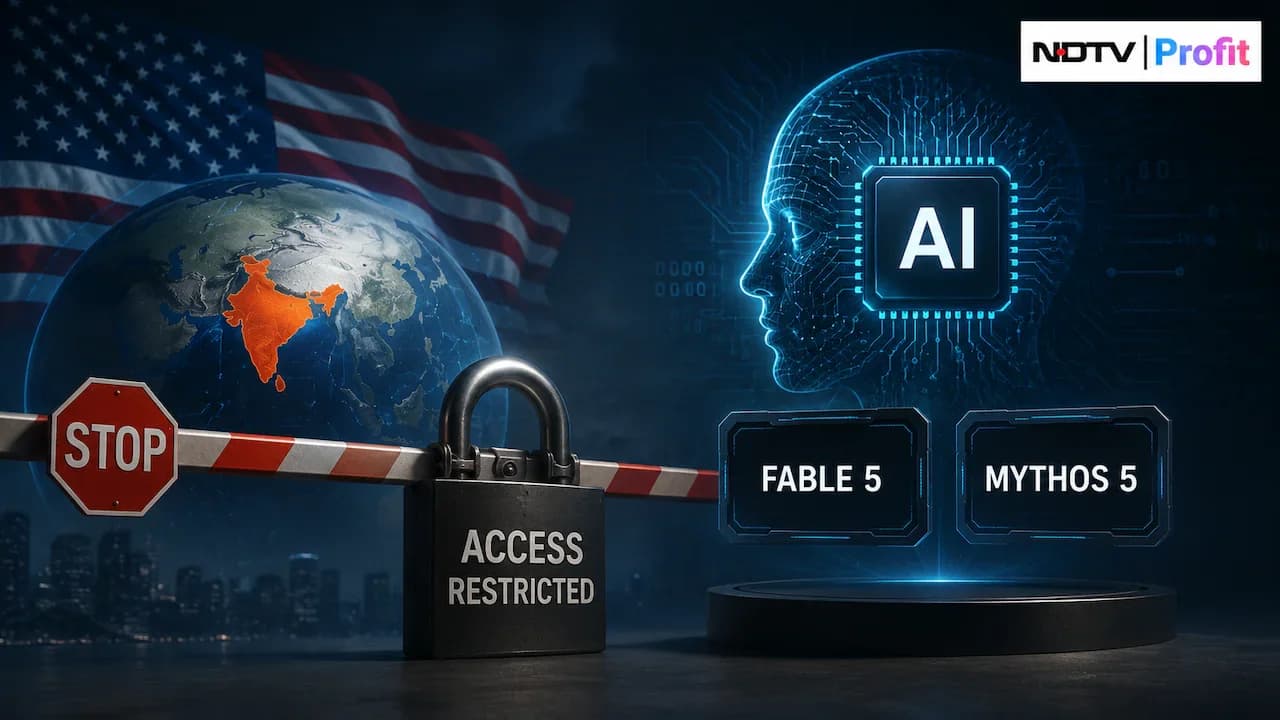
On June 12, 2026, Anthropic PBC barred non-US customers from accessing Fable 5 and Mythos 5, the most advanced LLM platforms under the Claude universe. According to reports from NDTV Profit, this action follows the 'Framework for Artificial Intelligence Diffusion' introduced by the US government in January 2025, which establishes a destination-based licensing architecture. Under this regime, clients in countries not classified as 'close US allies' may be denied access to advanced models on a case-by-case basis, with India not on the list of adequate export control frameworks. The controversy around Anthropic's Claude Fable 5 and Mythos shows why the AI bubble debate matters to cybersecurity, as these models were specifically highlighted for their cyber capabilities with the UK AI Security Institute reporting improved performance in capture-the-flag challenges and multi-step cyber-attack simulations.
Many banks and NBFCs in India are expanding credit reach through near-instantaneous AI-enabled credit risk decisions, but impacted use cases include KYC and AML monitoring, stressed cases and fraud detection, customer grievance redressal and investment decisioning. As reported by NDTV Profit, a majority of regulated financial institutions are utilizing wrappers on underlying models developed in the US (ChatGPT, Copilot, Gemini) through API access, with these arrangements largely enabled through API-based LLM agreements. These arrangements are considered 'outsourcing' under applicable RBI regulations, potentially requiring half-yearly board reviews and periodic senior management assessments. The Fed has made that shift explicit, stating that AI's risks and benefits are now more tangible and AI could become a force multiplier for the financial system, with algorithmic trading based on machine learning already accounting for 60% to 70% of equity transaction volumes in the US and other major markets.
According to NDTV Profit reports, the RBI expects banks to assess exit strategy risk, country risk, and concentration and systemic risk for all outsourcing arrangements. The regulator specifically requires that REs establish viable contingency plans considering alternative service providers or bringing outsourced activities back in-house during emergencies. However, moving AI activities in-house is not feasible as banks lack direct compute hardware investment capabilities and API licensing arrangements typically contain regulatory direction carve-outs. For cybersecurity leaders, the lesson is clear that frontier AI can improve vulnerability discovery, research and defensive analysis, but it also creates governance, access, trust and accountability challenges. If a model is powerful enough to help defenders find weaknesses faster, it will also help attackers move faster, meaning organisations should avoid panic buying and demand clear controls.
Central bankers are increasingly treating agentic AI as a financial-stability concern because the technology is already embedded across trading, risk monitoring, fraud detection, and operational decisions. The Fed has made that shift explicit, stating that AI's risks and benefits are now more tangible and AI could become a force multiplier for the financial system. Algorithmic trading based on machine learning already accounts for 60% to 70% of equity transaction volumes in the US and other major markets, demonstrating AI's material exposure in financial markets. The ECB's simulation work found that AI architecture is itself a source of financial instability, with Q-learning algorithms showing high coordination but prone to extreme bank-run-like dynamics, while large language models produced heterogeneous and unpredictable behavior. The AI bubble will burst in the sense that the current level of hype cannot last forever, with expectations normalising and investment becoming more selective as buyers become more demanding.
As outlined by NDTV Profit, potential solutions include encouraging utilization of existing indigenous alternatives through regulatory directives, model localization requiring on-shore compute and models, and India-focused development of indigenous LLMs specifically trained on the India data-stack. The banking sector previously implemented systemic upgrades like 'Rupay' as an alternative to existing card networks, demonstrating a similar collaborative approach may be adopted for indigenous AI development. With risks and benefits now more tangible, better-positioned banks are those that can point to many use cases with measurable efficiency gains, clearer governance, and demonstrable controls rather than press-release adoption. The AI bubble is the gap between the huge expectations around artificial intelligence and the measurable value it is delivering for many organisations, meaning the strongest security message will not be 'we use AI' but 'we help you reduce risk, and we can prove it'.